GBP/USD Weekly Forecast: Downside remains compelling amid Russia-Ukraine war
- GBP/USD tumbled to three-months lows below 1.3250 amid Russia-Ukraine war.
- Cable’s bearish consolidation suggests more pain amid a light calendar next week.
- Developments in the Russia-Ukraine war will continue to impact the risk-sensitive GBP.


GBP/USD accelerated its downside momentum in a busy Nonfarm Payrolls week, having reached the lowest level in three months below mid-1.3200s. Risk-aversion remained the underlying market theme, as Russian aggression in Ukraine failed to subside, despite two rounds of ‘peace talks’. Stagflation risks amid soaring oil prices will likely keep cable undermined in a relatively light week ahead, as investors remain on edge due to the ongoing Ukraine crisis.
GBP/USD threatened by the Ukraine crisis
GBP/USD bears kept challenging bullish commitments all through the week, leaving the price volatile between the 1.3440-1.3200 range. Headlines relating to the Russia-Ukraine war influenced risk sentiment in the absence of any top-tier economic releases from the UK. Meanwhile, traders paid little heed to the impact of the US ADP Employment data, ISM Manufacturing and Services data, as Ukraine tensions dominated.
Cable opened the week on a slippery slope, as it dropped back to test the 1.3300 level after Friday’s impressive recovery to 1.3375. News over the weekend that the West banned several Russian banks from the SWIFT international payment system combined with Russia’s President Vladimir Putin ordering nuclear deterrents on high alert, re-ignited tensions after the first round of ‘peace talks’ ended with no progress. That said, a major turnaround in risk sentiment rescued GBP bulls, as safe-haven demand for the US dollar evaporated.
Fed Chair Jerome Powell maintained his hawkish stance in testimony at the semi-annual monetary policy report, confirming a 25 bps rate hike next week while showing the Fed’s openness for a series of rate hikes over the year. The greenback received a shot in the arm from Powell’s hawkishness, despite uncertainty over the Ukraine crisis, as it continued to outperform across the G10 FX board. Wednesday saw a short-covering rally in the currency pair on reports of a potential cease-fire between the two warring nations, as they headed towards round two of negotiations on Thursday.
Sellers returned with a bang on Friday, however, after various media agencies reported a Russian attack on the Zaporizhzhya Nuclear Power Plant, Europe's largest nuclear power station in Ukraine. Although the Ukrainian authorities quickly dialed down fears over radiation risks, concerns over Russia’s aggression intensified. Moreover, soaring oil prices stoked stagflation fears, sapping investors’ confidence further while exerting additional downside pressure on the high-beta GBP.
Exacerbating the pain in GBP/USD, the US Nonfarm Payrolls jumped to 678K in February vs. 400K expected, which triggered a fresh upswing in the dollar at the expense of the pound. The stunning US jobs report failed to have any impact on the Fed’s March rate hike expectations, as markets still price in a 95% change of a 25 bps lift-off in the week of March 14.
GBP/USD: Week ahead
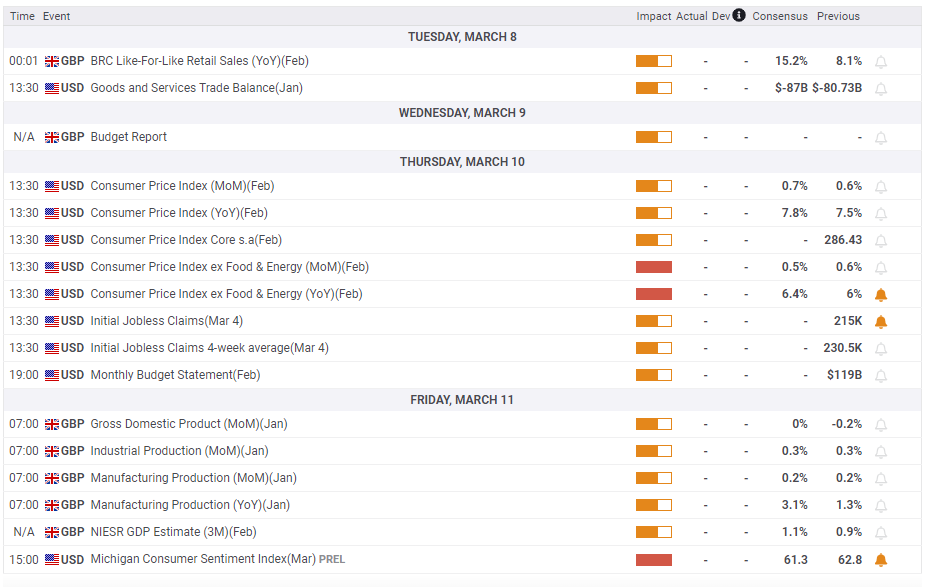
The week ahead appears to be the lightest week of this month in terms of economic data releases. The UK calendar has nothing much to report except for the Annual Budget Release, which is tentatively scheduled on Wednesday.
The US data docket is also sparse in the first half of the week. The US February inflation data stands out on Thursday, followed by the Preliminary UoM Consumer Sentiment reading on Friday. The outcome of the US inflation report is unlikely to have any material impact on the expectations for the March Fed meeting.
Russia-Ukraine war-related developments will continue to emerge as the key risk factors next week, with a cease-fire unlikely to be seen as a principal outcome should peace talks extend. Investors will also remain wary of oil price action and any significant impact on the Bank of England’s (BOE) monetary policy expectations.
Also, of note remains the European Central Bank (ECB) policy decision next week, which could have the EUR/GBP cross-driven ‘rub-off’ effect on the British pound, eventually affecting GBP/USD.
GBP/USD: Technical outlook
With the blood bath across the market, GBP/USD eyes deeper losses in the coming days, as several major support levels have given way. A sustained move below the December 22 low of 1.3240 will lead to additional declines towards the critical demand area around 1.3170.
Downside risks remain intact, as the 14-day Relative Strength Index (RSI) is flirting with oversold territory, though it has yet to cross into it, leaving some scope for the sellers to flex their muscles. Adding credence to the negative outlook, the bearish 21-Daily Moving Average (DMA) is set to pierce the 100-DMA from above, which if materialized will confirm a bear cross.
Should the buyers manage to recapture ground above the 1.3240-1.3250 area with conviction, a rebound could be in the offing. The immediate hurdle on the road to recovery will be seen at 1.3270 levels, the previous month low. Further up, Friday’s high of 1.3354 will be put to test once again. Bears, however, will likely remain in control so long as the price holds below powerful resistance at around 1.3440.

GBP/USD: Forecast poll
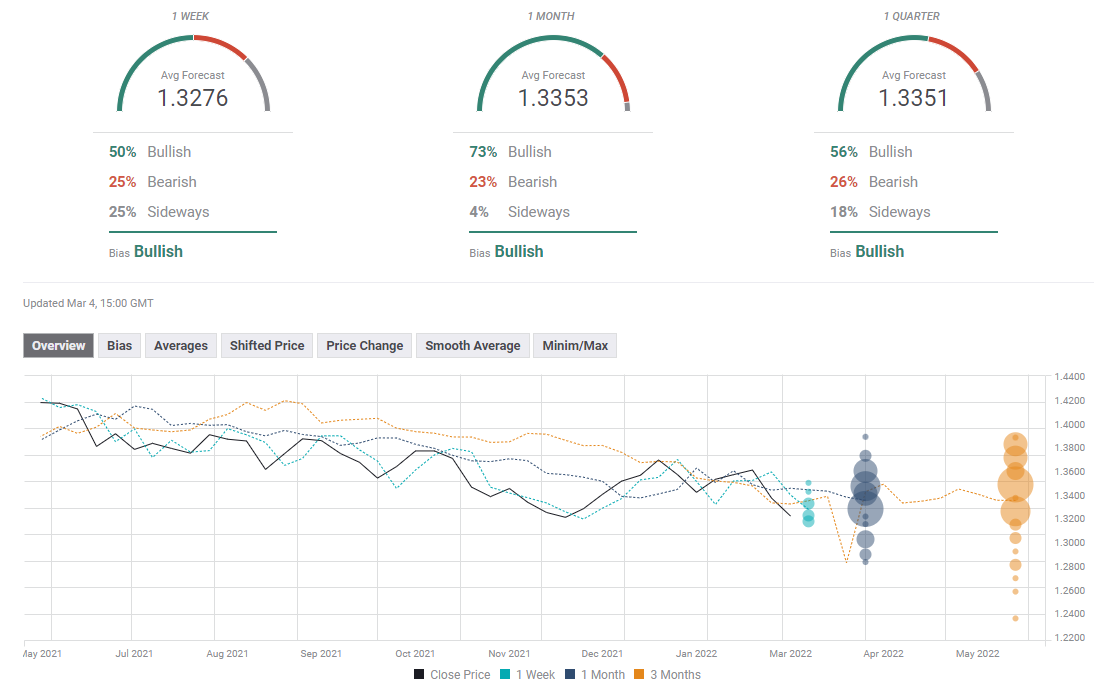
Despite the sharp decline witnessed this week, FXStreet Forecast Poll shows that experts expect the pair to stage a recovery next week. Toward the end of March, GBP/USD is forecast to trade around mid-1.3300s.
Premium
You have reached your limit of 3 free articles for this month.
Start your subscription and get access to all our original articles.
Author
Dhwani Mehta
FXStreet
Residing in Mumbai (India), Dhwani is a Senior Analyst and Manager of the Asian session at FXStreet. She has over 10 years of experience in analyzing and covering the global financial markets, with specialization in Forex and commodities markets.