|

GBP/USD: Looks cheap for good reason

  • GBP/USD buy zone of 1.24 to 1.16 could be deceiving
  • Monetary policy, recession, and inflation present downside risks
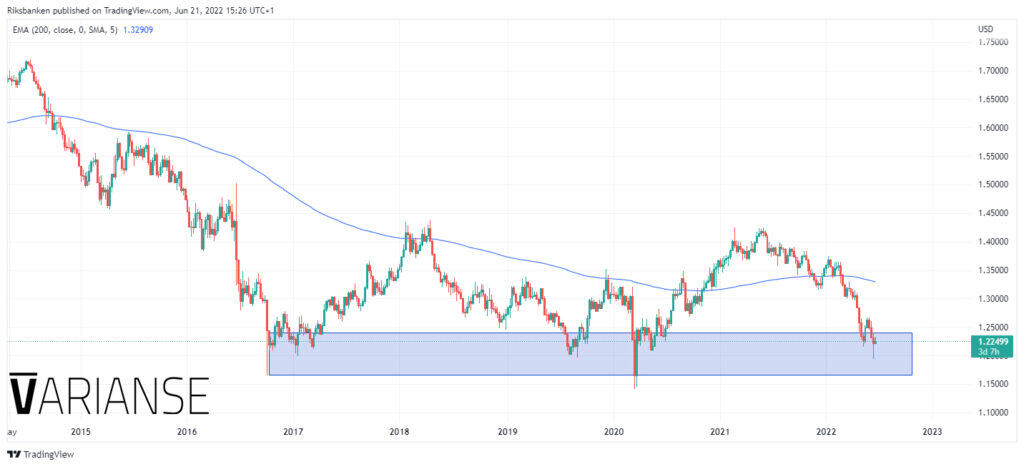
I’m tempted to look at a higher time frame chart of GBP/USD and say it looks cheap. Whether the pound has fallen due to the flash crash or COVID-19 concerns, buyers have always been quick to snap up GBP/USD anywhere between 1.24 and 1.16 levels. That might ultimately hold out to be true, but I’m not completely convinced that history will repeat itself.

UK inflation is my top concern for the British pound. Economic theory suggests that relatively higher inflation should put downward pressure on the nominal exchange rate, all other considerations being equal. Wednesday’s May UK CPI release is expected to show UK CPI rose to 9.1% y/y, which would put UK inflation ahead of that for the US for a second consecutive month.

Furthermore, the Bank of England looks for the time being less inclined than the Fed to do something about inflation. The Fed raised interest rates by 75 bps in June to take the Fed funds rate to a range of 1.5% to 1.75% and signalled its willingness to do what it takes to control inflation.

In contrast, the Bank of England raised by 25 bps in June to take bank rate to 1.25% as the majority of the MPC resisted a 50 bps hike. Even if the Bank of England does seek to tightening monetary policy more aggressively going forward, it may face more of an uphill climb in terms of convincing markets that it is serious about inflation.

GBP/USD buyers also need to contend with heightened fears of recession on both sides of the Atlantic, which would most likely disfavour the British pound more than the US dollar, as global investors seek the safety of US assets versus the rest of the world. In summary, GBP/USD looks cheap but for good reason.     

Author

Carl Paraskevas

Carl Paraskevas has over twenty years’ experience in finance and banking, primarily in research related roles at several institutions.


More from Carl Paraskevas
Share:

Editor's Picks

EUR/USD hits two-day highs near 1.1820

EUR/USD picks up pace and reaches two-day tops around 1.1820 at the end of the week. The pair’s move higher comes on the back of renewed weakness in the US Dollar amid growing talk that the Fed could deliver an interest rate cut as early as March. On the docket, the flash US Consumer Sentiment improves to 57.3 in February.

GBP/USD reclaims 1.3600 and above

GBP/USD reverses two straight days of losses, surpassing the key 1.3600 yardstick on Friday. Cable’s rebound comes as the Greenback slips away from two-week highs in response to some profit-taking mood and speculation of Fed rate cuts. In addition, hawkish comments from the BoE’s Pill are also collaborating with the quid’s improvement.

Gold climbs further, focus is back to 45,000

Gold regains upside traction and surpasses the $4,900 mark per troy ounce at the end of the week, shifting its attention to the critical $5,000 region. The move reflects a shift in risk sentiment, driving flows back towards traditional safe haven assets and supporting the yellow metal.

Crypto Today: Bitcoin, Ethereum, XRP rebound amid risk-off, $2.6 billion liquidation wave

Bitcoin edges up above $65,000 at the time of writing on Friday, as dust from the recent macro-triggered sell-off settles. The leading altcoin, Ethereum, hovers above $1,900, but resistance at $2,000 caps the upside. Meanwhile, Ripple has recorded the largest intraday jump among the three assets, up over 10% to $1.35.

Three scenarios for Japanese Yen ahead of snap election

The latest polls point to a dominant win for the ruling bloc at the upcoming Japanese snap election. The larger Sanae Takaichi’s mandate, the more investors fear faster implementation of tax cuts and spending plans. 

XRP rally extends as modest ETF inflows support recovery

Ripple is accelerating its recovery, trading above $1.36 at the time of writing on Friday, as investors adjust their positions following a turbulent week in the broader crypto market. The remittance token is up over 21% from its intraday low of $1.12.