GBP/USD Forecast: Sellers could continue to ignore oversold conditions
- GBP/USD dropped to a fresh three-month low below 1.2500 on Thursday.
- The pair's near-term technical outlook points to oversold conditions.
- Sour market mood could make it hard for Pound Sterling to recover.

GBP/USD came under renewed bearish pressure in the early European session on Thursday and dropped to its weakest level in three months below 1.2500. Although the near-term technical outlook highlights oversold conditions for the pair, a steady recovery could be difficult to come by in the risk-averse market atmosphere.
The US Dollar (USD) gathered strength against its rivals in the American session on Wednesday after the ISM Services PMI report showed that business activity in the service sector continued to grow at a healthy pace in August. Meanwhile, cautious comments from Bank of England (BoE) officials on the policy outlook weighed on Pound Sterling, causing GBP/USD to stretch lower.
Pound Sterling price this week
The table below shows the percentage change of Pound Sterling (GBP) against listed major currencies this week. Pound Sterling was the weakest against the US Dollar.
| USD | EUR | GBP | CAD | AUD | JPY | NZD | CHF | |
| USD | 0.59% | 0.95% | 0.37% | 1.05% | 0.93% | 0.92% | 0.74% | |
| EUR | -0.60% | 0.35% | -0.22% | 0.47% | 0.36% | 0.33% | 0.14% | |
| GBP | -0.96% | -0.37% | -0.58% | 0.11% | -0.01% | -0.04% | -0.22% | |
| CAD | -0.37% | 0.22% | 0.58% | 0.70% | 0.57% | 0.51% | 0.37% | |
| AUD | -1.08% | -0.48% | -0.11% | -0.70% | -0.14% | -0.15% | -0.33% | |
| JPY | -0.95% | -0.36% | 0.02% | -0.58% | 0.14% | -0.03% | -0.20% | |
| NZD | -0.94% | -0.29% | 0.04% | -0.54% | 0.15% | 0.02% | -0.17% | |
| CHF | -0.73% | -0.16% | 0.21% | -0.37% | 0.32% | 0.19% | 0.18% |
The heat map shows percentage changes of major currencies against each other. The base currency is picked from the left column, while the quote currency is picked from the top row. For example, if you pick the Euro from the left column and move along the horizontal line to the Japanese Yen, the percentage change displayed in the box will represent EUR (base)/JPY (quote).
Bank of England Governor Andrew Bailey refrained from confirming additional policy tightening. He explained that many indicators point to a fall in inflation in the UK and added that they were "much nearer of peak rates" while testifying before the UK Treasury Select Committee. Moreover, BoE policymaker Swati Dhingra noted that the BoE's policy was already "sufficiently restrictive."
Early Thursday, US stock index futures trade in negative territory and the USD Index, which gauges the USD's valuation against a basket of six major currencies, clings to modest gains near 105.00 - the multi-month high it set on Thursday.
The US Department of Labor will publish the weekly Initial Jobless Claims data later in the session. Markets expect the number of first-time applications for unemployment benefits to rise to 234,000 in the week ending September 1 from 228,000 in the previous week. A bigger-than-forecast increase could limit the USD's gains with the initial reaction. In case Wall Street's main indexes open deep in the red, however, the USD could continue to benefit from safe-haven flows.
GBP/USD Technical Analysis
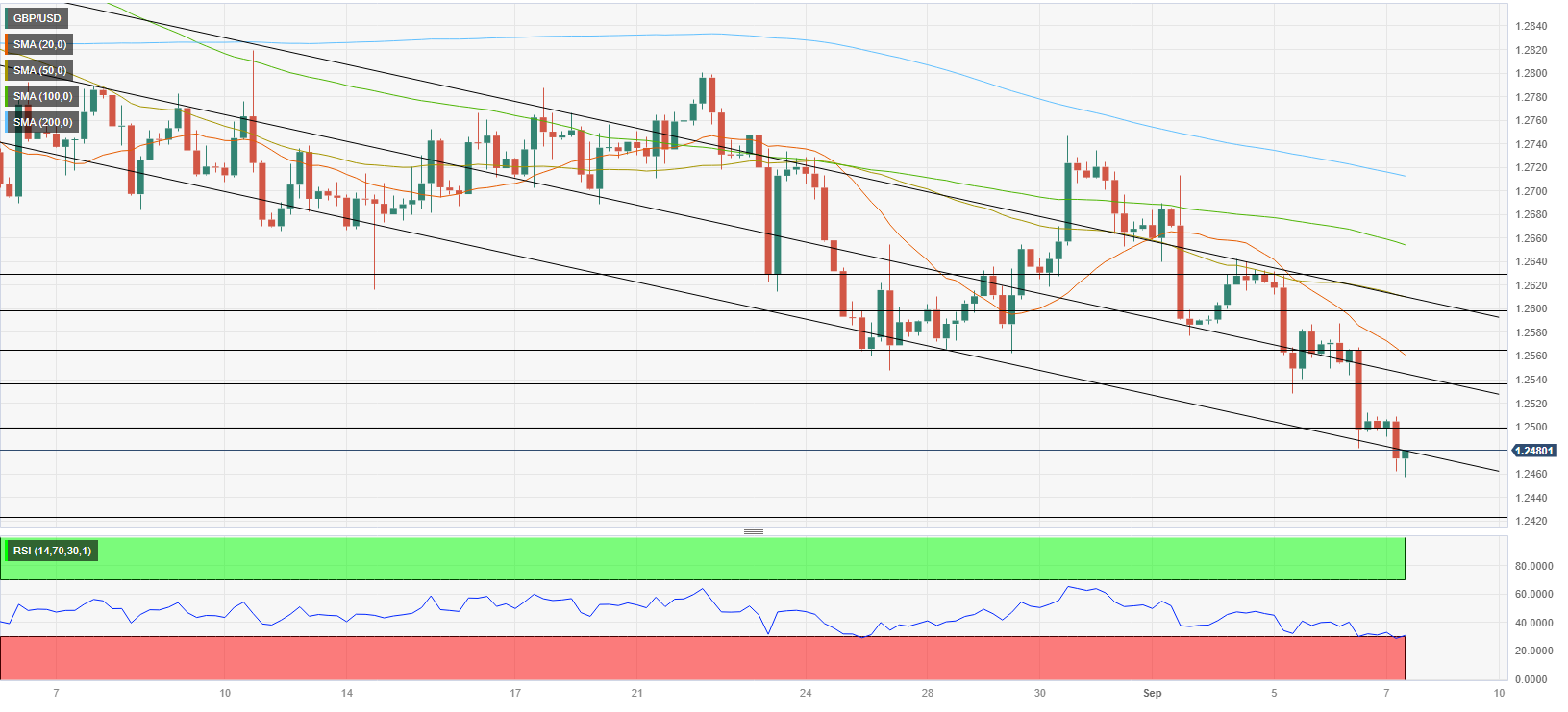
GBP/USD dropped below the lower limit of the descending regression channel and the Relative Strength Index (RSI) indicator on the 4-hour chart declined below 30, highlighting oversold conditions in the near term.
1.2480 (lower limit of the descending channel) aligns as immediate resistance before 1.2500 (psychological level, former support). In case GBP/USD rises above the latter and stabilizes there, it could extend its recovery toward 1.2540 (mid-point of the descending channel).
On the downside, 1.2420 (static level from June) could be seen as next bearish target before 1.2400 if GBP/USD fails to reclaim 1.2500.
Premium
You have reached your limit of 3 free articles for this month.
Start your subscription and get access to all our original articles.
Author
Eren Sengezer
FXStreet
As an economist at heart, Eren Sengezer specializes in the assessment of the short-term and long-term impacts of macroeconomic data, central bank policies and political developments on financial assets.