GBP/USD Forecast: Pound Sterling targets new multi-month highs on broad USD weakness
- GBP/USD holds above 1.2700 after posting strong gains on Monday.
- The US Dollar stays under pressure on growing fears of a recession.
- Technical buyers could remain interested once 1.2700 is confirmed as support.


GBP/USD benefited from the broad-based selling pressure surrounding the US Dollar (USD) and gained about 1% on Monday. The pair continues to stretch higher in the European session on Tuesday and trades at its highest level since mid-December above 1.2700.
Pound Sterling FAQs
The Pound Sterling (GBP) is the oldest currency in the world (886 AD) and the official currency of the United Kingdom. It is the fourth most traded unit for foreign exchange (FX) in the world, accounting for 12% of all transactions, averaging $630 billion a day, according to 2022 data. Its key trading pairs are GBP/USD, also known as ‘Cable’, which accounts for 11% of FX, GBP/JPY, or the ‘Dragon’ as it is known by traders (3%), and EUR/GBP (2%). The Pound Sterling is issued by the Bank of England (BoE).
The single most important factor influencing the value of the Pound Sterling is monetary policy decided by the Bank of England. The BoE bases its decisions on whether it has achieved its primary goal of “price stability” – a steady inflation rate of around 2%. Its primary tool for achieving this is the adjustment of interest rates. When inflation is too high, the BoE will try to rein it in by raising interest rates, making it more expensive for people and businesses to access credit. This is generally positive for GBP, as higher interest rates make the UK a more attractive place for global investors to park their money. When inflation falls too low it is a sign economic growth is slowing. In this scenario, the BoE will consider lowering interest rates to cheapen credit so businesses will borrow more to invest in growth-generating projects.
Data releases gauge the health of the economy and can impact the value of the Pound Sterling. Indicators such as GDP, Manufacturing and Services PMIs, and employment can all influence the direction of the GBP. A strong economy is good for Sterling. Not only does it attract more foreign investment but it may encourage the BoE to put up interest rates, which will directly strengthen GBP. Otherwise, if economic data is weak, the Pound Sterling is likely to fall.
Another significant data release for the Pound Sterling is the Trade Balance. This indicator measures the difference between what a country earns from its exports and what it spends on imports over a given period. If a country produces highly sought-after exports, its currency will benefit purely from the extra demand created from foreign buyers seeking to purchase these goods. Therefore, a positive net Trade Balance strengthens a currency and vice versa for a negative balance.
The USD weakened against its major rivals on Monday as the disappointing macroeconomic data releases from the US and US President Donald Trump's tariffs revived fears over an economic downturn in the US.
The ISM Manufacturing Purchasing Managers Index (PMI) declined to 50.3 in February from 50.9 in January. Additionally, the Employment Index of the PMI survey dropped to 47.6 from 50.3 in the same period, highlighting a contraction in the sector's payrolls. Other data from the US showed that Construction Spending fell by 0.2% on a monthly basis in January.
The Trump administration's 25% tariffs on Canadian and Mexican imports, as well as the additional 10% tariffs on Chinese imports, went into effect on Tuesday. Canada and China introduced retaliatory measures, opening the door for a deepening trade war that could further weigh on the US economic outlook.
The US economic calendar will not feature any high-tier data releases on Tuesday. In the second half of the day, Federal Reserve (Fed) policymakers will be delivering speeches. In case Fed officials adopt a cautious tone on growth prospects, citing the trade policy, the USD could continue to weaken and help GBP/USD extend its uptrend.
GBP/USD Technical Analysis
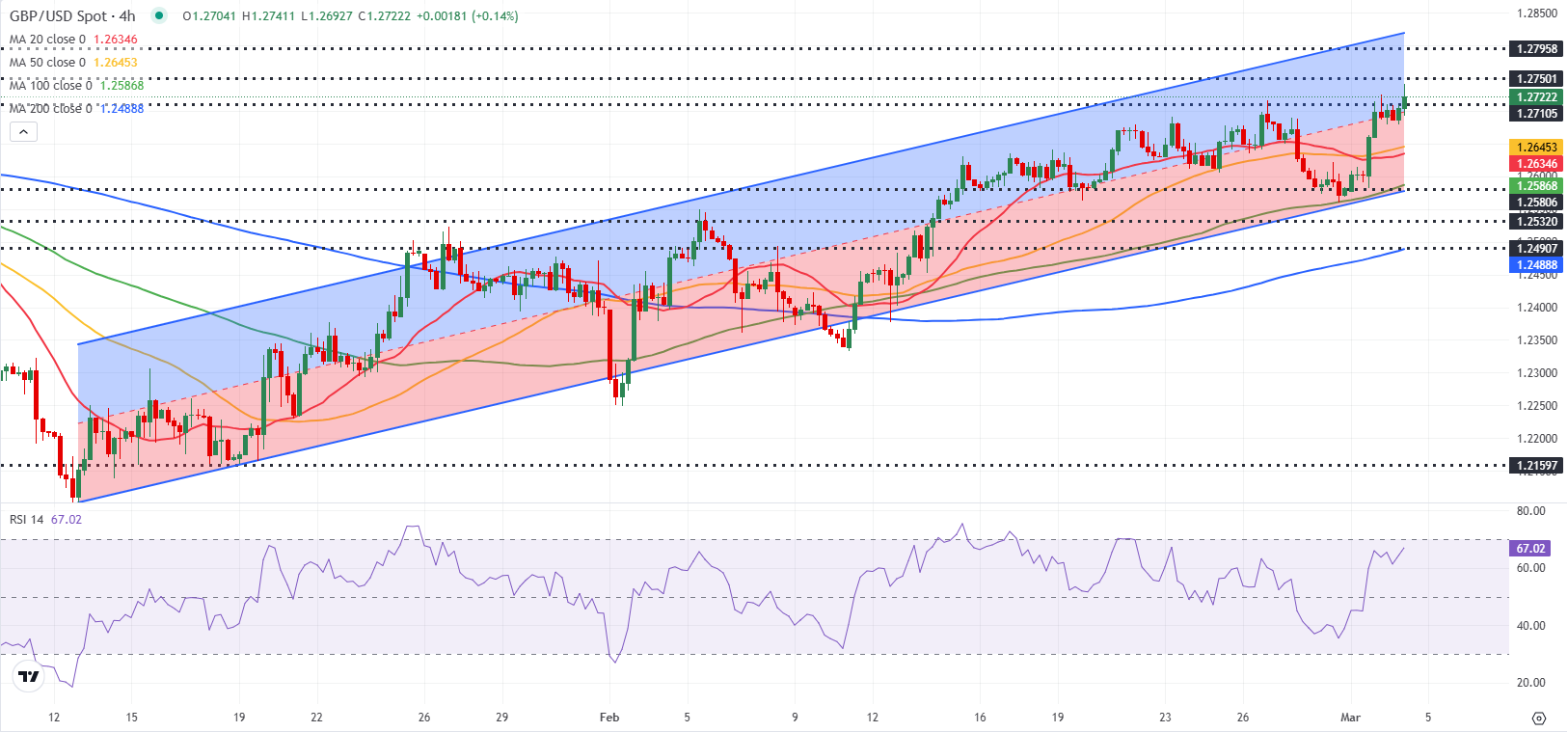
GBP/USD was last seen trading in the upper half of its two-month-old uptrend. Additionally, the Relative Strength Index (RSI) indicator on the 4-hour chart stays above 60, reflecting the bullish stance.
On the upside, 1.2750 (static level) aligns as first resistance before 1.2790 (200-day Simple Moving Average(SMA)) and 1.2820 (upper limit of the ascending channel). Looking south, the immediate support could be spotted at 1.2700 (mid-point of the ascending channel, static level) ahead of 1.2630 (100-day SMA) and 1.2570 (lower limit of the ascending channel, 20-day SMA).
Tariffs FAQs
Tariffs are customs duties levied on certain merchandise imports or a category of products. Tariffs are designed to help local producers and manufacturers be more competitive in the market by providing a price advantage over similar goods that can be imported. Tariffs are widely used as tools of protectionism, along with trade barriers and import quotas.
Although tariffs and taxes both generate government revenue to fund public goods and services, they have several distinctions. Tariffs are prepaid at the port of entry, while taxes are paid at the time of purchase. Taxes are imposed on individual taxpayers and businesses, while tariffs are paid by importers.
There are two schools of thought among economists regarding the usage of tariffs. While some argue that tariffs are necessary to protect domestic industries and address trade imbalances, others see them as a harmful tool that could potentially drive prices higher over the long term and lead to a damaging trade war by encouraging tit-for-tat tariffs.
During the run-up to the presidential election in November 2024, Donald Trump made it clear that he intends to use tariffs to support the US economy and American producers. In 2024, Mexico, China and Canada accounted for 42% of total US imports. In this period, Mexico stood out as the top exporter with $466.6 billion, according to the US Census Bureau. Hence, Trump wants to focus on these three nations when imposing tariffs. He also plans to use the revenue generated through tariffs to lower personal income taxes.
Premium
You have reached your limit of 3 free articles for this month.
Start your subscription and get access to all our original articles.
Author
Eren Sengezer
FXStreet
As an economist at heart, Eren Sengezer specializes in the assessment of the short-term and long-term impacts of macroeconomic data, central bank policies and political developments on financial assets.