GBP/USD Forecast: Pound Sterling needs to stabilize above 1.2130 to stretch higher
- GBP/USD recovered above 1.2100 in the European morning on Wednesday
- 1.2130 aligns as next resistance that Pound Sterling needs to clear to extend its rebound.
- The pair could struggle to hold its ground if safe-haven flows dominate the markets.


After dipping to its lowest level since March below 1.2040 in the Asian session on Wednesday, GBP/USD gained traction and climbed above 1.2100. The technical outlook suggests that the pair could extend its rebound if it manages to stabilize above 1.2130. Investors, however, could ignore technical conditions if markets remain risk-averse in the second half of the day.
Wall Street's main indexes suffered large losses on Tuesday as hawkish Federal Reserve bets flooded the markets after the US data showed that job openings rose sharply in August to highlight tightening conditions in the labor market. In turn, the benchmark 10-year US Treasury bond yield climbed to its highest level since 2007 above 4.8% and the US Dollar preserved its strength.
Following a bearish opening, US stock index futures turned flat in the European session and the 10-year US yield edged lower, helping GBP/USD erase some of its weekly losses.
Pound Sterling price today
The table below shows the percentage change of Pound Sterling (GBP) against listed major currencies today. Pound Sterling was the strongest against the New Zealand Dollar.
| USD | EUR | GBP | CAD | AUD | JPY | NZD | CHF | |
| USD | -0.24% | -0.44% | -0.13% | -0.23% | -0.09% | 0.19% | -0.35% | |
| EUR | 0.24% | -0.18% | 0.14% | 0.02% | 0.17% | 0.44% | -0.04% | |
| GBP | 0.43% | 0.16% | 0.33% | 0.22% | 0.35% | 0.64% | 0.13% | |
| CAD | 0.12% | -0.14% | -0.32% | -0.14% | 0.03% | 0.31% | -0.18% | |
| AUD | 0.25% | -0.01% | -0.21% | 0.12% | 0.15% | 0.43% | -0.06% | |
| JPY | 0.08% | -0.16% | -0.34% | -0.03% | -0.10% | 0.30% | -0.20% | |
| NZD | -0.20% | -0.44% | -0.65% | -0.31% | -0.44% | -0.27% | -0.51% | |
| CHF | 0.30% | 0.05% | -0.14% | 0.18% | 0.05% | 0.22% | 0.50% |
The heat map shows percentage changes of major currencies against each other. The base currency is picked from the left column, while the quote currency is picked from the top row. For example, if you pick the Euro from the left column and move along the horizontal line to the Japanese Yen, the percentage change displayed in the box will represent EUR (base)/JPY (quote).
In case US stocks turn north and register strong gains after the opening bell, GBP/USD could continue to stretch higher.
ADP is forecast to report an increase of 153,000 in private sector employment in September. If that data surprises to the upside and comes in above 200,000, the initial reaction is likely to provide a boost to the USD. The US economic docket will also feature the ISM Services PMI report. The headline PMI is expected to come in at 53.6 to show an ongoing expansion in the service sector's economic activity. If this figure falls toward 50 and revive concerns over the growth outlook, the USD could have a hard time finding demand.
GBP/USD Technical Analysis
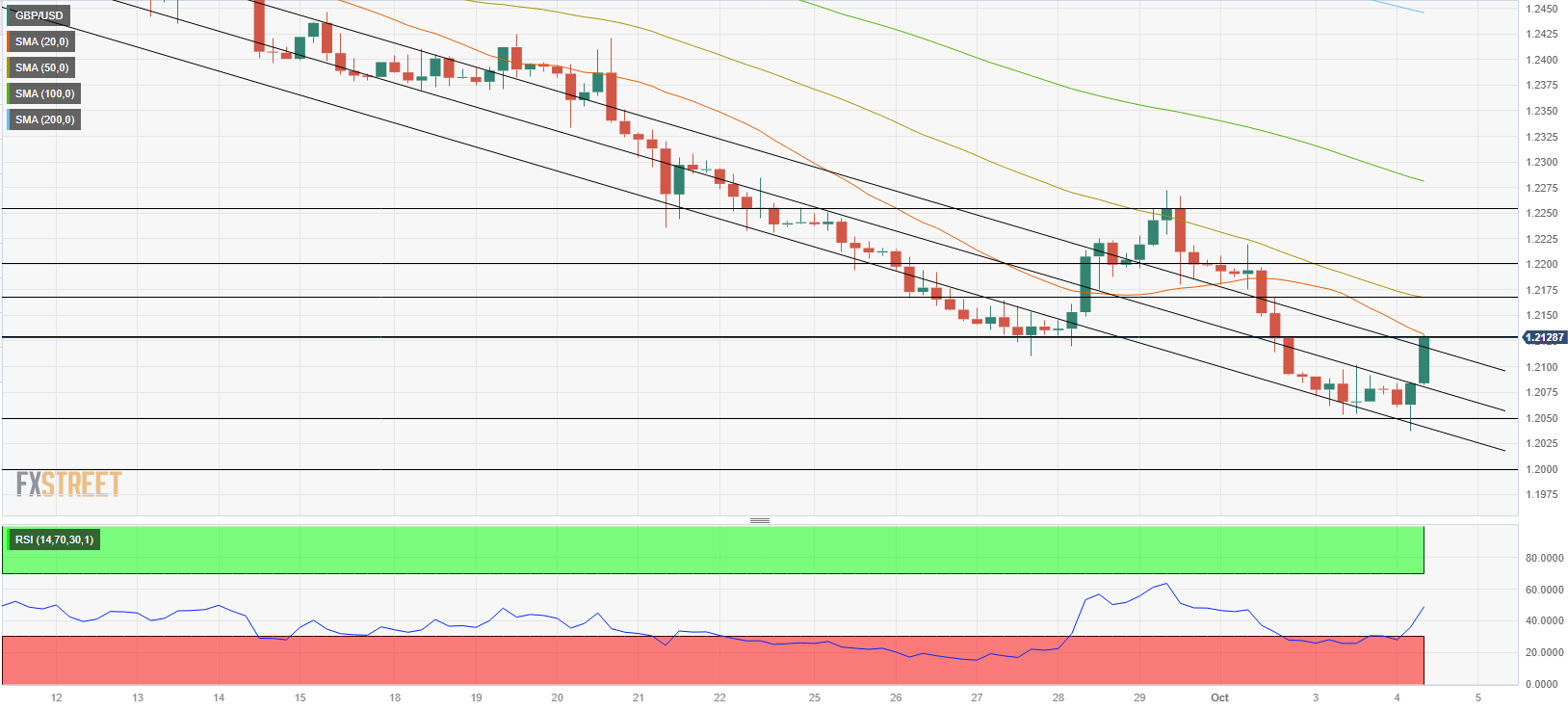
GBP/USD was last seen trading within a touching distance of 1.2130 (upper limit of the descending regression channel, 20-period Simple Moving Average (SMA), static level). In case the pair stabilizes above that level and confirms it as support, buyers could remain interested. In that scenario, 1.2170 (50-period SMA) could be set as the next recovery target before 1.2200 (static level, psychological level).
On the other hand, sellers could take action if GBP/USD returns within the descending regression channel by failing to hold above 1.2130. In that case, 1.2100 (psychological level) could be seen as interim support before 1.2050 (mid-point of the descending channel) and 1.2000 (psychological level, lower limit of the descending channel).
Premium
You have reached your limit of 3 free articles for this month.
Start your subscription and get access to all our original articles.
Author
Eren Sengezer
FXStreet
As an economist at heart, Eren Sengezer specializes in the assessment of the short-term and long-term impacts of macroeconomic data, central bank policies and political developments on financial assets.