Fed November Preview: Gold needs a dovish surprise to overcome key hurdle
- Fed is expected to reduce asset purchases by $15 billion per month.
- Investors will pay close attention to Powell’s remarks on rate outlook.
- A dovish Fed tone could trigger a rally in XAU/USD.


The US Federal Reserve is widely expected to leave the benchmark interest rate, the target range for federal funds, unchanged at 0%-0.25%, when it announces the policy decisions on Wednesday, November 3. The central bank is also set to reduce its monthly asset purchases.
The Fed has been buying $80 billion of Treasury securities and $40 billion of mortgage-backed securities (MBS) each month to fuel the economic recovery in the face of the coronavirus outbreak. Although policymakers have refrained from sharing any details regarding the possible adjustments, experts see the Fed cutting its purchases in Treasury securities and MBS by $10 billion and $5 billion per month, respectively, and ending the program by the second half of 2022.
Inflation concerns and economic slowdown
The US economic recovery gained momentum in the first half of the year fueled by vaccinations and unprecedented monetary and fiscal support. During that period, inflation started to push higher amid supply shortages and rising energy prices. Although FOMC policymakers downplayed inflation worries earlier in the year, they eventually acknowledged that factors ramping up price pressures would last longer than they initially anticipated.
In September, the FOMC noted in its policy statement that it would be appropriate to start reducing asset purchases before the end of the year. Since then, Fed officials have voiced their support for tapering to begin as early as November. Just before the blackout period, FOMC Chairman Jerome Powell said it was “time to taper.”
On a concerning note, August and September labour market reports revealed that the increase in Nonfarm Payrolls was much lower than market expectations. Furthermore, the US Bureau of Economic Analysis’ first estimate showed last week that the Real Gross Domestic Product (GDP) grew by only 2% on a yearly basis in the third quarter following the second quarter’s expansion of 6.7%. This print fell short of analysts’ estimate of 2.7% and revived fears over an economic slowdown.
Nevertheless, the market pricing shows that the disappointing GDP and NFP data had little to no impact on rate hike expectations. According to the CME Group FedWatch Tool, the possibility of a rate hike by June 2022 is now above 60%.
Before the publication of the updated Summary of Economic Projections in December, it would be surprising to see the Fed change the language on the rate outlook and inflation expectations. FOMC Chairman Jerome Powell is likely to remind markets that the rate increase is not a given when the QE program concludes and reiterate that inflation is forecast to last well into 2022 before moving back down toward 2%.
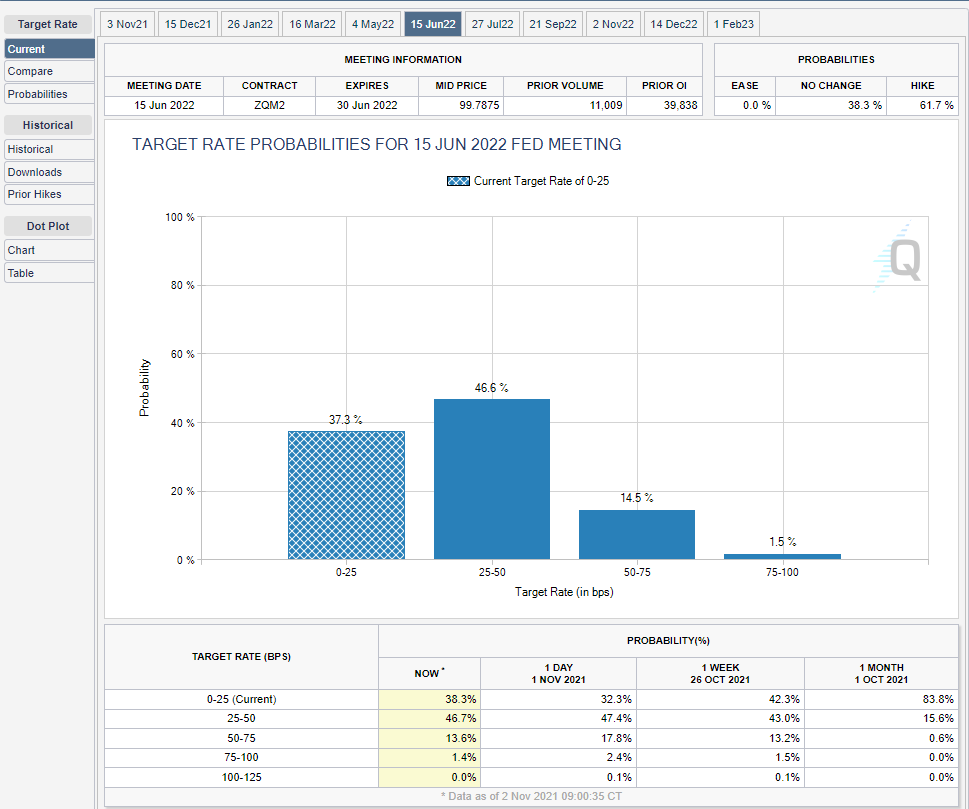
Source: cmegroup.com
Gold outlook
In case the Fed doubles down on the “temporary inflation” narrative and adopts a dovish tone due to the soft data, the greenback could come under heavy selling pressure and trigger a leg up in XAU/USD.
On the other hand, a hawkish policy outlook accompanied by a concerning inflation outlook could force the pair to turn south. However, it’s worth noting that gold is a traditional option for hedging inflation, suggesting that the precious metal’s losses could remain limited if the Fed’s hawkish shift is forced by price pressures.
In summary, a dovish surprise could trigger a more significant reaction in gold than a hawkish one.
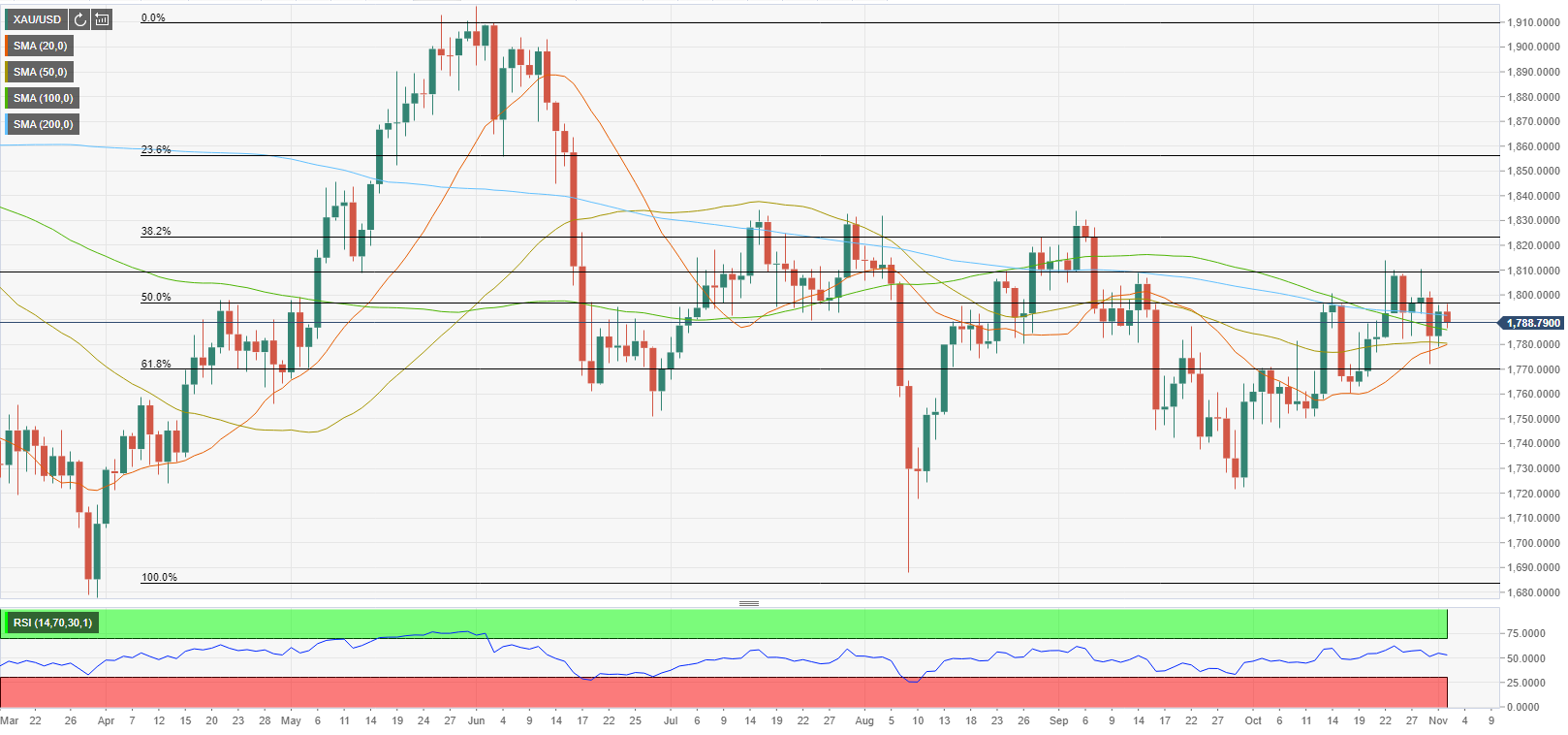
XAU/USD has started the new week in a calm manner and continues to trade in a relatively tight range below $1,800. Reflecting the pair’s indecisiveness, the Relative Strength Index (RSI) indicator on the daily chart is moving sideways near 50.
On the downside, $1,780 (50-day SMA) aligns as the initial support ahead of $1,770 (former resistance, Fibonacci 61.8% retracement of the April-June uptrend). A daily close below the latter could open the door for additional losses toward $1,750 (static level).
The initial resistance is located in the $1,790/$1,800 area, where the 200-day SMA, 100-day SMA and the Fibonacci 50% retracement level collide. A dovish Fed tone could lift gold above that area and attract buyers. $1,810 (static level) is the next target on the upside before $1,825 (Fibonacci 38.2% retracement).
Premium
You have reached your limit of 3 free articles for this month.
Start your subscription and get access to all our original articles.
Author
Eren Sengezer
FXStreet
As an economist at heart, Eren Sengezer specializes in the assessment of the short-term and long-term impacts of macroeconomic data, central bank policies and political developments on financial assets.