EZ inflation and GDP preview: Downbeat figures could trigger the next leg down for EUR/USD
- Eurozone inflation figures for January are set to show a drop in core inflation.
- GDP numbers for the old continent may tilt to the downside.
- EUR/USD is in a vulnerable position ahead of the data.


Has Europe bottomed out? Not so fast. The European Central Bank has been cautious in its response to several positive statistics – and probably for good reasons.
The double-feature publication of both preliminary Consumer Price Index figures for January and Gross Domestic Product data for the fourth quarter contains downside risks.
Inflation – the deck is stacked against EUR/USD
Inflation figures will likely have the upper hand in determining the reaction in the euro as they are fresh – from January 2020. The economic calendar is pointing to an uptick from 1.3% to 1.4% in headline CPI – driven higher by rising oil prices. The most recent coronavirus-related downfall will likely be reflected in February's figures.
While the ECB officially targets headline CPI, the focus is on core inflation, which has hit a "glass ceiling" – stubbornly hitting 1.3% several times in 2019, but failing to break above that level, which would have put it at the highest since 2013. Economists now expect it to retreat to 1.2%, a depressing outcome that would place it further away from the bank's 2% target.
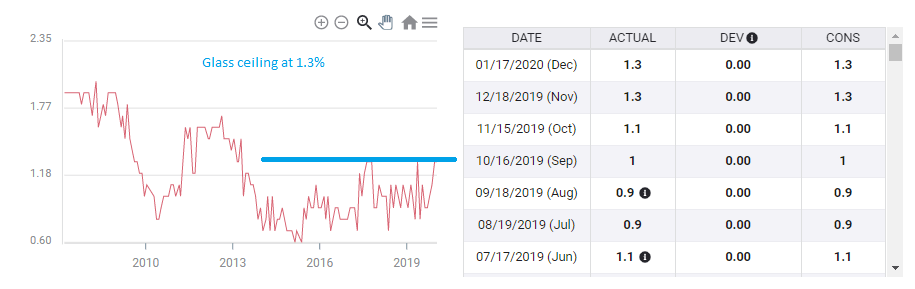
Capped core inflation
In case that Core CPI meets projections, any slide would disappoint not only the ECB – that stated it is seeing signs of rising underlying inflation – but also euro bulls. A worse outcome of 1.1% would already be a big
Even if the data point exceeds estimates with 1.3%, that would only be standing in place and leaving it far from the Frankfurt-based institution's objective. The common currency would probably need a beat at 1.4% – breaking that glass ceiling – for it to move higher
GDP growth – is the only way down?
The old continent has experienced sluggish growth in the first three quarters of 2019 – and the last quarter is unlikely to be any different. Economists expect an increase of 0.2% in quarterly GDP, repeating the third quarter's read.
Year over year, markets await a minor slowdown from the already meager rate of 1.2% to only 1.1%. For comparison, the US economy grew at an annualized pace of 2.1% in the July-September quarter.
Ahead of the publication, France, Italy, and Spain – the eurozone's second, third, and fourth-largest economies will publish their initial estimates. If all three countries print surprises that go in the same direction – either to the upside or to the downside – traders would change expectations for the all eurozone figure.
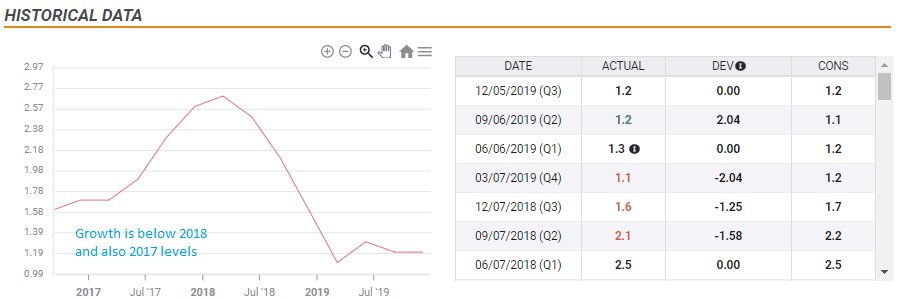
However, Germany already released an overview for the whole of 2019 – and it looks worrying. The continent's largest economy said growth stood at only 0.6% yearly – the worst since 2013. While Berlin refrained from publishing data for the fourth quarter, the full 2019 figure speaks for itself – pointing to stagnation.
With Germany growing only 0.6%, it is hard to see the euro area statistic beating early estimates. A small upside surprise with 1.2% yearly cannot be ruled out, but it is unlikely to change the overall picture for the euro.
Only an acceleration to 1.3% could boost the common currency, and only a drop to 0.9% could hurt it. As mentioned earlier, inflation figures – which the ECB targets and are fresher than GDP statistics – will likely have a more robust impact.
Scenarios for EUR/USD
While there are many permutations with two simultaneous publications, three general scenarios await traders.
1) As expected: If Core CPI slows to 1.2% and annual GDP to 1.1%, the pressure on the euro will likely continue. The probability is high as substantial surprises are uncommon in these figures.
The common currency has been under pressure in recent weeks, and for good reasons. The US economy is growing at a quicker pace than the eurozone and the coronavirus outbreak has pushed investors toward the safe-haven US dollar. Unimpressive European data would only add insult to injury, extending the gradual grind lower.
2) Weaker than expected: A significant miss in underlying inflation or a combination of a minor shortfall in both figures could send EUR/USD significantly lower, accelerating the trend.
The probability is medium, especially for a scenario of dual minor misses.
3) Better than expected: A double beat or a surprising rise of Core CPI to 1.4% would send euro/dollar higher, but headwinds could limit these gains.
Given recent disappointing German data, the probability is low.
Conclusion
The wind is blowing against EUR/USD and expectations for weaker Core CPI and slower growth are realistic. If figures mostly meet forecasts, the currency pair has room to continue its decline. Worse-than-expected statistics could kick it significantly lower, while only a considerable upside surprise could send euro/dollar higher.
Author
Yohay Elam
FXStreet
Yohay is in Forex since 2008 when he founded Forex Crunch, a blog crafted in his free time that turned into a fully-fledged currency website later sold to Finixio.