EUR/USD Weekly Forecast: US Dollar bearish case fueled by inflation figures
- United States inflation figures unwound a US Dollar sell-off set to continue next week.
- The European Central Bank stands between a rock and a hard place.
- EUR/USD points to 1.1460/70 as long as buyers defend the psychological 1.1000 mark.


The EUR/USD pair advanced for a fourth consecutive week, reconquering 1.1000 and trading as high as 1.1075, a level that was last seen in March 2022. Optimism arose, and the US Dollar sold off on the back of softer-than-anticipated United States inflation-related figures.
Macroeconomic figures confirmed the end of the Federal Reserve (Fed) tightening cycle, also fueled by the banking crisis that unfolded mid-March. Back in March, the American central bank hiked its benchmark rate by 25 basis points (bps) and anticipated one more 25 bps hike before pausing. Additionally, policymakers adopted a conservative stance after two local banks, Silicon Valley Bank and Signature Bank, collapsed amid funding issues.
Easing inflation, pausing Fed
According to the US Bureau of Labor Statistics, the Consumer Price Index (PCI) rose by 0.1% MoM in March and 5.0% compared to a year earlier, below the market expectations and down from 0.4% and 6.0%, respectively. Furthermore, the Producer Price Index (PPI) in the same month was up by 2.7% YoY, down from 4.9% in February.
Stock markets rallied with the news, while the safe-haven Dollar suffered a substantial sell-off, as the Fed dropped its aggressive stance to help the economy dodge a recession.
The US Dollar also got hit by the Federal Open Market Committee (FOMC) meeting Minutes published on Wednesday, as the document showed that policymakers forecast a mild recession starting later this year and noted that “the recent developments in the banking sector had further increased the already-high level of uncertainty associated with their outlooks for economic activity, the labor market, and inflation.”
At the same time, US-employment-related data keeps pointing to a loosening labor sector. Weekly unemployment claims rose to 239K in the week ended April 7, higher than the previous 228K and the 232K expected. Finally, Retail Sales in the country declined by 1% in March, worse than the 0.4% slide anticipated by market participants.
The Euro lacks strength of its own, with EUR/USD rallying mostly on US Dollar weakness. Nevertheless, European data came in line with expectations, providing mild support to the shared currency. Eurozone Retail Sales were down 0.8% in March, as expected, while the April Sentix Investor Confidence index improved to -8.7. Industrial Production in the Union rose at an annualized pace of 2% in February, beating the forecast, while Germany confirmed the Harmonized Index of Consumer Prices (HICP) at 7.8% YoY in March.
European Central Bank to keep tightening
Meanwhile, European Central Bank (ECB) policymakers maintained their hawkish bias. Speaking on the sidelines at the International Monetary Fund (IMF), Governing Council member Bostjan Vasle said that they are considering 25 and 50 basis points (bps) rate hike options for the May policy meeting, while policymaker Pierre Wunsch repeated it on Friday. Also, President Christine Lagarde said that she expects inflation in the Euro area to continue to fall with lagged price pressure fading out in her statement delivered at the IMF spring event.
On the one hand, the ECB believes it has completed the majority of the increases in borrowing costs required to tame inflation, according to the Governing Council, yet on the other, inflation still stands over three times above the central bank’s comfort target of around 2%. The ECB is also facing pressure from the banking sector amid aggressive monetary tightening, leaving European policymakers between a rock and a hard place.
The upcoming central banks' decision will be critical in confirming the monetary path, one way or the other. The Federal Reserve will announce on May 3, while the European Central Bank will follow on May 4.
The macroeconomic calendar has little of interest next week. Germany will publish the April ZEW Survey on Economic Sentiment, and the March Producer Price Index (PPI), while the EU will unveil the final estimate of the March HICP, the latter expected to be confirmed at 6.9% YoY. There are no first-tier events scheduled in the US, while on Friday, S&P Global will publish the preliminary estimates of the Services and Composite PMIs for all major economies.

EUR/USD technical outlook
The EUR/USD pair retreated from its multi-month peak but trades above the 1.1000 figure, which opens the door for an extension towards the 1.1460/70 area, a solid static long-term resistance level.
From a technical point of view, the risk skews to the upside, according to the weekly chart. The pair has managed to extend its rally and hold above a still bearish 100 Simple Moving Average (SMA) while the 20 SMA continues heading firmly north below the longer one. At the same time, technical indicators extended their advances to fresh 2023 highs, maintaining their upward strength and reflecting dominant buying interest.
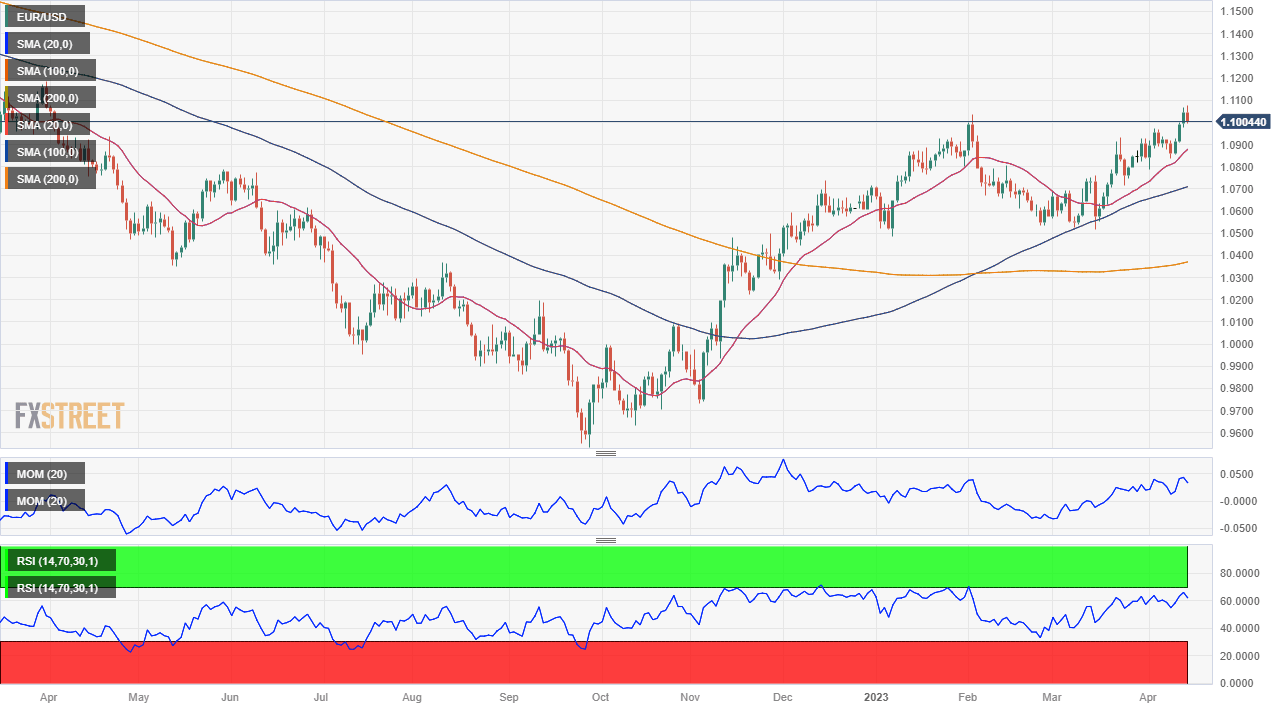
The daily chart hints at a potential bearish correction, although such is far from confirmed. Technical indicators remain within positive levels but ease from near overbought readings. At the same time, moving averages maintain their solid bullish slopes far below the current level, with the 20 SMA currently at around 1.0880.
A break through 1.1000 will surely be a discouraging sign for near-term buyers, although fresh longs will likely appear in the 1.0880/1.0910 area. Below the latter, however, the pair could extend its slump towards 1.0745, the 61.8% retracement of the 2022 yearly slump. Beyond 1.1060, on the other hand, the pair can rally initially towards 1.1120 en route to the 1.1200 figure.
EUR/USD sentiment poll
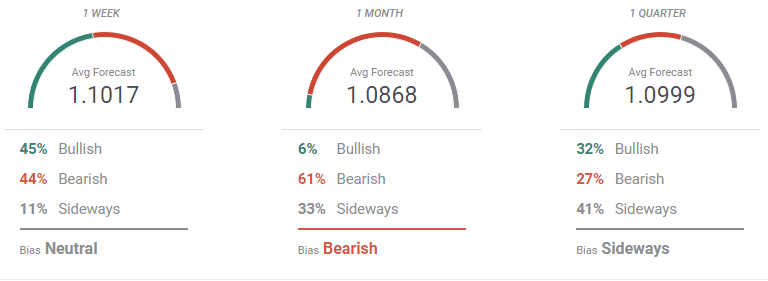
According to the FXStreet Forecast Poll, EUR/USD could have a hard time extending gains beyond the current area. On average, polled experts see the pair holding a handful of pips above the 1.1000 threshold in the weekly perspective, but below it in the longer views. 61% of them expect the pair to drop in a one-month view, although such a figure decreases to 27% in the quarterly perspective when the pair is seen returning to the current price zone.
The Overview chart shows a firmer upward momentum in the near term, which fades in time. The quarterly moving average has lost its former impulse and is currently flat at around 1.1000. In the near term, however, most targets accumulate around the 1.1150 area, in line with the ongoing trend. Finally, market participants have continued to lift the base of the potential range, with hardly any bets below 1.0600.
Premium
You have reached your limit of 3 free articles for this month.
Start your subscription and get access to all our original articles.
Author
Valeria Bednarik
FXStreet
Valeria Bednarik was born and lives in Buenos Aires, Argentina. Her passion for math and numbers pushed her into studying economics in her younger years.