EUR/USD Weekly Forecast: The perfect storm for a dollar’s rally
- Central bankers rush to tighten monetary policies as inflation fails to recede.
- The Russia-Ukraine crisis continues to dominate financial markets.
- EUR/USD bearish case is firmly in place, lower lows for the year in sight.


The EUR/USD pair kept trading on sentiment throughout the week, ending it at around the 1.1000 figure. The pair plummeted to 1.0855, its lowest since May 2020 on Monday, as the Russian-Ukrainian crisis kept escalating. Concerns eased temporarily mid-week as Kyiv put a diplomatic solution on the table, but to no avail. The mood was down for most of the week, although it got a positive turn on Friday after Russian President Vladimir Putin said that “there were certain positive shifts” in negotiations with Ukraine. President Volodymyr Zelenskyy, on the other hand, noted that it would take time and patience to achieve victory.
Sixteen days of war
Russian shelling of Ukraine has continued throughout the week, human corridors have been scarce, and those opened by Moscow lead to Russia or Belarus. International sanctions increased, with the US banning imports of crude oil and energy-related products from Russia effective this week and Europe rushing to find alternatives to gas.
The Old Continent still depends on Russian gas, however. Almost 60% of the region's needs depend on imports, half of which come from their Asian neighbor. The European Commission had announced plans to cut Russian gas by two-thirds by the end of 2022 and to end all imports by 2030. Also, the UK Prime Minister announced they would phase out oil products by the end of this year.
ECB hawkish and dovish at the same time
Beyond the Eastern European chaos, this past week brought the European Central Bank monetary policy announcement. The ECB kept rates unchanged as expected, although the central bank announced it would end the Asset Purchase Program in the third quarter of the year, sooner than anticipated. The APP will amount to 40 billion euros on April, 30 billion euros in May and 20 billion euros in June.
President Christine Lagarde said that inflation is likely to stabilize at the central bank’s 2% target over the medium term, adding that Moscow’s invasion of Ukraine is a watershed moment for Europe and that it would have a material impact on economic activity and inflation. As a result, the central bank downwardly revised its growth forecast and anticipated rising inflationary pressures.
US inflation at a 40-year high
The US reported its February Consumer Price Index on Thursday, which soared to 7.9% YoY as expected, but still a multi-decade high. The headline reading came one week ahead of the US Federal Reserve’s monetary policy meeting. The central bank is expected to raise interest rates for the first time since 2018, and policymakers will likely hint at a faster pace of hikes in 2022.
A few weeks ago, Chair Jerome Powell hinted at a 25 bps hike, cooling down a bit hopes for a 50 bps move. Nevertheless, the latest inflation figures brought back to the table a larger hike than that announced by Powell in his testimony before Congress.
Geopolitical turmoil, skyrocketing commodity prices and tighter monetary policies are making the perfect combo for continued risk-off trading, which will end up benefiting the greenback.
Among other relevant data released in the last few days, the EU confirmed the Q4 Gross Domestic Product at 0.3%, while German inflation soared to 7.6% YoY in February. Finally, the preliminary estimate of the US March Michigan Consumer Sentiment Index printed at 59.7, much worse than anticipated.
Beyond the Fed’s decision, the next week will bring US February Retail Sales. Germany will publish the March ZEW Survey on Economic Sentiment, while the EU will post the final readings of its February inflation estimates.

EUR/USD technical outlook
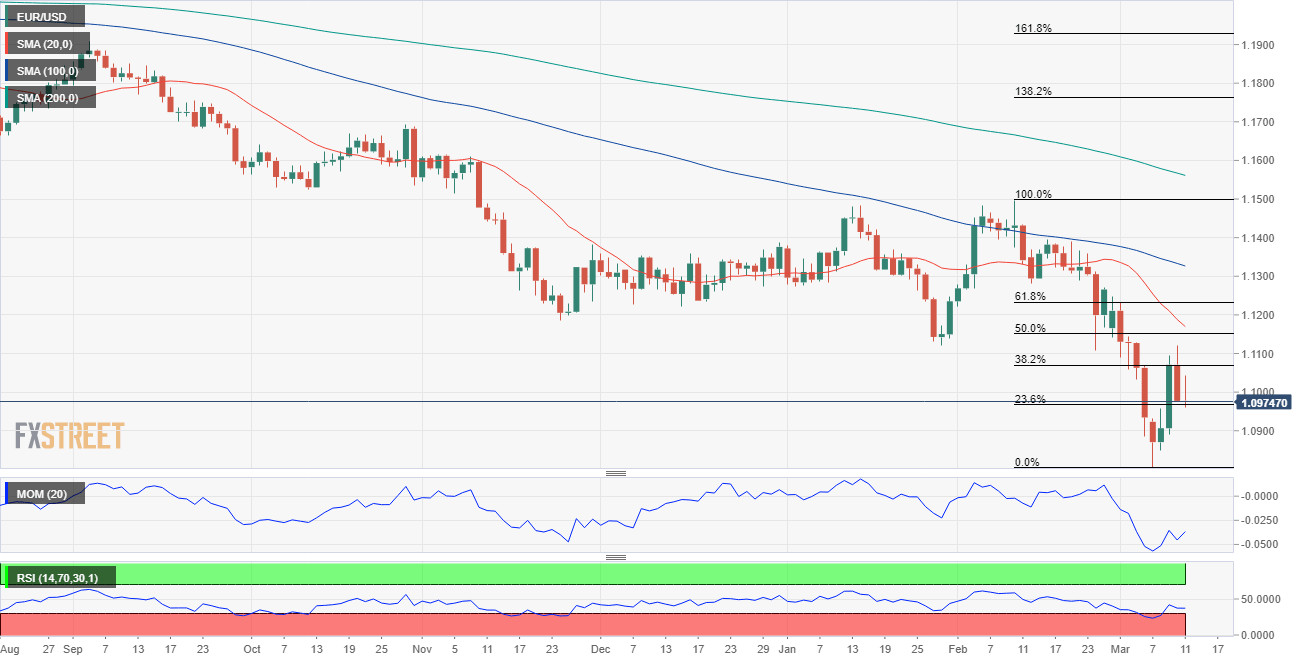
The pair has posted a lower low and a lower high for a fourth consecutive week, reflecting the dominant bearish trend and hinting at further slides ahead. When measuring this year’s slump, the pair has failed to gain ground above the 38.2% Fibonacci retracement at 1.1067, a relevant resistance level.
The weekly chart shows that the risk remains skewed to the downside, as the pair is trading well below bearish moving averages. At the same time, technical indicators are holding near their recent lows, without signs of bearish exhaustion.
Technical readings on the daily chart show that the risk is skewed to the downside, as technical indicators have stabilized well into negative territory after correcting extreme oversold readings. At the same time, the 20-SMA heads firmly lower, far above the current level and below the longer ones, which also offer bearish slopes.
An immediate support level comes in at around 1.0960, where the pair meets the 23.6% retracement of the aforementioned slump, followed by the year’s low at 1.0855. Below the latter, the next possible bearish target is 1.0760. To the upside, bulls may gather some confidence if the pair surpasses 1.1120, the weekly high, aiming to test 1.1225, the 61.8% Fibonacci retracement of the aforementioned slump.
 EUR/USD sentiment poll
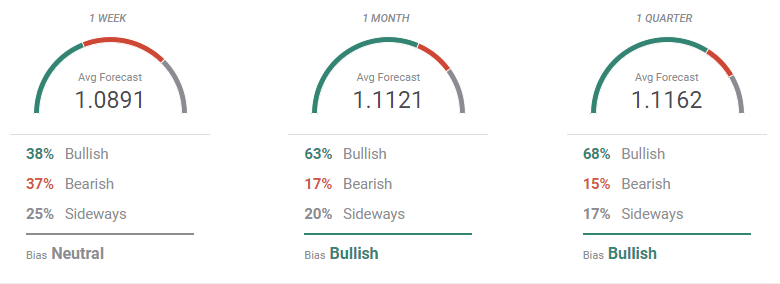
According to the FXStreet Forecast Poll, the EUR/USD pair has room to recover in the next few weeks, although, on average, the pair is seen holding below the 1.1200 figure, and hardly seen beyond above 1.1400 in the upcoming three months. It is worth noting that bulls increase as time goes by, reaching 68% of the polled experts in the quarterly perspective.
The Overview chart shows that the weekly moving average bounced modestly from a multi-month low, while the longer ones remain directionless, somehow suggesting speculative interest expects a corrective advance but is unsure about sustained gains.
Premium
You have reached your limit of 3 free articles for this month.
Start your subscription and get access to all our original articles.
Author
Valeria Bednarik
FXStreet
Valeria Bednarik was born and lives in Buenos Aires, Argentina. Her passion for math and numbers pushed her into studying economics in her younger years.