EUR/USD Price Forecast: Recovery faces initial target at 1.0530
- EUR/USD jumped past the 1.0500 barrier on strong USD sell off.
- The US Dollar retreated from last week’s tops despite tariff concerns.
- Tariffs on Canada and Mexico should kick in on March 4.


EUR/USD staged a noticeable comeback on Monday, advancing more than a cent from Friday’s two-week lows and reclaiming the area beyond 1.0500 the figure on the back of a pronounced retracement in the US Dollar (USD).
The deep decline in the Greenback prompted the US Dollar Index (DXY) to abandon the area of recent highs and recede to the 106.50 zone amid declining US yields across the curve and steady jitters surrounding US tariffs.
Tariff tensions and geopolitical hopes
Trade issues remained centre stage as President Trump announced last week that 25% tariffs on imports from Canada and Mexico would take effect on March 4. Tariffs can influence currency markets in different ways: if they stoke inflation, the Federal Reserve (Fed) may lean toward tighter monetary policy, which often boosts the USD. However, a significant slowdown in economic activity caused by prolonged trade barriers could push the Fed to adopt a more dovish stance. In Europe, any US move to impose tariffs on EU goods carries the potential to weaken the Euro (EUR) and thus weigh on EUR/USD.
However, the geopolitical factor returned to the scene on Monday, as talks over a potential peace deal in the Russia-Ukraine war lifted spirits and lent much needed oxygen to the riskier assets, all following the disastrous Trump-Zelenskyy meeting at the White House last week.
Central banks in the spotlight
The Fed recently held its policy rate steady at 4.25%–4.50%, citing robust US growth, steady inflation, and a healthy labour market. Fed Chair Jerome Powell has emphasised that it is too soon to consider rate cuts given ongoing inflationary pressures and strong employment figures. Other Fed officials have echoed these concerns, particularly as trade disputes could boost consumer prices and complicate the inflation outlook.
Meanwhile, the European Central Bank (ECB) is expected to lower its main rate by 25 basis points at its meeting on Thursday, as it aims to stimulate sluggish eurozone growth.
Following the bank’s latest event, ECB President Christine Lagarde rejected calls for a larger 50-basis-point cut, choosing to remain data-dependent. Despite the uncertainty surrounding trade, she expressed confidence that inflation will reach the ECB’s target by 2025, implying that any additional easing will be measured.
Technical outlook
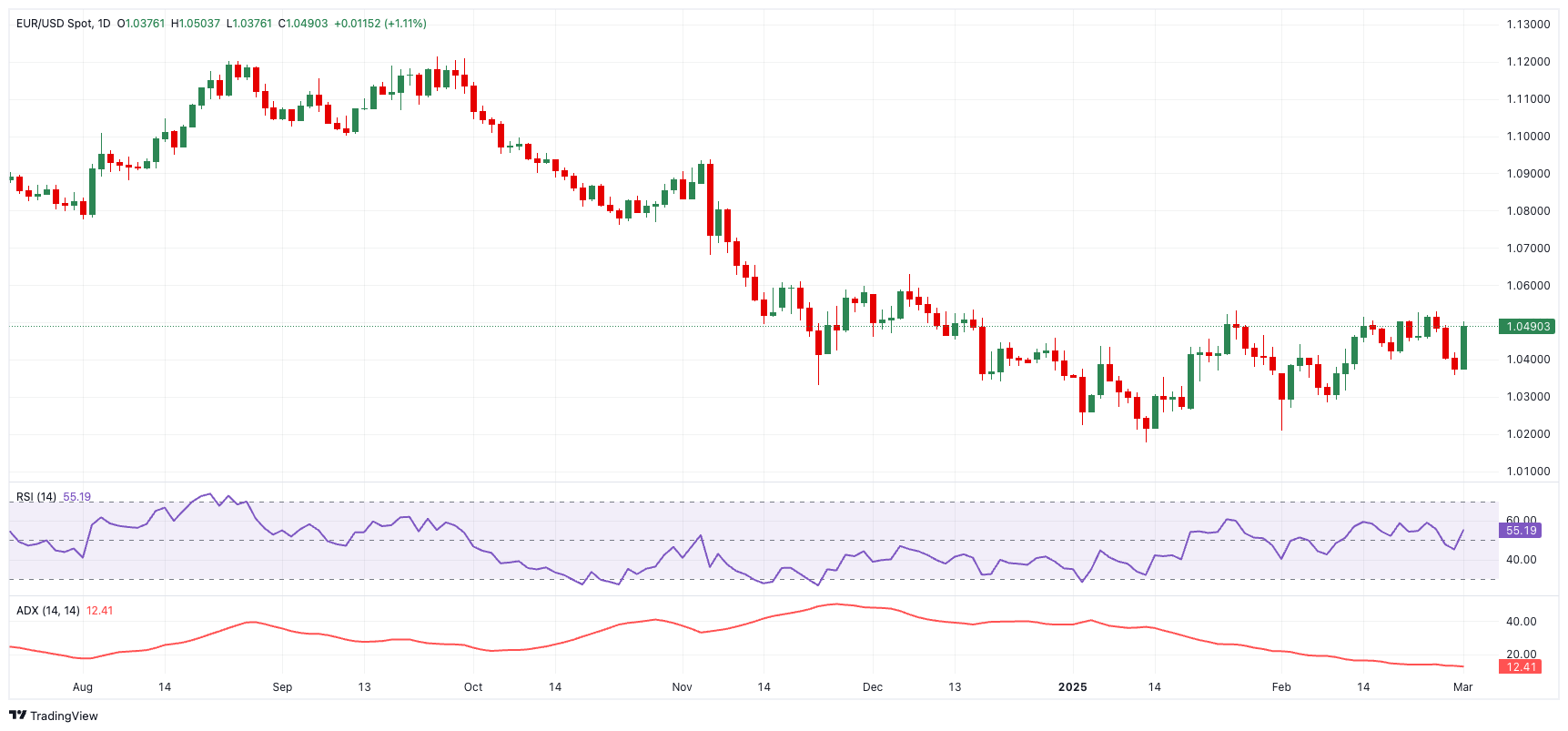
EUR/USD is testing the critical 1.0500 barrier, reversing much of last week’s leg lower.
Should the pair stage a recovery, the first resistance appears at the monthly peak of 1.0528 (February 26), just before the YTD high of 1.0532 (January 27). Further up, traders will watch the 1.0572 Fibonacci retracement (of the September–January slide) and the December 2024 peak of 1.0629.
On the downside, immediate support lies at the weekly low of 1.0359 (February 28), followed by another weekly low of 1.0282 (February 10) and the February low of 1.0209 (February 3). Down from here comes the 2025 bottom of 1.0176 (January 13).
Momentum indicators offer mixed signals, as the Relative Strength Index (RSI) near 55 suggests a pick-up in the bullish momentum, while the Average Directional Index (ADX) near 12 indicates an overall weak trend.
EUR/USD daily chart
Short-Term Outlook
For now, EUR/USD remains caught between shifting trade policies, contrasting central bank moves, subdued eurozone growth, and political developments in Germany. Until there is greater clarity on tariffs or a clearer stance from both the Fed and the ECB, the pair may continue to trade within a range.
Premium
You have reached your limit of 3 free articles for this month.
Start your subscription and get access to all our original articles.
Author
Pablo Piovano
FXStreet
Born and bred in Argentina, Pablo has been carrying on with his passion for FX markets and trading since his first college years.