EUR/USD Price Forecast: Initial contention sits near 1.1050
- EUR/USD set aside part of the recent weakness and revisited 1.1080.
- The Dollar traded in a vacillating mood amidst the Labor Day holiday.
- Uncertainty looms over a potential ECB rate cut in September.


After three consecutive days of losses, EUR/USD finally managed to regain the smile and print a decent advance at the beginning of the week, revisiting the 1.1080 zone against the backdrop of a tepid bout of selling pressure in the US Dollar (USD).
So far, spot seems to have met quite a decent contention around the 1.1050 region, roughly around the 61.8% Fibo retracement of the August rally.
Around the USD, the US Dollar Index (DXY) remained slightly on the defensive against the backdrop of thin trading conditions, all in response to the US Labor Day holiday and the consequent absence of activity in the domestic markets.
The pair’s daily uptick was also influenced by a broad recovery in German 10-year bund yields, which rose to multi-week highs around 2.35%.
Investors are closely monitoring any indications regarding the size of the expected interest rate cut by the Fed in September, after Fed Chair Jerome Powell suggested it might be time to recalibrate monetary policy at his speech at the Jackson Hole Symposium in late August. Powell also noted that "barring any unexpected developments, the labour market is unlikely in the near term to add significantly to upward pressures on inflation" and highlighted that the Fed does not want to see further cooling in labour market conditions.
The US Nonfarm Payrolls (NFP) due on Friday will be particularly important following Powell's pivot from combating inflation to focussing on preventing job losses, as the employment data carries the potential to determine the extent of the Fed's anticipated rate cut.
According to CME Group's FedWatch Tool, the probability of a 25 bps rate cut in September hovers around 68%.
Regarding the European Central Bank (ECB), its latest minutes indicated that policymakers did not see a compelling reason to cut interest rates last month, but they also cautioned that this issue could be revisited in September, considering the ongoing impact of high rates on economic growth.
However, recent sources noted that policymakers are becoming increasingly divided over the growth outlook, a disagreement that could influence the rate cut discussions for months to come. Some are concerned about a potential recession, while others remain focused on persistent inflation pressures. The crux of the discussion centres on how slowing economic growth and a possible recession could affect inflation—the ECB's main priority—as it aims to bring inflation down to 2% by the end of 2025.
Nevertheless, the release of lower-than-expected flash CPI data in Germany and the broader Euroland for August should challenge a cautious approach by rate setters, thus paving the way for the central bank to consider another rate cut at the September 12 gathering.
On this, ECB board member Isabel Schnabel, known for her conservative stance on policy, argued that inflation concerns should take precedence over growth. In a speech on Friday, she said that monetary policy should continue to prioritize returning inflation to the target in a timely manner. While acknowledging that risks to growth have risen, she maintained that a soft landing is still more likely than a recession.
In summary, if the Fed opts for further or more significant rate cuts, the policy gap between the Fed and the ECB could narrow over the medium to long term, potentially boosting EUR/USD. This is especially possible as markets expect the ECB to reduce rates two more times this year.
However, over the longer term, the U.S. economy is expected to outperform that of Europe, suggesting that any prolonged weakness in the dollar may be limited.
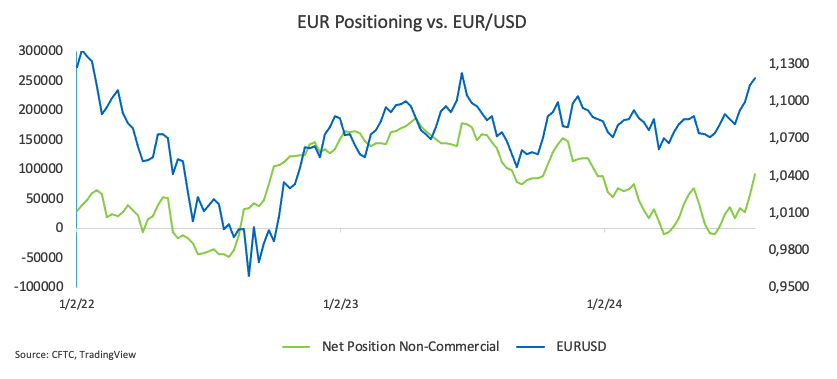
Lastly, speculators (non-commercial traders) have increased their net long positions in the Euro (EUR) to levels not seen since January, while commercial players (hedge funds) have raised their net short positions to multi-month highs, driven by a marked increase in open interest.
EUR/USD daily chart
 EUR/USD short-term technical outlook
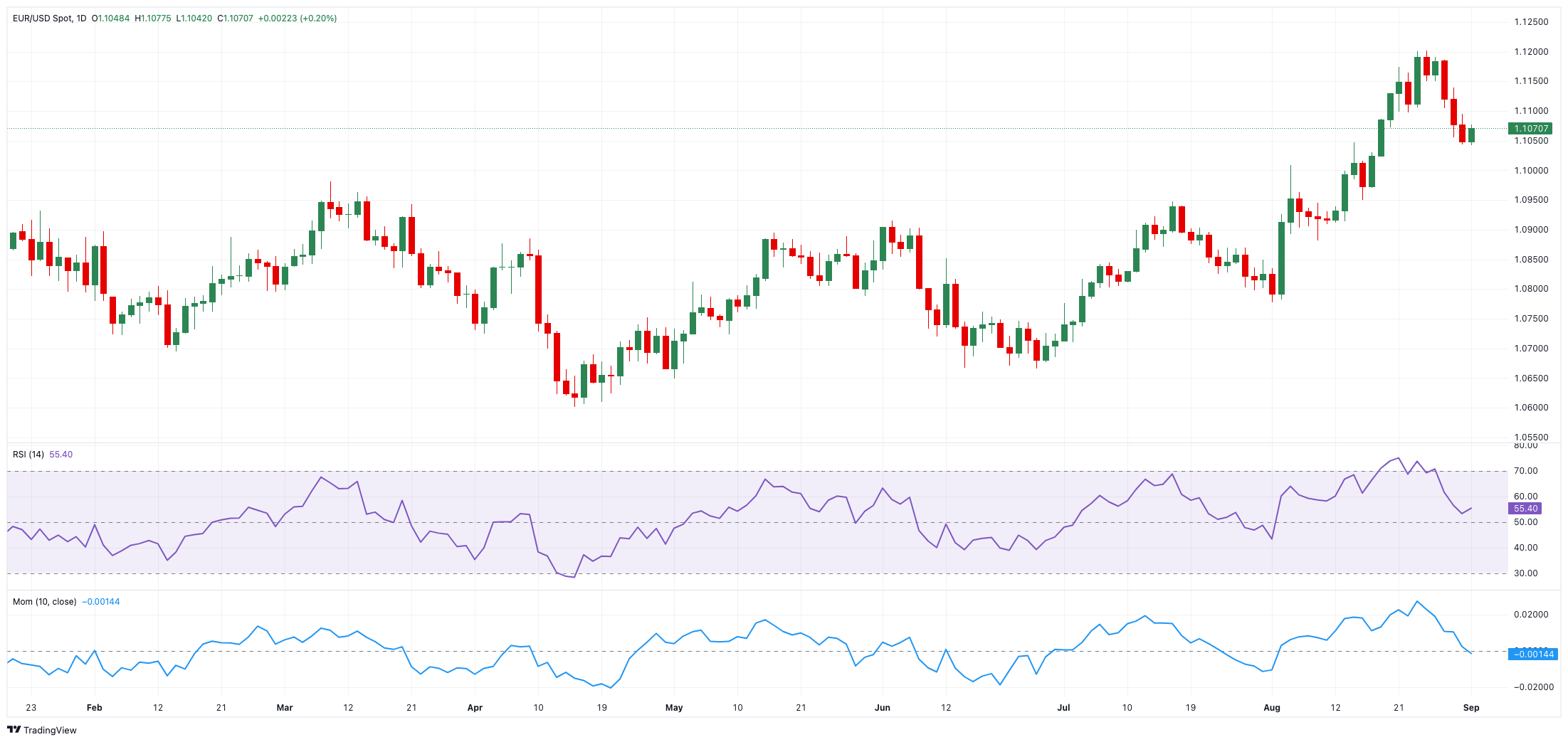
Further north, the EUR/USD is expected to challenge its 2024 high of 1.1201 (August 26), followed by the 2023 top of 1.1275 (July 18) and the 1.1300 round level.
The pair's next downward target is the provisional 55-day SMA at 1.0898, ahead of the weekly low of 1.0881 (August 8), and the crucial 200-day SMA at 1.0853. The loss of the latter exposes the weekly low of 1.0777 (August 1), prior to the June low of 1.0666 (June 26), and the May low of 1.0649 (May 1).
Meanwhile, the pair's rising trend is expected to continue as long as it continues above the important 200-day SMA.
The four-hour chart shows a mild resurgence of the bullish perspective. The initial resistance is 1.1201, which comes before 1.1275. Instead, 1.1040 provides immediate support, followed by 1.1030, and the 200-SMA at 1.0969. The relative strength index (RSI) rose past 41.
Premium
You have reached your limit of 3 free articles for this month.
Start your subscription and get access to all our original articles.
Author
Pablo Piovano
FXStreet
Born and bred in Argentina, Pablo has been carrying on with his passion for FX markets and trading since his first college years.