EUR/USD Price Forecast: Hotter than expected US inflation unwinds risk-off


EUR/USD Current price: 1.0318
- US inflation rose at a faster-than-anticipated pace in January.
- Fed Chairman Jerome Powell is due to testify before Congress.
- EUR/USD is testing the 1.0300 region and poised to break lower.
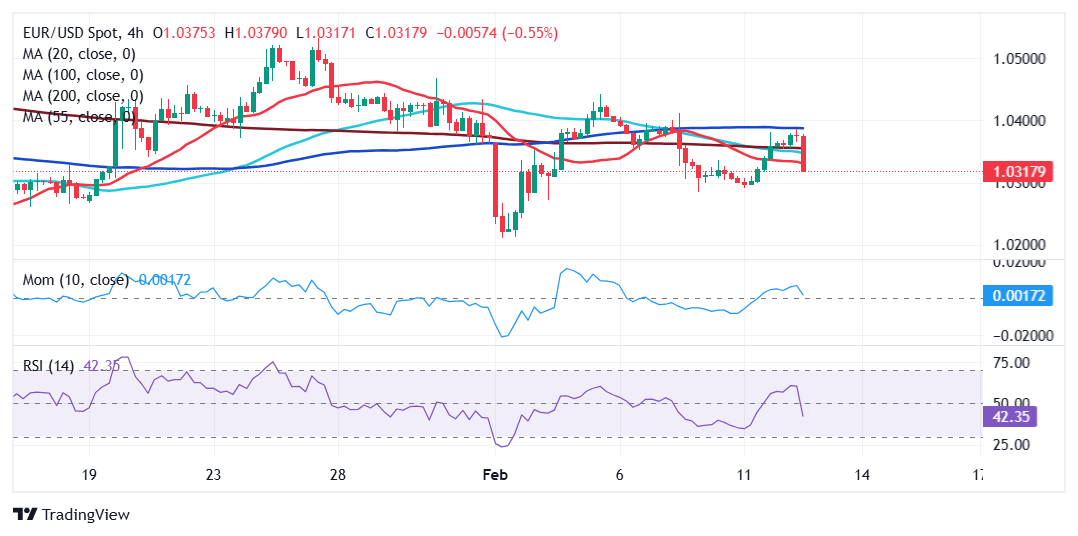
The EUR/USD pair advanced to a fresh weekly high of 1.0384 during European trading hours on Wednesday, moving cautiously ahead of United States (US) first-tier figures. The US Dollar (USD) eased for a third consecutive day, albeit losses were moderated ahead of the US Consumer Price Index (CPI) release.
The absence of relevant European data exacerbated range-trading ahead of the US CPI, which finally resulted in hotter-than-anticipated. All figures were above expected, with the annual CPI up by 3.0% in January compared to the same month last year. The core annual reading printed at 3.3% vs the previous 3.2% and the expected 3.1%. On a monthly basis, the CPI rose 0.5%, higher than the 0.4% posted in December and the expected 0.3%.
Higher-than-expected inflation figures triggered a USD run, as an interest rate cut is now out of the picture in the upcoming months. The EUR/USD pair turned red with the news and trades around 1.0320.
Later today, Federal Reserve (Fed) Chairman Jerome Powell will testify on the Fed’s Semi-Annual Monetary Policy Report to the US House Committee on Financial Services. He will likely repeat what he said on Tuesday, so the surprise factor would be missing, meaning Powell’s testimony may have a limited impact on the USD, although questions about hotter inflation may introduce some noise.
EUR/USD short-term technical outlook
From a technical point of view, the daily chart for the EUR/USD pair shows the risk of a downward extension has increased. A mildly bullish 20 Simple Moving Average (SMA) provided dynamic resistance in the 1.0380 region for a second consecutive day. The 100 and 200 SMAs gain downward traction far above the shorter one, in line with mounting selling pressure. Finally, technical indicators resumed their slides within negative levels, also supporting a bearish continuation.
In the near term, and according to the 4-hour chart, the case for another slide is also stronger. EUR/USD retreated from around a flat 100 SMA while then breaking below a bearish 20 SMA. Technical indicators, in the meantime, turned south almost vertically, with the Relative Strength Index (RSI) indicator already at 44, in line with additional slides should the pair extend its slide below 1.0300.
Support levels: 1.0300 1.0260 1.0220
Resistance levels: 1.0340 1.0385 1.0420
Premium
You have reached your limit of 3 free articles for this month.
Start your subscription and get access to all our original articles.
Author
Valeria Bednarik
FXStreet
Valeria Bednarik was born and lives in Buenos Aires, Argentina. Her passion for math and numbers pushed her into studying economics in her younger years.