EUR/USD Price Forecast: Further weakness looks likely below 1.0400
- EUR/USD came under strong downside pressure and threatened 1.0400.
- The US Dollar gather further pace and advanced to multi-day highs.
- President Trump added an extra 10% on imports from China.


EUR/USD continued its weekly retracement on Thursday, coming under heightened pressure and putting the key 1.0400 support to the test, on the back of the strong bid bias in the US Dollar (USD).
Against that, the US Dollar Index (DXY) reclaimed the 107.00 hurdle and above, reaching new six-day highs amid a modest bounce in US and German yields.
The Greenback’s price action reflected ongoing anxiety about US tariffs, as well as renewed questions about the health of the US economy following weaker results from fundamentals in past days.
Mounting tariff tensions
Markets stayed on edge Thursday due to concerns over further tariff announcements, especially after President Donald Trump reiterated that tariffs on US imports from Canada and Mexico will proceed as scheduled, that is, on March 4. In addition, Trump announced an extra 10% on levies on Chinese goods.
Tariffs can influence currency markets in different ways. If they push inflation higher, the Federal Reserve (Fed) may keep monetary policy tighter for longer, which could lift the USD.
On the other hand, a slowdown in economic activity from increased trade barriers during a protracted time might lead the Fed to adopt a more dovish stance.
Furthermore, any move to impose tariffs on EU goods could weigh on the Euro (EUR) and drag EUR/USD lower.
All eyes on monetary policymakers
The Federal Reserve recently kept its policy rate steady at 4.25%–4.50%, citing robust US growth, stable inflation, and a strong labour market. In his congressional testimony, Fed Chair Jerome Powell emphasised that it is too early to consider cutting rates, pointing to persistent inflationary pressures and employment figures as key drivers of Fed policy. His views has been reinforced by subsequent opinions from Fed rate setters.
In addition, Minutes from the latest FOMC meeting echoed this sentiment, noting that ongoing trade disputes could further boost consumer prices, complicating the inflation outlook and making the Fed cautious about any near-term policy changes.
In Europe, the European Central Bank (ECB) lowered its main rate by 25 basis points in a bid to support sluggish growth in the eurozone.
ECB President Christine Lagarde rejected calls for a larger 50-basis-point cut, choosing instead to remain data-dependent. Despite lingering trade uncertainties, she expressed confidence that inflation would reach the ECB’s target by 2025, suggesting that any further easing will be gradual.
Earlier in the week, Governing Council member Isabel Schnabel (hawk) raised doubts about whether the ECB’s 2.75% deposit rate is effectively slowing the eurozone economy, while Joachim Nagel (hawk) offered a more optimistic view of inflation. Both officials left the door open for further rate cuts if inflation edges down to 2% this year.
Technical levels to watch
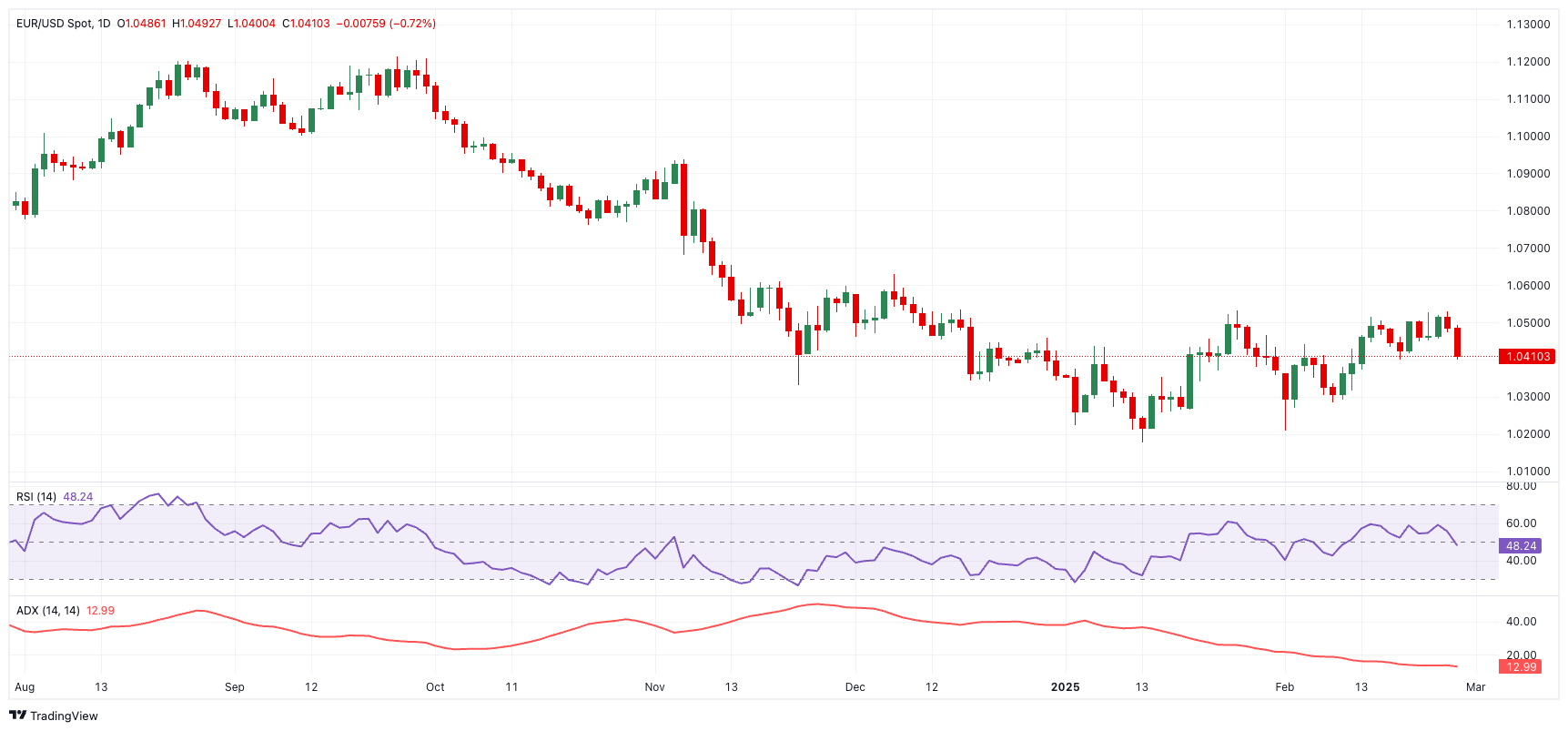
If EUR/USD extends its gains, the next resistance is near the monthly peak of 1.0528 (February 26), just ahead of the YTD high of 1.0532 (January 27), a region underpinned by the interim 100-day Simple Moving Average. Further up comes the 1.0572 Fibonacci retracement of the September-January drop, and then the December 2024 high of 1.0629.
On the downside, initial support appears at the weekly lows of 1.0399 (February 27), and 1.0282 (February 10), ahead of the February low of 1.0209 (February 3), and finally the 2025 bottom of 1.0176 (January 13).
Technical indicators paint a mixed picture. While the Relative Strength Index (RSI) near 48 points to weakening bullish momentum, the Average Directional Index (ADX) near 13 suggests an overall weak trend.
EUR/USD daily chart
Clouded view of the near term
For the moment, EUR/USD is swayed by shifting trade policies, contrasting central bank moves, weak eurozone growth, and evolving political developments in Germany. Unless there is more clarity on tariffs or clearer guidance from the Fed and ECB, the pair may remain in a range until these key risk factors become clearer.
Premium
You have reached your limit of 3 free articles for this month.
Start your subscription and get access to all our original articles.
Author
Pablo Piovano
FXStreet
Born and bred in Argentina, Pablo has been carrying on with his passion for FX markets and trading since his first college years.