EUR/USD Price Forecast: Decent support is seen around 1.0400
- EUR/USD reversed three straight days of losses and climbed to 1.0480.
- The US Dollar lost upside impulse as investors digested tariff news.
- Markets’ attention now shifts to flash PMIs on Friday.


A renewed bout of selling pressure hurt the US Dollar (USD) on Thursday, sending the US Dollar Index (DXY) back south of the 107.00 border and boosting EUR/USD to the area of two-day highs in the 1.0480-1.0490 band.
The corrective move in the Greenback came amid the steady tariff narrative from the White House and complicated discussions on the geopolitical scenario, where the US and Russia continued to negotiate the end of the Russia-Ukraine war.
The pair’s pullback also coincided with a bearish performance in US and German yields across the curve.
Tariff tensions remain front and centre
Even though there haven’t been fresh announcements on US trade policy, tariffs are still a key source of market anxiety. The White House delayed a 25% tariff on Canadian and Mexican imports but kept a 10% levy on Chinese goods in place, leaving investors guessing about the next move.
Concerns mounted when President Trump announced a 25% tariff on steel and aluminium imports, triggering fears of further retaliation. Initially, this weighed on the US Dollar, but if these tariffs end up fuelling inflation, the Federal Reserve (Fed) may be inclined to keep rates higher for longer—potentially boosting the Greenback.
Central banks take the spotlight
At its latest meeting, the Fed left rates steady at 4.25%–4.50%, balancing solid US growth, persistent inflation, and a strong labour market. In recent congressional testimony, Fed Chair Jerome Powell emphasized that it’s too early to consider rate cuts, pointing to inflation and employment data as the main drivers of policy.
According to the FOMC Minutes released earlier in the week, Fed officials are particularly concerned that tariff-related costs could be passed on to consumers, adding upward pressure on inflation. Policymakers noted that external risks—trade disputes, geopolitical events, and strong consumer spending—could delay any meaningful drop in inflation. They agreed that interest rates should stay where they are until inflation shows a clear path toward the Fed’s 2% target.
On the other side of the Atlantic, the European Central Bank (ECB) opted for a 25-basis-point rate cut to support the eurozone’s sluggish economy. ECB President Christine Lagarde dismissed the idea of a larger 50-point cut, preferring a more gradual, data-driven approach. Despite trade tensions, she remains optimistic that inflation will hit the target by 2025, suggesting a measured pace for ECB policy moves.
Winners and losers in a tariff-driven world
If tariffs end up stoking inflation in the US, the Fed could stay hawkish for longer, potentially strengthening the dollar. For the euro, looming US tariffs on EU imports could push EUR/USD closer to parity as early as Q2.
Key price markers
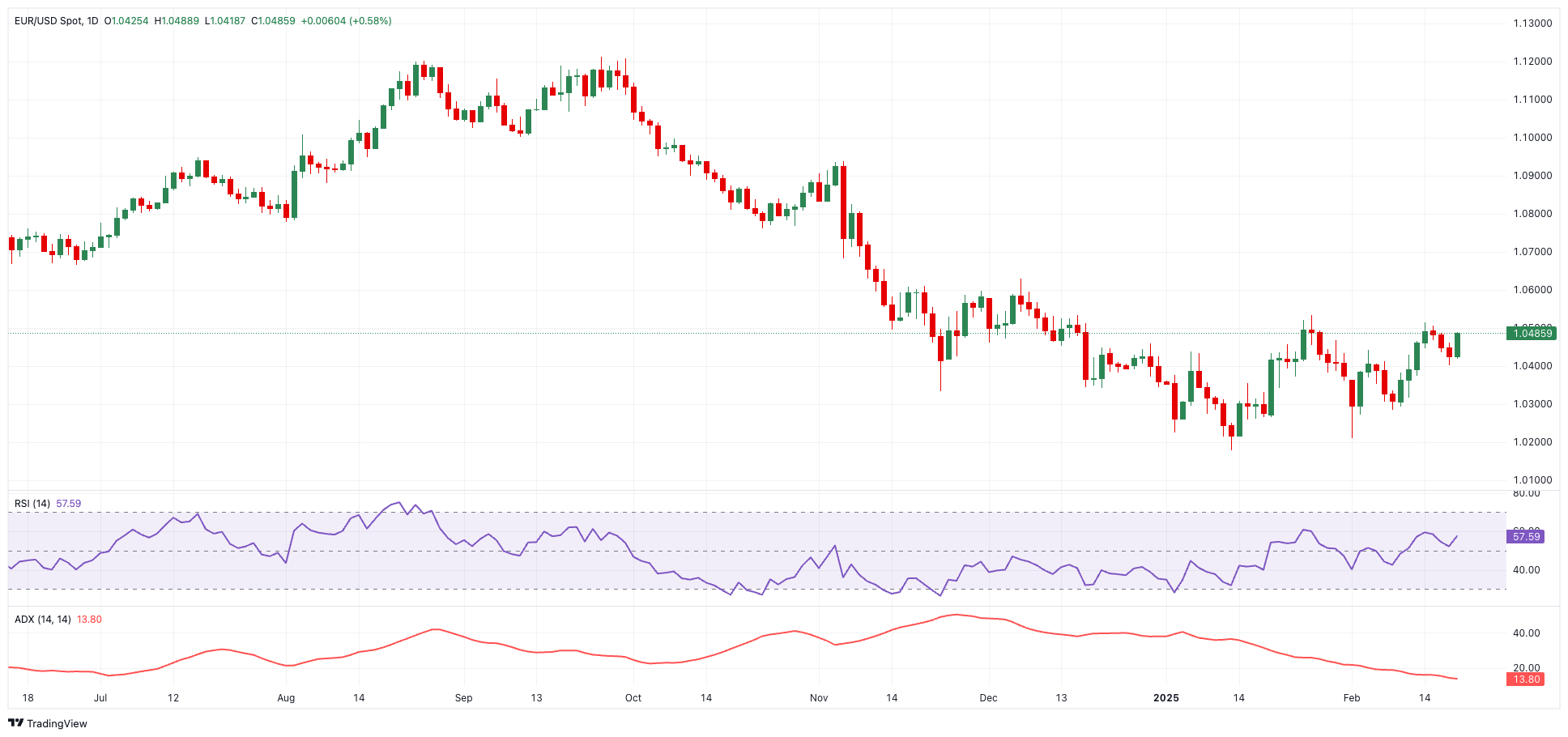
EUR/USD is flirting with the 1.0500 barrier on renewed selling bias in the Greenback.
The continuation of this rebound could see the February peak of 1.0513 (February 14 high) retested, followed by 1.0532 (the 2025 high from January 27). Beyond that, the 100-day SMA at 1.0558 and the December top at 1.0629 come into play.
On the downside, 1.0282 (the February 10 weekly low) offers the first layer of support, followed by 1.0209 (February 3 monthly low). A break below this could clear the way to the 2025 bottom of 1.0176 (January 13).
Additionally, technical indicators send mixed signals: the RSI has climbed above 58, supporting a bullish stance, while the ADX below 14 suggests a lack of strong directional momentum.
EUR/USD daily chart
Looking ahead
In the short term, EUR/USD will likely stay caught between trade developments, diverging central bank paths, slower eurozone growth, and political uncertainties—especially in Germany. Until there’s more clarity on trade policy and a firmer sense of where the Fed and ECB are headed, the euro’s outlook remains uncertain.
Premium
You have reached your limit of 3 free articles for this month.
Start your subscription and get access to all our original articles.
Author
Pablo Piovano
FXStreet
Born and bred in Argentina, Pablo has been carrying on with his passion for FX markets and trading since his first college years.