EUR/USD Price Forecast: Concerns about Trump’s tariffs spur fears


EUR/USD Current price: 1.0803
- Global stocks collapsed amid concerns that Trump’s trade war will undermine worldwide growth.
- German data was quite encouraging, with Retail Sales up and inflation easing further.
- EUR/USD pressures the 1.0800 mark and is set to extend its near-term slide.
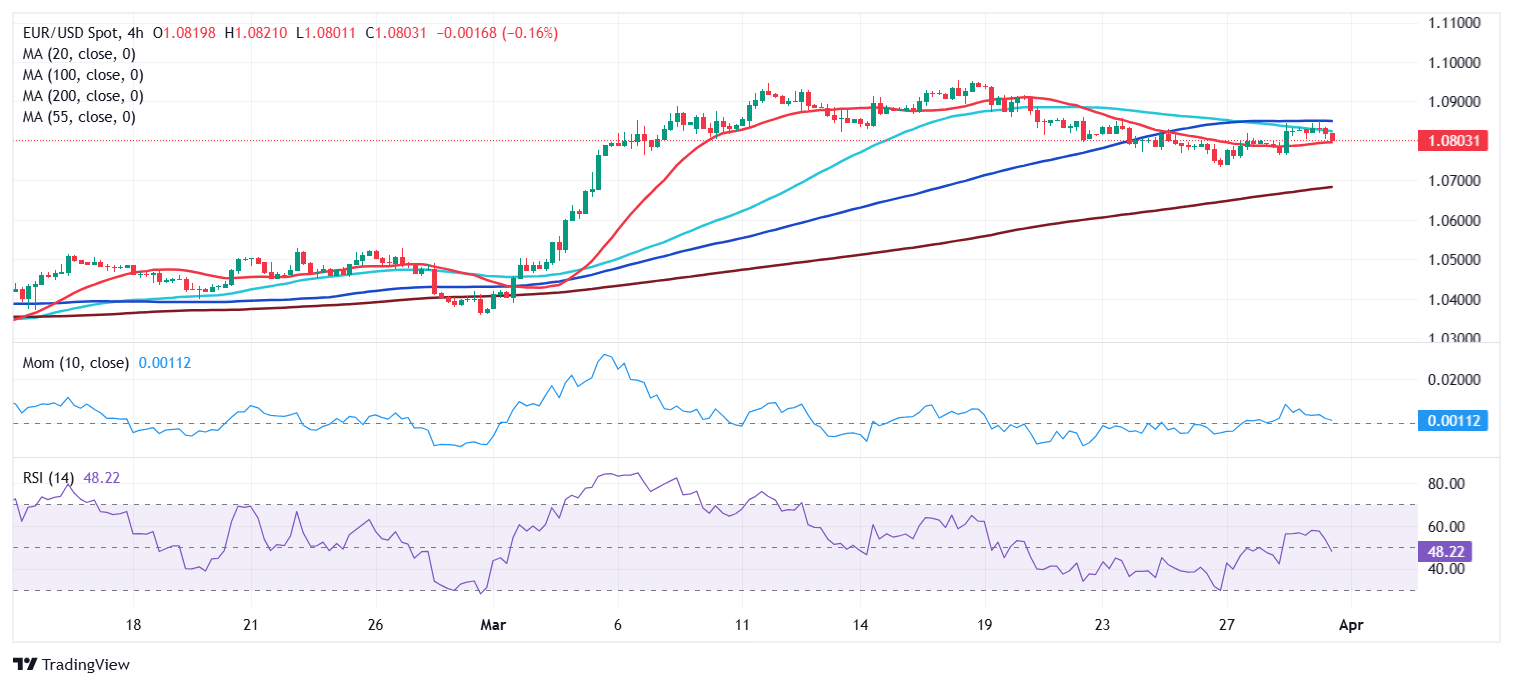
The EUR/USD pair trades within a limited range on Monday, hovering around 1.0800 early in the American session. The US Dollar (USD) started the week with a soft tone, pushing EUR/USD towards 1.0850 during Asian trading hours.
However, a persistent dismal mood finally limited high-yielding Euro (EUR) strength. Global stocks trade deep in the red, with the Nikkei 225 losing roughly 4% and most Asian indexes down over 1%. European stock markets are also under strong selling pressure.
Fears rest on United States (US) President Donald Trump’s tariffs. Trump’s April 2 “Liberation Day” is around the corner, and he pledged to announce massive reciprocal levies to protect the American economy. Even further, market players fear he would escalate the trade war, which could result in a worldwide economic setback.
At the same time, European Central Bank (ECB) President Christine Lagarde hit the wires on Monday, noting that Europe must take better control of its own destiny, while adding that a trade war between the EU and the US is a “lose-lose scenario.” Regarding inflation, Lagarde said that it needs to come down in a “durable manner” and that to do so, policymakers need to have an interest rate that is carefully set.
Data-wise, Germany reported that Retail Sales were up 0.8% in February, better than the 0% anticipated. The preliminary estimate of the March Harmonized Index of Consumer Prices (HICP) was reported at 2.3% YoY, down from the previous 2.6% and below the 2.4% anticipated.
The US will release minor figures, including the March Chicago Purchasing Managers’ Index and the Dallas Fed Manufacturing Business Index.
EUR/USD short-term technical outlook
The daily chart for the EUR/USD pair suggests the slide may continue in the upcoming sessions. The pair started the day below a still bullish 20 Simple Moving Average (SMA) and met sellers right above it. Additionally, technical indicators head firmly south, with the Momentum indicator accelerating lower below its 100 mark. Meanwhile, a flat 200 SMA provides support at around 1.0730, with buyers surging around it last week.
In the near term, and according to the 4-hour chart, a directionless 100 SMA provides resistance around 1.0850, while an also flat 20 SMA lies around 1.0790, providing near-term support. Finally, technical indicators head firmly south, although within neutral levels. A slide below the mentioned 1.0790 should open the door for additional slides towards the 1.0700 mark.
Support levels: 1.0790 1.0750 1.0710
Resistance levels: 10850 1.0885 1.0925
Tariffs FAQs
Tariffs are customs duties levied on certain merchandise imports or a category of products. Tariffs are designed to help local producers and manufacturers be more competitive in the market by providing a price advantage over similar goods that can be imported. Tariffs are widely used as tools of protectionism, along with trade barriers and import quotas.
Although tariffs and taxes both generate government revenue to fund public goods and services, they have several distinctions. Tariffs are prepaid at the port of entry, while taxes are paid at the time of purchase. Taxes are imposed on individual taxpayers and businesses, while tariffs are paid by importers.
There are two schools of thought among economists regarding the usage of tariffs. While some argue that tariffs are necessary to protect domestic industries and address trade imbalances, others see them as a harmful tool that could potentially drive prices higher over the long term and lead to a damaging trade war by encouraging tit-for-tat tariffs.
During the run-up to the presidential election in November 2024, Donald Trump made it clear that he intends to use tariffs to support the US economy and American producers. In 2024, Mexico, China and Canada accounted for 42% of total US imports. In this period, Mexico stood out as the top exporter with $466.6 billion, according to the US Census Bureau. Hence, Trump wants to focus on these three nations when imposing tariffs. He also plans to use the revenue generated through tariffs to lower personal income taxes.
Premium
You have reached your limit of 3 free articles for this month.
Start your subscription and get access to all our original articles.
Author
Valeria Bednarik
FXStreet
Valeria Bednarik was born and lives in Buenos Aires, Argentina. Her passion for math and numbers pushed her into studying economics in her younger years.