EUR/USD Forecast: Upbeat US data boosts odds for another leg south


EUR/USD Current Price: 1.0717
- Uncertainty about Fed's decisions and a potential US default undermine the mood.
- German Q1 GDP contracted 0.3%, much worse than previously estimated.
- EUR/USD trades near the 1.0700 threshold and aims to break below it.
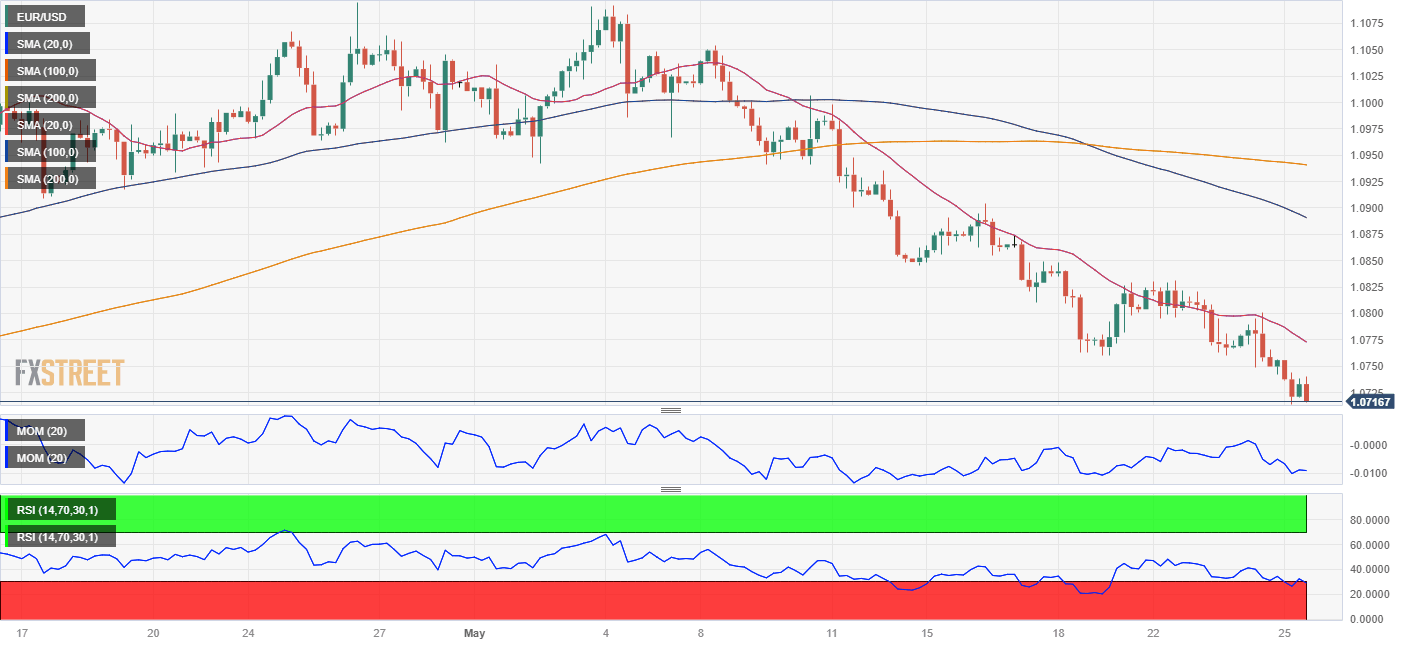
The EUR/USD pair has extended its decline to 1.0713 on Thursday, its lowest in two months. A risk-averse environment keeps favoring the US Dollar against most major rivals, as market players are concerned about a potential United States (US) default, as discussions about an extension of the debt ceiling continue.
On Wednesday, House Speaker Kevin McCarthy noted that there's ground to cover to reach an agreement, although he added the country would not default. Additionally, the Federal Open Market Committee (FOMC) released the Minutes of the latest meeting, in which policymakers agreed to remove a key sentence indicating "additional policy firming may be appropriate." The document also showed voting members were divided on how to proceed from now on, as some see the need for more increases, while others believe slowing growth will remove the need to tighten further.
Macroeconomic data added to the Euro's weak tone, as the Q1 German Gross Domestic Product (GDP) was downwardly revised from a preliminary estimate of 0% to -0.3%. Furthermore, the Gfk Consumer Confidence Survey rose less than anticipated in June, printing at -24.2. The US also published a Q1 GDP estimate, which upwardly revised annualized economic growth to 1.3%. At the same time, Initial Jobless Claims for the week ended May 19 beat expectations, contracting to 229K. Finally, the April Chicago Fed National Activity Index rose to 0.07 from -0.37. The batch of positive news boosted the USD but fell short of cooling the generalized dismal mood. Later in the day, the US will release April Pending Home Sales, while a couple of Federal Reserve (Fed) officials will be on the wires.
EUR/USD short-term technical outlook
The EUR/USD pair nears the 1.0700 threshold, and, given that it stays below 1.0745, the risk skews to the downside. The mentioned level stands for the 61.8% retracement of the 2022 yearly decline and has become a psychological barrier. Meanwhile, technical readings in the daily chart favor a bearish extension. The pair extends its slide below a flat 100 Simple Moving Average (SMA) while the 20 SMA accelerated its decline above it. Technical indicators confirm the downward bias, maintaining their downward slopes near oversold readings.
The 4-hour chart shows that technical indicators head firmly lower, with the Relative Strength Index (RSI) indicator within oversold levels, although without signs of bearish exhaustion. At the same time, the 20 SMA accelerated its slide well above the current level while below also bearish longer moving averages. A break through 1.0700 should see the pair testing 1.0660 before the end of the day.
Support levels: 1.0700 1.0660 1.0620
Resistance levels: 1.0745 1.0790 1.0840
Premium
You have reached your limit of 3 free articles for this month.
Start your subscription and get access to all our original articles.
Author
Valeria Bednarik
FXStreet
Valeria Bednarik was born and lives in Buenos Aires, Argentina. Her passion for math and numbers pushed her into studying economics in her younger years.