EUR/USD Forecast: Third straight NFP miss could help the pair rebound
- EUR/USD stabilized near 1.0850 following Thursday's sharp decline.
- US August jobs report could trigger the next big action in the pair.
- Euro needs to clear 1.0900 to attract technical buyers.


EUR/USD found support and stabilized near 1.0850 early Friday following Thursday's sharp decline. In case the pair reclaims 1.0900 later in the day, it could continue to stretch higher ahead of the weekend.
Investors started to refrain from pricing in another rate hike in European Central Bank (ECB) key rates in September and caused the Euro to lose interest on Thursday. Later in the day, the data from the US showed that the Personal Consumption Expenditures (PCE) Price Index came in largely in line with market estimates, while the weekly Initial Jobless Claims declined 228,000 from 232,000.
Although the probability of the Federal Reserve (Fed) leaving its policy rate unchanged held steady at around 50% after these data releases, the US Dollar gathered strength and weighed on EUR/USD. Considering the lack of action in US T-bond yields, the USD's recovery could be fuelled by profit-taking on the last trading day of August on Thursday.
Euro price today
The table below shows the percentage change of Euro (EUR) against listed major currencies today. Euro was the strongest against the New Zealand Dollar.
| USD | EUR | GBP | CAD | AUD | JPY | NZD | CHF | |
| USD | -0.06% | -0.05% | 0.00% | 0.23% | 0.01% | 0.25% | -0.13% | |
| EUR | 0.08% | 0.03% | 0.07% | 0.31% | 0.09% | 0.33% | -0.05% | |
| GBP | 0.04% | -0.02% | 0.05% | 0.28% | 0.06% | 0.29% | -0.08% | |
| CAD | 0.00% | -0.07% | -0.05% | 0.24% | 0.01% | 0.25% | -0.14% | |
| AUD | -0.23% | -0.32% | -0.27% | -0.24% | -0.23% | 0.02% | -0.38% | |
| JPY | -0.01% | -0.08% | -0.05% | -0.02% | 0.24% | 0.27% | -0.13% | |
| NZD | -0.26% | -0.32% | -0.29% | -0.25% | -0.01% | -0.24% | -0.38% | |
| CHF | 0.14% | 0.05% | 0.09% | 0.12% | 0.37% | 0.12% | 0.39% |
The heat map shows percentage changes of major currencies against each other. The base currency is picked from the left column, while the quote currency is picked from the top row. For example, if you pick the Euro from the left column and move along the horizontal line to the Japanese Yen, the percentage change displayed in the box will represent EUR (base)/JPY (quote).
Nonfarm Payrolls (NFP) in the US are forecast to rise 170,000 in August after July's less-than-expected increase of 187,000. In case NFP comes in at or below 150,000 and fall short of the market consensus for the third straight month in August, the USD could come under renewed selling pressure and allow EUR/USD to regain its traction.
A positive surprise, with an NFP print above 200,000, could provide a boost to the USD and force EUR/USD to stay under bearish pressure heading into the weekend.
The US economic docket will also feature the ISM Manufacturing PMI report later in the day. Investors, however, are unlikely to take positions based on the PMI reading after the US jobs report.
EUR/USD Technical Analysis
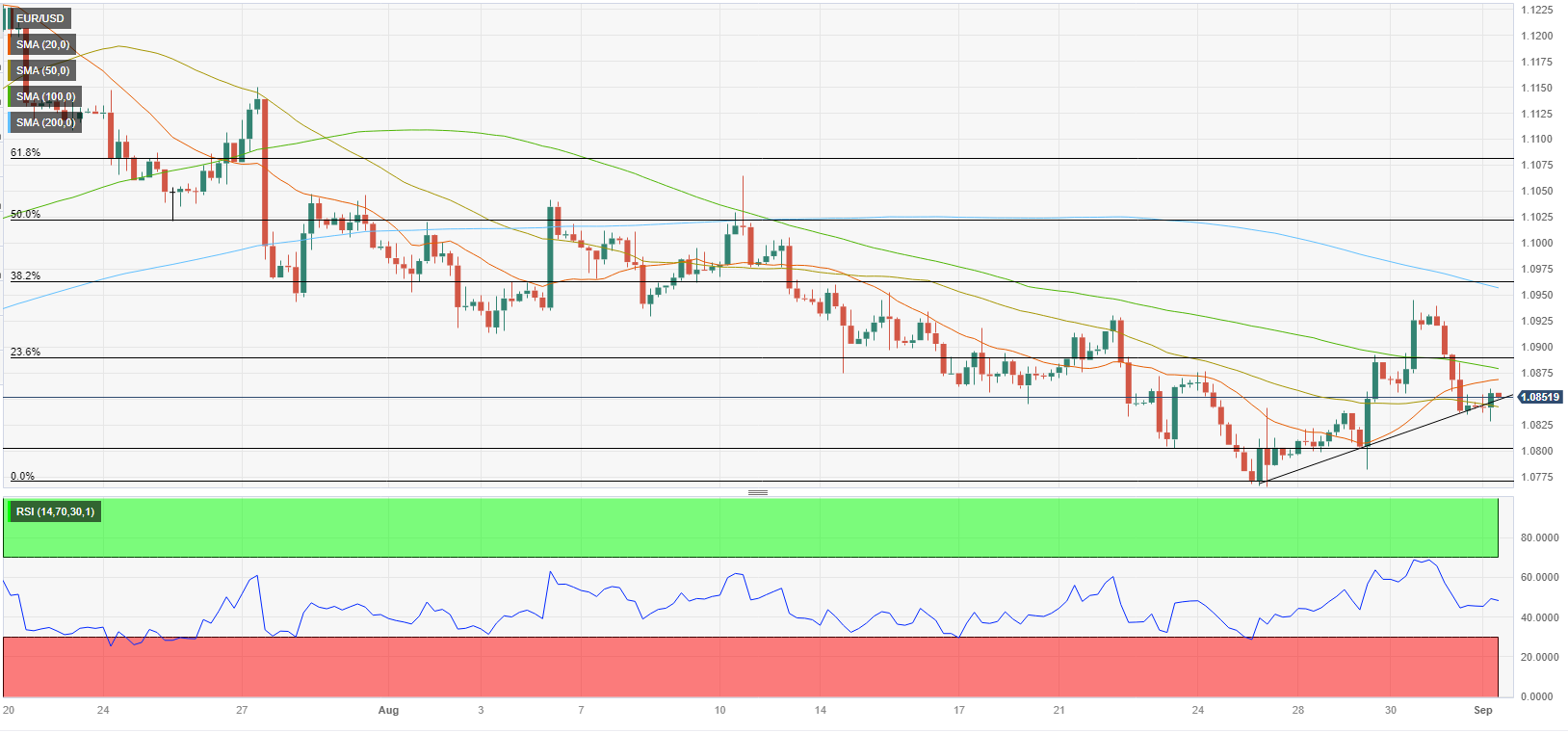
The Relative Strength Index (RSI) indicator on the 4-hour chart turned flat near 50 early Friday, suggesting that sellers remain on the sidelines for the time being.
On the upside, EUR/USD faces strong resistance at 1.0890-1.0900, where the 100-period Simple Moving Average (SMA) on the 4-hour chart and the Fibonacci 23.6% retracement of the latest downtrend align. A 4-hour close above that level could attract technical buyers and open the door for an extended recovery toward 1.0930 (static level) and 1.0960 (Fibonacci 38.2% retracement, 200-period SMA).
Looking south, first support is located at 1.0840 (50-period SMA) before 1.0800 (psychological level) and 1.0770 (end-point of the downtrend) could be seen.
Premium
You have reached your limit of 3 free articles for this month.
Start your subscription and get access to all our original articles.
Author
Eren Sengezer
FXStreet
As an economist at heart, Eren Sengezer specializes in the assessment of the short-term and long-term impacts of macroeconomic data, central bank policies and political developments on financial assets.