EUR/USD Forecast: Further falls due amid downtrend channel, weak data, trade troubles
- EUR/USD has been under pressure amid trade uncertainty and weak data.
- Euro-zone inflation, US GDP, and trade stand out in the last week of November.
- Late November's daily chart is pointing to the downside.
- The FX Poll is showing a moderately bearish tendency.

This week in EUR/USD: Slowdown, trade, and the Fed
Is a euro-zone recession around the corner? While final German Gross Domestic Product figures have confirmed that the nation escaped a downturn in the third quarter, more recent statistics paint a darker picture. Markit's flash Purchasing Managers' Indexes for November have shown a slowdown in the services sector. While manufacturing is contracting at a more moderate pace, it has been dragging down both the German and the euro-zone economies.
The data has weighed on EUR/USD and capped any attempts to recover. Christine Lagarde, the new President of the European Central Bank, has been unable to boost the common currency. In her first policy speech, her call for euro-zone governments to do more paled in comparison to her predecessor.
Without clear calls from Lagarde and lacking an outright recession, Germany may continue with its tight fiscal policy. And if the continent's locomotive fails to ignite, the bank may step in with more bond-buying – sending the euro lower.
For broader markets, US-Sino relations have dominated the agenda. Headlines jumped choppily from optimism to pessimism, with the latter taking hold amid growing rows between the world's largest economies. The safe-haven US Dollar has been gaining ground. The administration is set to slap additional tariffs on China on December 15, and markets are becoming more anxious as the days pass.
Congress passed a bill supporting pro-Democracy protesters in Hong Kong, angering Beijing, which summoned the American ambassador to express its dissatisfaction with the development. At the time of writing, President Donald Trump has still not signed the bill into law.
The Federal Reserve is watching trade developments. Lael Brainard, Governor at the Fed and permanent voter, said that the high level of uncertainty is weighing on investment. However, John Williams, her colleague at the New York Fed, has reaffirmed the bank's position that the US economy is in "a good place."
The meeting minutes from the recent Federal Open Market Committee (FOMC) have shown broad support for the latest rate cut – the third in a row – but also that members backed a long pause. The Fed's wait-and-see mode contrasts the ECB's ongoing bond-buying. Trump summoned Jerome Powell, Chairman of the Federal Reserve, to an unscheduled meeting and then complained about the strong dollar. The greenback initially dipped, but then recovered.
US figures have been mixed, with an upbeat Philly Fed Manufacturing Index and a minor beat in Existing Home Sales. The upcoming week already features top-tier data.
Euro-zone events: German IFO, flash inflation figures
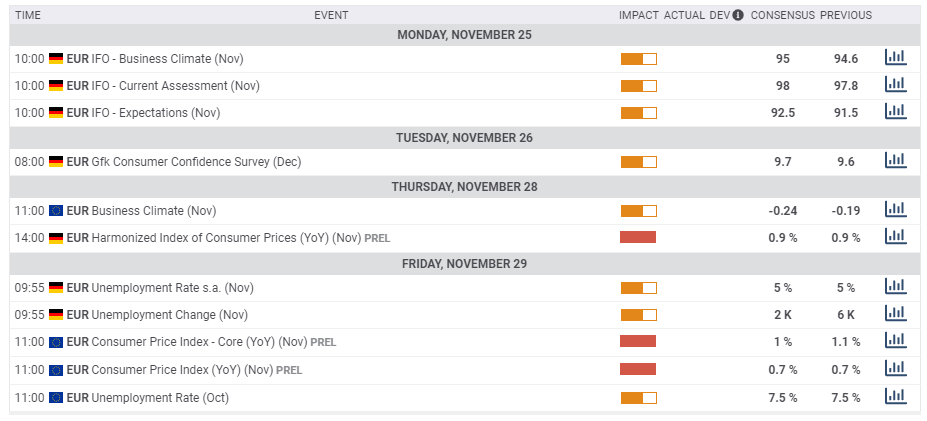
Is the German economy recovering, or is it headed to a recession? Data from IFO – the nation's No. 1 thinktank – may provide some clues. The Business Climate index, Current Assessment, and Expectations figures are all expected to advance in November's report, albeit from low levels.
Economists expect Inflation figures from the old continent's powerhouse to have remained unchanged at 0.9% annually in the early release for this month.
The data from Germany shape expectations for the Consumer Price Index data for the whole continent, due out on Friday. Traders will likely focus on Core CPI, which has bumped up to 1.1% in October and is now set to slide back down to 1%. Headline inflation is forecast to remain unchanged at 0.7% – far from the ECB's 2% target.
Unemployment statistics – from both Germany and the euro-zone – have come out below expectations of late. Labor markets have generally been thriving in recent years, and a turnaround may cause sleepless nights for policymakers.
In addition to economic indicators, comments from ECB members may move the common currency as well as trade relations with the US.
Here are the events lined up in the euro-zone on the forex calendar:
US events: GDP, durables, and trade
Trade headlines top the agenda for American investors also on Thanksgiving week. Markets will be closed on Thursday, and liquidity will likely remain subdued on the following day – Black Friday.
If Trump and his counterpart Xi Jinping announce a deal, the dollar may drop, allowing EUR/USD to rise. An accord that includes removing past levies would be preferred. However, if talks break down and the US advances toward slapping new duties, the greenback may continue rising amid safe-haven flows, sending eurodollar down.
Developments around Trump's impeachment hearings have yet to affect markets, but the pressure is mounting. The president has been further implicated in the Ukraine scandal. Senior confidants such as Gordon Sondland, ambassador to the EU, and millionaire Trump donor, spilled the beans on an attempted quid-pro-quo deal with the Ukranian president.
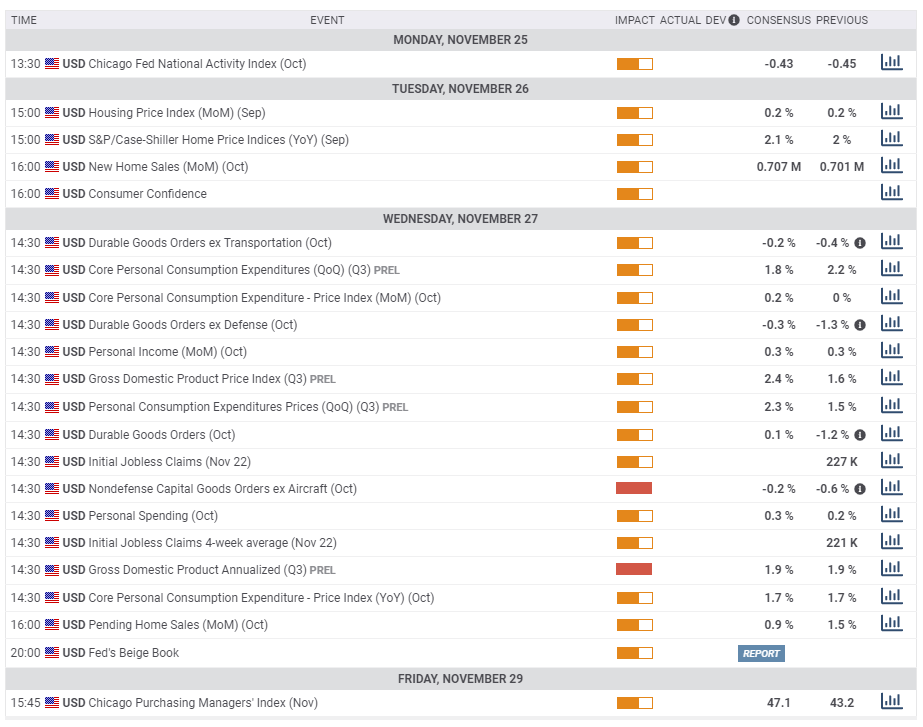
The US calendar kicks off in earnest on Tuesday, with three housing figures and the Conference Board's Consumer Confidence Index for November. While consumers remain optimistic, the gauge is off the high levels above 130 points. Confidence is correlated with retail sales, and shoppers' mood ahead of Christmas will test the resilience of the economy.
The calendar is packed on Wednesday, with an update on third-quarter Gross Domestic Product (GDP) standing out. The second reading is projected to confirm the 1.9% annualized growth initially published. That growth level would outperform other developed economies but reflects moderate, if not mediocre expansion.
Durable Goods Orders for October provide more up-to-date data for the world's largest economy. Investment has been dragging the economy lower, and investors expect no significant improvement in the first report for the fourth quarter. The nondefense ex-air gauge – the "core of the core" – is set to have the most significant impact on markets.
The Fed's preferred inflation gauge is also released at the same time. Core Personal Consumption Expenditure (Core PCE) carries expectations of remaining below 2% – the bank's target – once again.
Here are the scheduled events in the US:
EUR/USD Technical Analysis
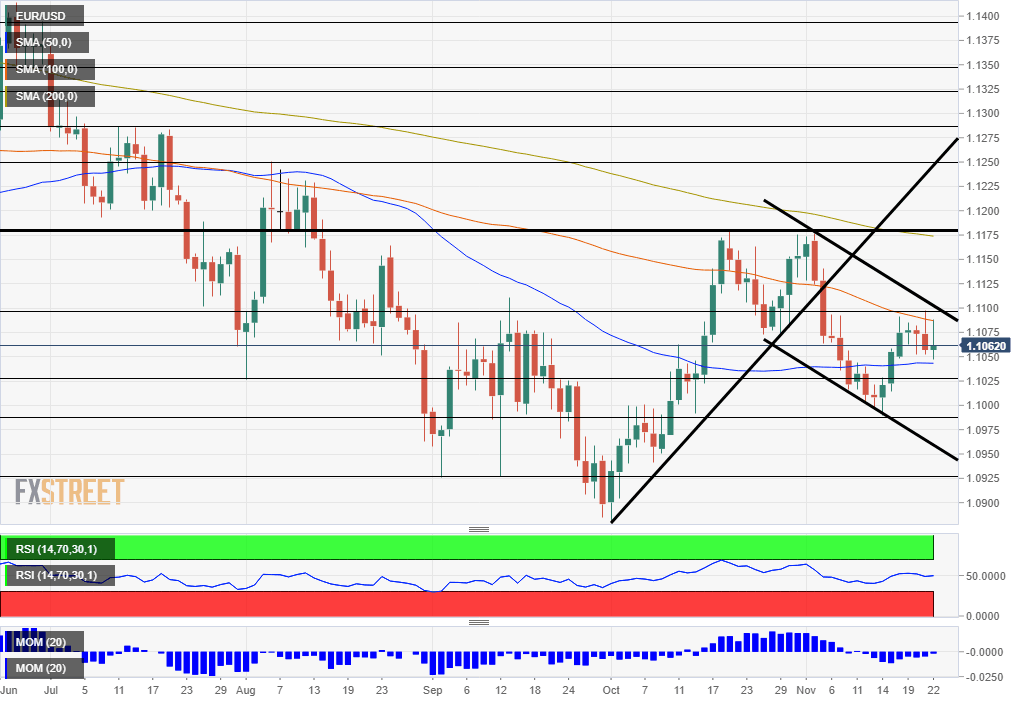
EUR/USD is trading within a downtrend channel on the daily chart, after breaking below uptrend support earlier in the month. These bearish developments are joined by downside momentum. The currency pair has failed in its attempts to recapture the 100-day Simple Moving Average and trades well below the 200-day SMA. However, the 50-day SMA provides a cushion.
Support awaits euro/dollar at 1.1045, which is where the 50-day SMA hits the price. It is closely followed by 1.1025, which was a swing low in the summer. Next, we find November's low of 1.0990, followed by 1.0925, a double-bottom from September. The 2019 low of 1.0879 is the next level to watch.
Resistance awaits at 1.11, the mid-November peak, which nearly converges with the 100-day SMA. It is followed by robust resistance at 1.1180 – a double-top that also is also the confluence with the 200-day SMA. 1.1250, 1.1290, and 1.1325 tower above.
EUR/USD Sentiment
Markets have yet to price in America's outperforming of Europe fully. Moreover, the US and China may wait until closer to December 15 to clinch an accord. Overall, there is more room to the downside than to the upside.
The FXStreet Poll is showing that forecasters are undecided about the short term but see moderate falls afterward. Targets are little changed in comparison to the previous week. While some experts predict wild swings, most have come to accept the low-volatility environment.

Related Forecasts
- USD/JPY Forecast: Tricky tests after Trump's one-two punch
- GBP/USD Forecast: Corbyn comeback or Boris bull-run? Opinion polls to move markets
Author
Yohay Elam
FXStreet
Yohay is in Forex since 2008 when he founded Forex Crunch, a blog crafted in his free time that turned into a fully-fledged currency website later sold to Finixio.

















