EUR/USD Forecast: Euro needs to stabilize above 1.0900 to reach new multi-month tops
- EUR/USD has gone into a consolidation phase near 1.0900.
- The near-term technical outlook suggests that the pair's bullish bias stays intact.
- ECB commentary could continue to influence the Euro's performance.


EUR/USD has gone into a consolidation phase at around 1.0900 early Tuesday after having failed to preserve its bullish momentum on Monday. The pair's technical outlook shows that the buyers retain control in the short term but the Euro needs to stabilize above 1.0900 to extend its uptrend.
Mixed comments from European Central Bank (ECB) officials didn't allow EUR/USD to stretch higher in the second half of the day on Monday despite the risk-positive market atmosphere.
ECB policymaker Peter Kazimir reiterated that they need to deliver two more 50 basis points rate hikes and ECB President Christine Lagarde noted that rates will have to "rise significantly" and stay at restrictive levels for as long as necessary. On the other hand, Governing Council member Yannis Stournaras argued that the adjustment of interest rates needs to be more gradual given the slowdown in the Eurozone economy.
The data from Germany revealed that the business activity in the private sector continued to contract in early January with S&P Global Composite PMI coming in at 49.7, up from 49 in December. Furthermore, the S&P Global Manufacturing PMI for the Eurozone edged higher to 48.8 while the Services PMI improved to 50.7. These numbers, however, had little to no immediate impact on the Euro's valuation.
In the second half of the day S&P Global PMI surveys for the US will be looked upon for fresh impetus. Comments regarding the input price pressures in the service sector could trigger a market reaction since the US Federal Reserve is focused on that aspect of inflation. Both the headline Manufacturing and Services PMIs are forecast to recover modestly from December levels. In case PMIs surpass market expectations by a wide margin, the US Dollar could gather strength against its rivals.
Meanwhile, market participants will keep a close eye on ECB commentary ahead of the 'quiet period' that starts on Thursday. If more policymakers voice their support for a more gradual approach to policy tightening, the Euro could find it difficult to attract additional buyers in the near term.
EUR/USD Technical Analysis
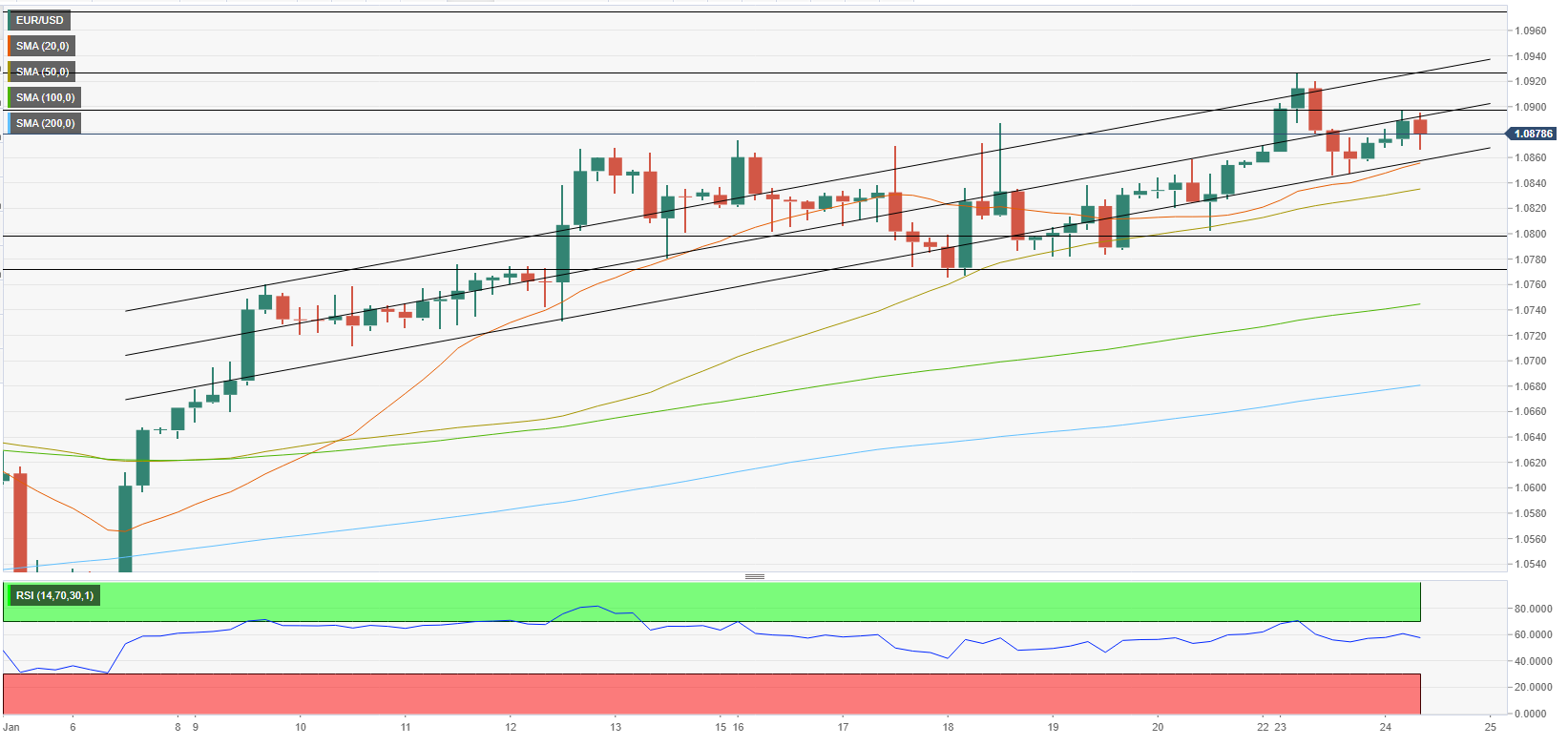
Despite the latest pullback, EUR/USD continues to trade within the ascending regression channel coming from early January. Additionally, the Relative Strength Index (RSI) indicator on the four-hour chart holds above 50. Both of these technical developments suggest that the pair's current action could be considered as a technical correction.
On the downside, 1.0850 (lower limit of the ascending channel, 20-period Simple Moving Average (SMA)) aligns as immediate support. If EUR/USD falls below that level and starts using it as resistance, sellers could show interest and trigger an extended slide toward 1.0830 (50-period SMA) and 1.0800 (psychological level).
In order to gather bullish momentum, EUR/USD needs to rise above 1.0900 (psychological level, mid-point of the ascending channel) and stabilize there. In that scenario, additional gains toward 1.0930 (upper-limit of the ascending channel) and 1.0980 (former support, static level) could be witnessed.
Premium
You have reached your limit of 3 free articles for this month.
Start your subscription and get access to all our original articles.
Author
Eren Sengezer
FXStreet
As an economist at heart, Eren Sengezer specializes in the assessment of the short-term and long-term impacts of macroeconomic data, central bank policies and political developments on financial assets.