EUR/USD Forecast: Euro looks fragile ahead of ECB policy announcements
- EUR/USD consolidates weekly losses above 1.1000 on Thursday.
- European Central Bank (ECB) is widely expected to lower key rates by 25 bps.
- The US economic calendar will feature weekly Jobless Claims and August producer inflation data.


EUR/USD failed to preserve its recovery momentum on Wednesday and closed the day marginally lower. The pair stays in a consolidation phase above 1.1000 as markets await the European Central Bank's (ECB) policy announcements and the US data releases.
Euro PRICE This week
The table below shows the percentage change of Euro (EUR) against listed major currencies this week. Euro was the weakest against the Australian Dollar.
| USD | EUR | GBP | JPY | CAD | AUD | NZD | CHF | |
|---|---|---|---|---|---|---|---|---|
| USD | 0.63% | 0.61% | 0.23% | 0.05% | -0.08% | 0.65% | 1.19% | |
| EUR | -0.63% | -0.07% | -0.36% | -0.57% | -0.76% | 0.04% | 0.54% | |
| GBP | -0.61% | 0.07% | -1.44% | -0.51% | -0.69% | 0.09% | 0.60% | |
| JPY | -0.23% | 0.36% | 1.44% | -0.19% | -0.29% | 0.42% | 1.14% | |
| CAD | -0.05% | 0.57% | 0.51% | 0.19% | -0.08% | 0.59% | 1.30% | |
| AUD | 0.08% | 0.76% | 0.69% | 0.29% | 0.08% | 0.78% | 1.27% | |
| NZD | -0.65% | -0.04% | -0.09% | -0.42% | -0.59% | -0.78% | 0.52% | |
| CHF | -1.19% | -0.54% | -0.60% | -1.14% | -1.30% | -1.27% | -0.52% |
The heat map shows percentage changes of major currencies against each other. The base currency is picked from the left column, while the quote currency is picked from the top row. For example, if you pick the Euro from the left column and move along the horizontal line to the US Dollar, the percentage change displayed in the box will represent EUR (base)/USD (quote).
The mixed inflation report from the US helped the US Dollar (USD) stay resilient against its rivals in the American session on Wednesday and didn't allow EUR/USD to hold its ground. Annual inflation, as measured by the change in the Consumer Price Index (CPI), softened to 2.5% in August from 2.9% in July. However, the core CPI, which excludes volatile food and energy prices, rose 0.3% on a monthly basis, surpassing the market expectation for an increase of 0.2%.
The ECB is expected to lower key rates by 25 basis points following the September policy meeting. Since this decision is widely anticipated, markets could react to ECB President Christine Lagarde's comments on the policy outlook.
Lagarde is unlikely to confirm or deny further policy easing later this year. In case she adopts an optimistic tone about inflation developments, while voicing concerns about the uncertainty surrounding the growth outlook, markets could see this as a hint of additional rate cuts in the near future. In this scenario, the Euro could come under renewed selling pressure. If Lagarde notes that they need to see more progress in disinflation before opting for another rate reduction, the immediate reaction could help the Euro find demand.
The US economic calendar will feature weekly Initial Jobless Claims and the Producer Price Index data for August. Following the CPI release, the probability of a 50 basis points Federal Reserve (Fed) rate cut in September declined to 13%, according to the CME FedWatch Tool. These data are unlikely to alter the market pricing of the Fed rate outlook in a significant way. Hence, the impact on the USD's valuation could remain short-lived.
EUR/USD Technical Analysis
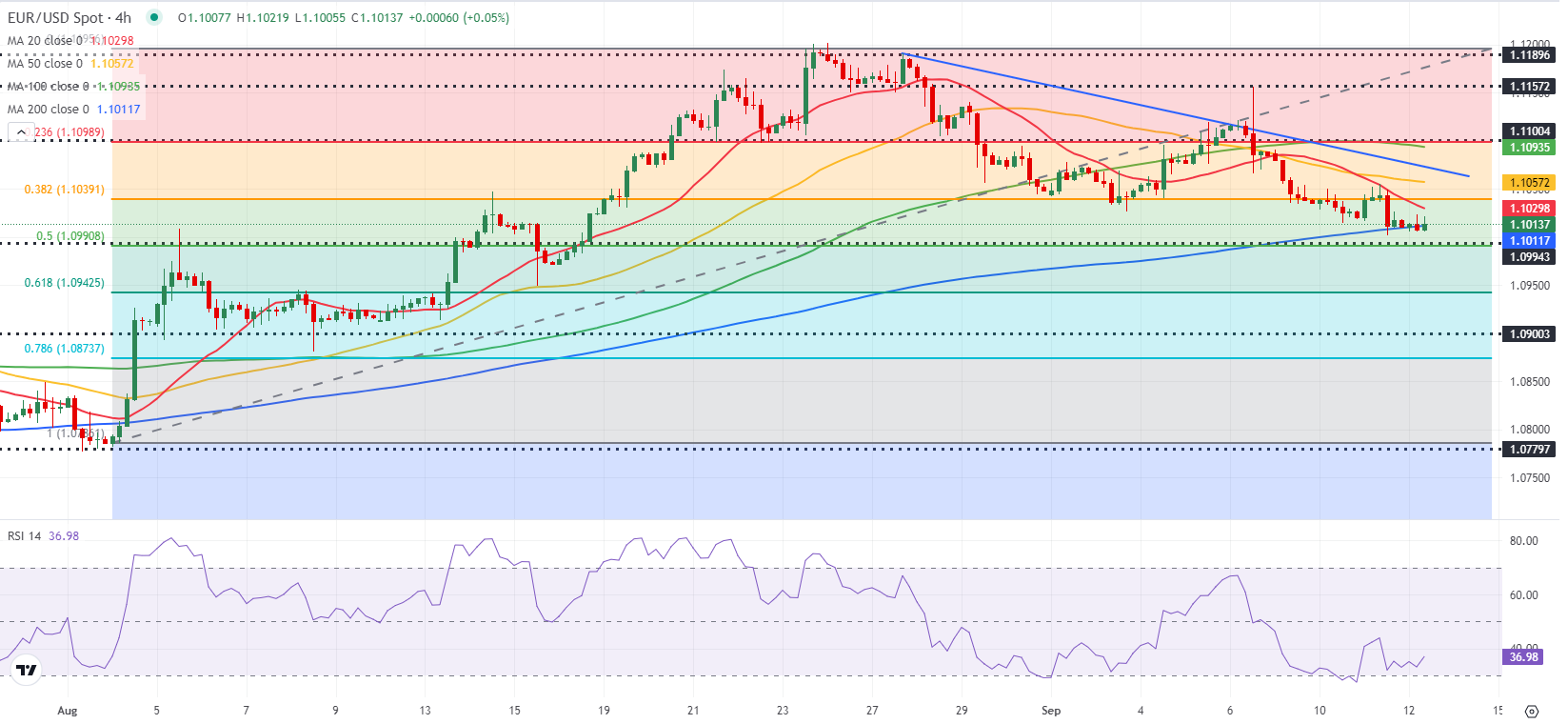
EUR/USD remains bearish in the near term, with the Relative Strength Index (RSI) indicator on the 4-hour chart staying well below 50. The pair could face immediate support at 1.1010-1.1000 (200-period Simple Moving Average (SMA), Fibonacci 50% retracement of the latest uptrend) before 1.0940 (Fibonacci 61.8% retracement) and 1.0900 (psychological level, static level).
On the upside, immediate resistance is located at 1.1040 (Fibonacci 38.2% retracement) ahead of 1.1060 (50-period SMA) and 1.1100 (Fibonacci 23.6% retracement, 100-period SMA).
ECB FAQs
The European Central Bank (ECB) in Frankfurt, Germany, is the reserve bank for the Eurozone. The ECB sets interest rates and manages monetary policy for the region. The ECB primary mandate is to maintain price stability, which means keeping inflation at around 2%. Its primary tool for achieving this is by raising or lowering interest rates. Relatively high interest rates will usually result in a stronger Euro and vice versa. The ECB Governing Council makes monetary policy decisions at meetings held eight times a year. Decisions are made by heads of the Eurozone national banks and six permanent members, including the President of the ECB, Christine Lagarde.
In extreme situations, the European Central Bank can enact a policy tool called Quantitative Easing. QE is the process by which the ECB prints Euros and uses them to buy assets – usually government or corporate bonds – from banks and other financial institutions. QE usually results in a weaker Euro. QE is a last resort when simply lowering interest rates is unlikely to achieve the objective of price stability. The ECB used it during the Great Financial Crisis in 2009-11, in 2015 when inflation remained stubbornly low, as well as during the covid pandemic.
Quantitative tightening (QT) is the reverse of QE. It is undertaken after QE when an economic recovery is underway and inflation starts rising. Whilst in QE the European Central Bank (ECB) purchases government and corporate bonds from financial institutions to provide them with liquidity, in QT the ECB stops buying more bonds, and stops reinvesting the principal maturing on the bonds it already holds. It is usually positive (or bullish) for the Euro.
Premium
You have reached your limit of 3 free articles for this month.
Start your subscription and get access to all our original articles.
Author
Eren Sengezer
FXStreet
As an economist at heart, Eren Sengezer specializes in the assessment of the short-term and long-term impacts of macroeconomic data, central bank policies and political developments on financial assets.