EUR/USD Forecast: Euro faces key support at 1.0850
- EUR/USD has lost its traction and retreated below 1.0900.
- The near-term technical outlook points to a bearish tilt.
- A hot US PCE inflation reading could cause the pair to stretch lower.


EUR/USD has continued to edge lower early Friday after having snapped a six-day winning streak on Thursday. The pair manages to hold above the key support that seems to have formed at 1.0850 but the near-term technical outlook reveals a lack of buyer interest.
On Thursday, the data published by the US Bureau of Economic Analysis (BEA) showed that the real Gross Domestic Product expanded at an annual rate of 2.9% in the fourth-quarter. This reading surpassed the market expectation of 2.6% and helped US Treasury bond yields edge higher. In turn, the US Dollar stayed resilient against its rivals in the second half of the day and forced EUR/USD to stay on the back foot.
The negative shift witnessed in risk sentiment makes it difficult for the pair to stage a rebound early Friday. At the time of press, US stock index futures were down between 0.2% and 0.7%. Nevertheless, the US Dollar Index is having difficulty gathering bullish momentum and allowing EUR/USD to limit its losses for the time being.
In the second half of the day, the BEA will release the Personal Consumption Expenditures (PCE) Price Index data, the Federal Reserve's (Fed) preferred gauge of inflation. On a monthly basis, core PCE inflation is forecast to rise by 0.3% in December. Unless core PCE inflation prints a negative or near-0% reading, the negative impact of a soft inflation figures on the US Dollar should remain short-lived. Markets have already fully priced in two more 25 basis points Fed rate hikes in February and March and the lagging PCE inflation data is unlikely to change that.
On the other hand, a stronger-than-expected reading could help the US Dollar gather strength against its major rivals ahead of the weekend and open the door to an extended slide in EUR/USD. Again, this data by itself shouldn't influence the Fed's rate outlook in a significant way but investors could refrain from betting against the US Dollar ahead of the weekend.
EUR/USD Technical Analysis
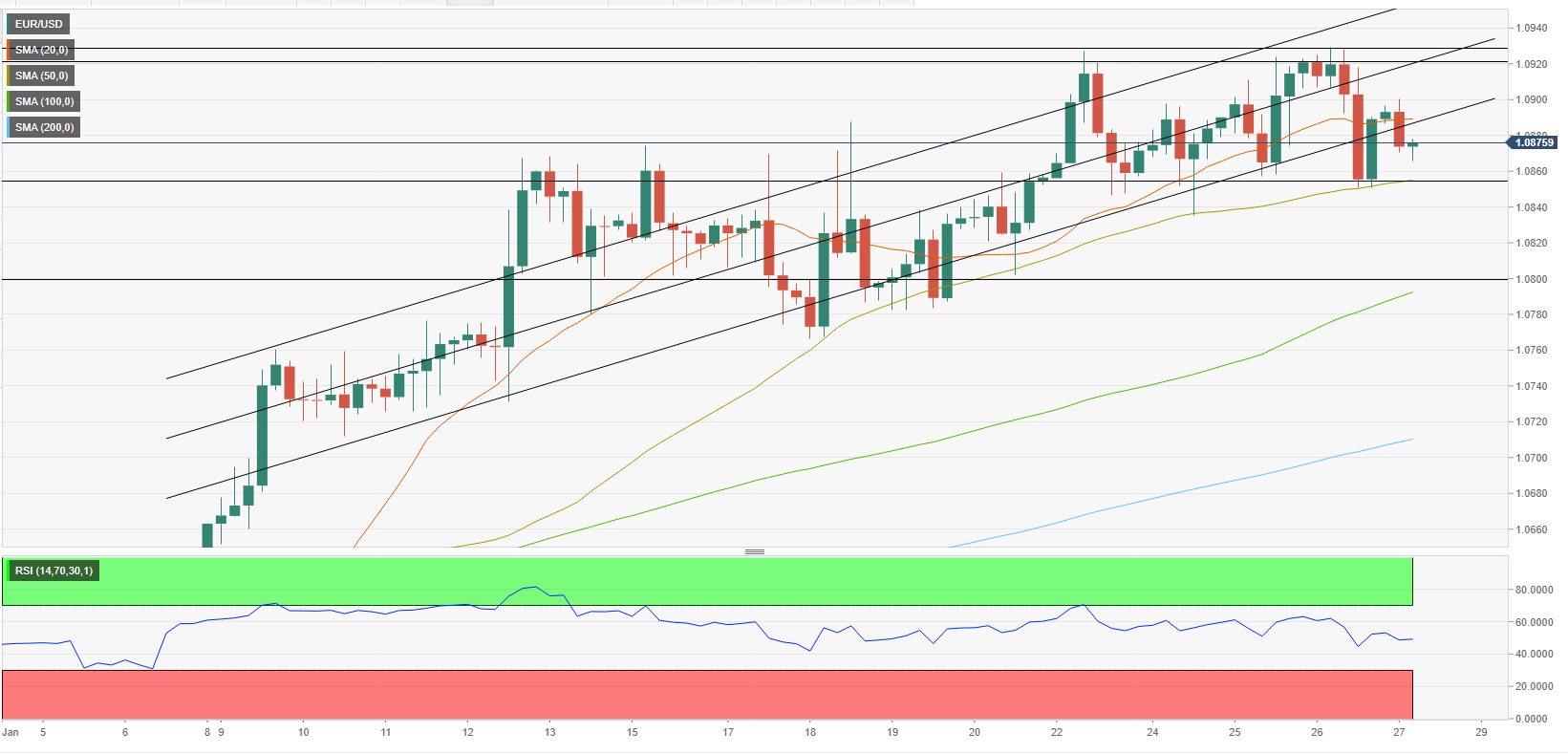
EUR/USD broke below the ascending regression channel late Thursday. Although the pair returned within that channel during the Asian trading hours, it lost its recovery momentum and closed the last four-hour candle below the lower-limit. Furthermore, the pair now trades below the 20-period Simple Moving Average (SMA) and the Relative Strength Index (RSI) indicator stays slightly below 50, suggesting that buyers remain on the sidelines.
On the downside, 1.0850 (static level, 50-period SMA) aligns as key support level. In case EUR/USD falls below that level and starts using it as resistance, it could continue to push lower toward the 1.0800/1.0790 area (psychological level, static level, 100-period SMA).
If EUR/USD rises above 1.0900 (20-period SMA, lower limit of the channel) and stabilizes there, it could extend its rebound toward 1.0930 (mid-point of the ascending channel, static level) and 1.0980 (former support, static level).
Premium
You have reached your limit of 3 free articles for this month.
Start your subscription and get access to all our original articles.
Author
Eren Sengezer
FXStreet
As an economist at heart, Eren Sengezer specializes in the assessment of the short-term and long-term impacts of macroeconomic data, central bank policies and political developments on financial assets.