EUR/USD Forecast: Euro bears return following Friday's meager recovery
- EUR/USD has turned south at the start of the week.
- Safe-haven flows dominate the financial markets on Monday.
- US Dollar Index regains traction following Friday's choppy action.


EUR/USD has failed to build on Friday's modest recovery gains early Monday and started to push lower toward 1.0100. In the absence of high-tier macroeconomic data releases, the market mood is likely to impact the pair's action.
Renewed concerns over China reinstating coronavirus-related lockdowns weigh on market mood at the beginning of the week. Additionally, Nord Stream 1 gas pipeline shut down for a scheduled 10-day maintenance. Although this is an annual occurrence, investors are worried that Russia could see this as an opportunity to further trim its energy exports to Europe by delaying the reopening.
Reflecting the risk-averse atmosphere, the Euro Stoxx 600 Index is down nearly 1% and US stock index futures are losing between 0.6% and 0.9%. Meanwhile, the US Dollar Index is up 0.65% at 107.60, reflecting the positive impact of risk aversion on the greenback's valuation.
On the other hand, the CME Group FedWatch Tool shows that markets are pricing in nearly a 30% probability, up from 13% a week ago, of the Fed hiking its policy rate by 75 basis points (bps) again in September after a 75 bps hike in July. The stronger-than-expected Nonfarm Payroll (NFP) data seems to be causing investors to reassess the Fed's rate outlook.
The recession next time, US employers hang tough with jobs.
EUR/USD Technical Analysis
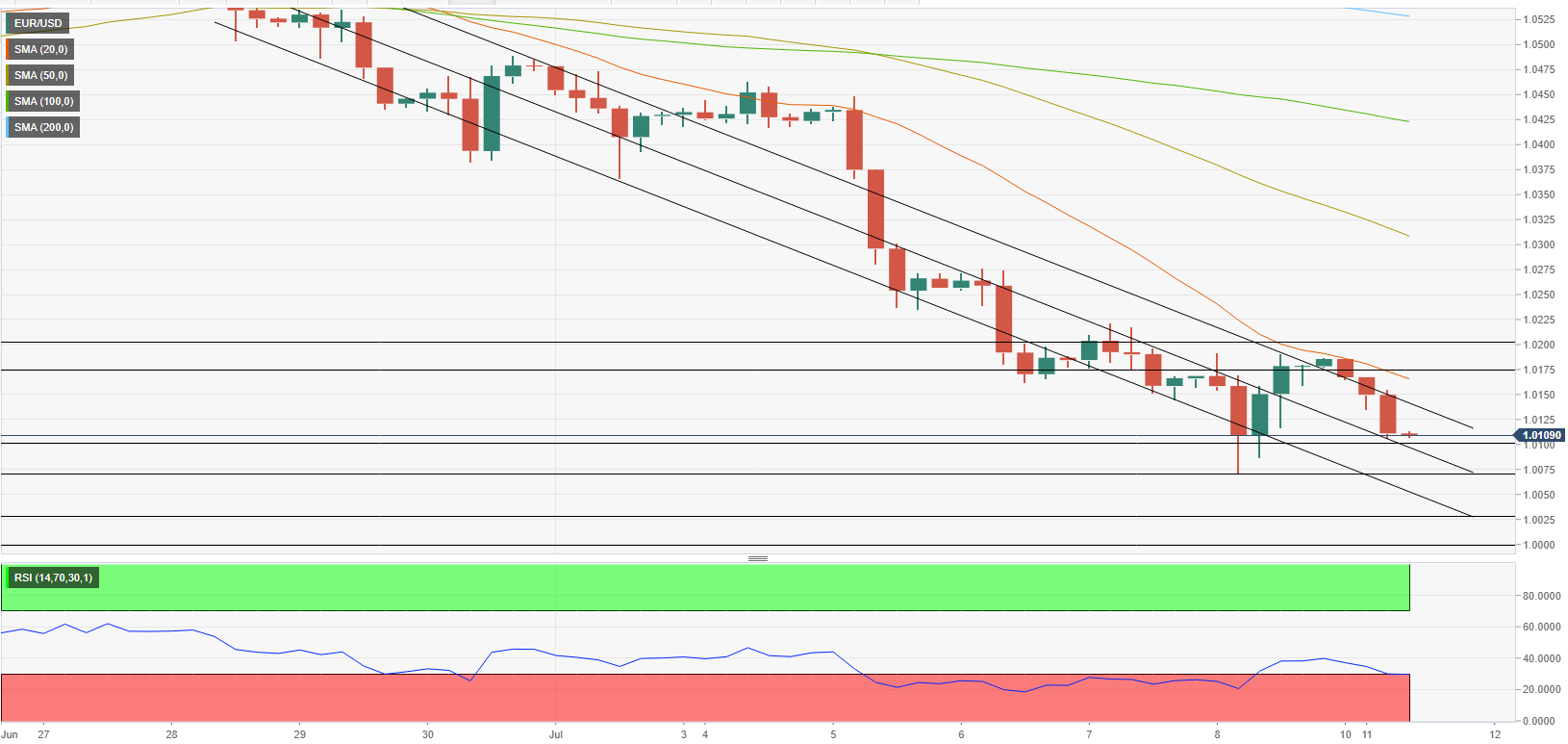
Following Friday's rebound, EUR/USD has returned with its descending regression channel coming from late June, suggesting that the bearish bias stays intact. In the meantime, the Relative Strength Index (RSI) indicator on the four-hour chart stays near 30, showing that buyers remain on the sidelines.
On the downside, 1.0100 (psychological level) aligns as interim support ahead of 1.0070 (static level) and 1.0000. Resistances are located at 1.0150 (upper limit of the descending regression channel), 1.0175 (20-period SMA) and 1.0200 (static level, psychological level).
Premium
You have reached your limit of 3 free articles for this month.
Start your subscription and get access to all our original articles.
Author
Eren Sengezer
FXStreet
As an economist at heart, Eren Sengezer specializes in the assessment of the short-term and long-term impacts of macroeconomic data, central bank policies and political developments on financial assets.

















