EUR/USD faces downward pressure as markets reassess rate cut expectations


As of Monday, EUR/USD remains under selling pressure, with investors closely watching U.S. labor market data and its potential impact on Federal Reserve rate decisions. Although Friday’s labor report highlighted a cooling job market, there is no indication of a significant deterioration that would justify a 50-basis-point rate cut. The Fed appears poised to initiate a rate cut cycle with a 25-basis-point cut in September, followed by two additional cuts of the same magnitude by the end of 2024, for a total cut of 75 basis points.
The U.S. dollar's recent decline can be attributed to more aggressive market expectations, with some pricing in a 113-basis-point cut by Christmas and an additional 132 basis points by the end of 2025. However, the upcoming U.S. Consumer Price Index (CPI) data for August, set for release on Wednesday, will be critical. The market expects headline inflation to decrease from 2.9% to 2.6%, which could provide more clarity on the trajectory of rate cuts.
In the Eurozone, markets have fully priced in a 25-basis-point rate cut by the European Central Bank (ECB) on Thursday. However, uncertainty lingers about whether additional cuts will follow in October and December. Strong wage growth and service sector inflation continue to fuel the hawks, while slowing growth indicators give doves reason to speculate on further rate cuts. Given the mixed economic backdrop, a gradual three-quarter-point cut in rates seems the more likely scenario.
Technical analysis
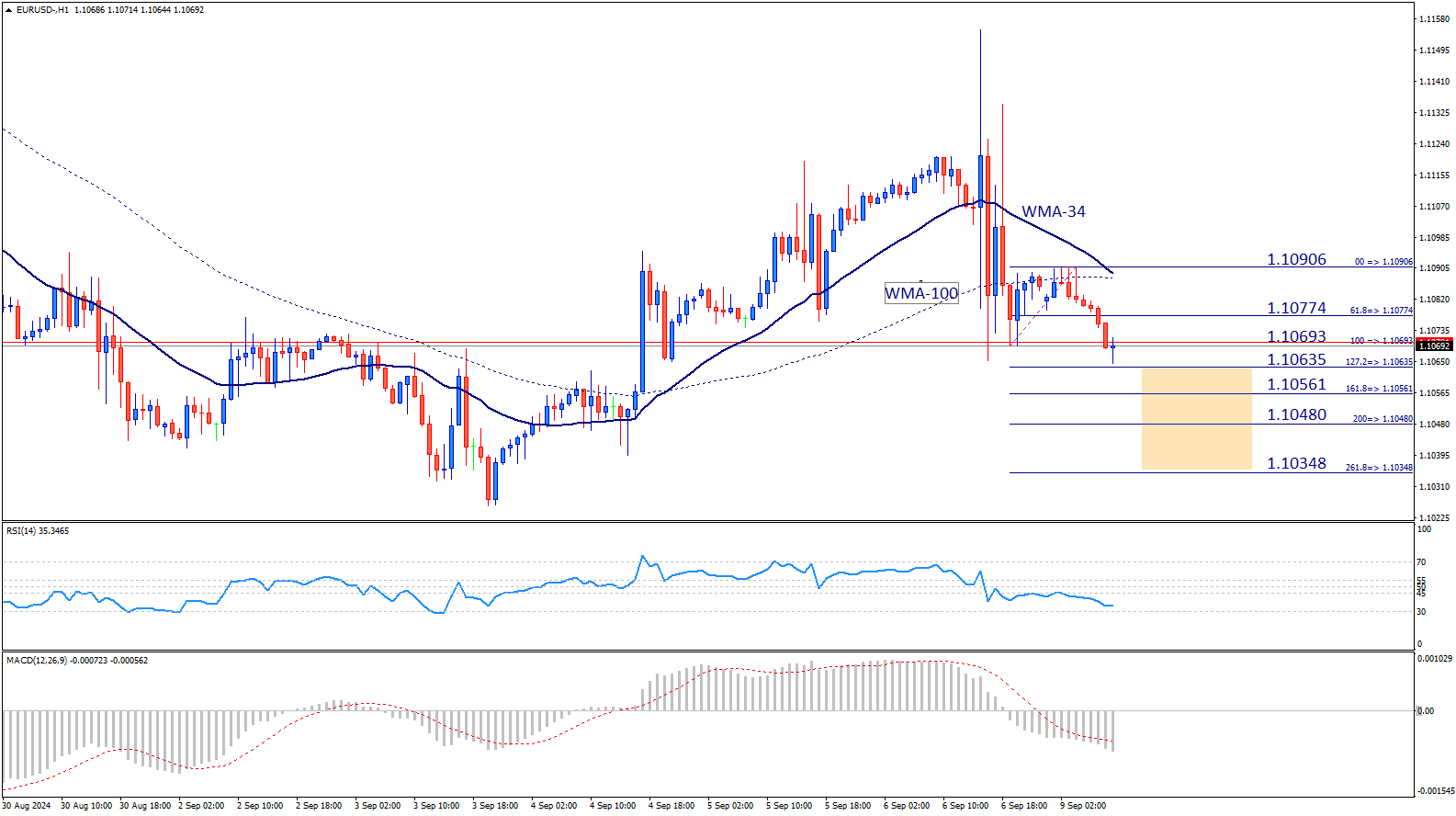
On the hourly chart, EUR/USD is facing a test of key support at 1.10693, following a pullback from the 100-period moving average. Sellers are attempting to push the pair below this level, which, if broken, could signal further downside. The next immediate support lies at 1.10635. If the bears maintain control, additional targets at 1.10561, 1.10480, and 1.10348 come into play.
Oscillator confirmations
RSI (Relative Strength Index): Currently in a bearish zone, indicating increased selling momentum.
MACD (Moving Average Convergence Divergence): Bearish, with the MACD line below the signal line, reinforcing the negative sentiment.
Moving Averages: Mixed signals from moving averages, with the short-term trend showing bearish pressure, while the longer-term trend remains neutral.
Alternative scenario
If buyers regain control and push the price above the immediate resistance at 1.10774, EUR/USD could aim for the next resistance at 1.10906. A confirmed break above this level would invalidate the bearish outlook and signal the resumption of an upward trend.
Key levels
-
Resistance levels:
-
Resistance 2: 1.10906.
-
Resistance 1: 1.10774.
-
-
Current price: 1.10692.
-
Support levels:
-
Support 1: 1.10635.
-
Support 2: 1.10561.
-
Support 3: 1.10480.
-
Support 4: 1.10348.
-
Key events to watch
Monday’s data calendar includes the Sentix Investor Confidence index for the Eurozone, which will give further insights into investor sentiment. In the U.S., wholesale inventories and consumer credit data, along with the New York Federal Reserve’s Consumer Expectations Survey, will provide additional guidance. Investors will also be closely watching Apple’s unveiling of the iPhone 16 and other products, as corporate announcements could add another layer of market volatility.
Conclusion
EUR/USD remains under pressure as markets reassess their expectations for rate cuts from both the Federal Reserve and the European Central Bank. The pair is trading near key support levels, with a bearish outlook unless buyers can break above the resistance at 1.10906. Upcoming economic data, particularly the U.S. CPI and ECB rate decision, will be crucial in determining the next move for this currency pair. Traders should stay alert to potential volatility as markets react to these key events.
Author
Ali Mortazavi
Errante
BEc, CMSA, Member of IFTA - International Federation of Technical Analysis, Associate Member of STA - Society of Technical Analysis (UK).