Elliott Wave analysis on Gold: Intraday retracement within bull run


Gold has seen a bullish trend over the past few months, and we are currently witnessing strong and accelerating price action, driving the metal to new all-time highs. The drivers behind this surge are geopolitical tensions and its role as an inflation hedge. Interestingly, this ascent is occurring despite a strong US Dollar Index, which usually moves inversely to gold.
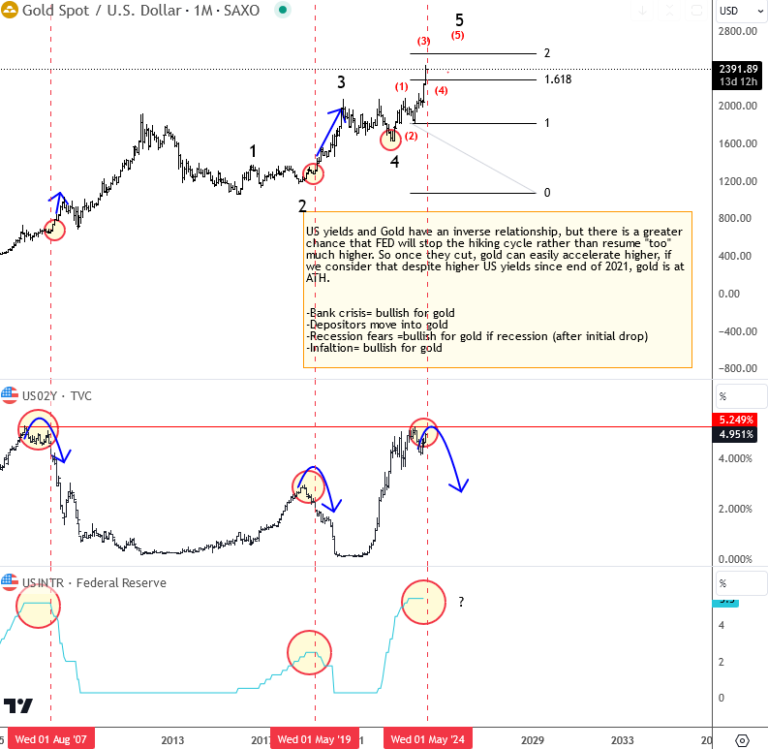
Moreover, gold is rallying amid rising US yields. However, the most intriguing aspect is the potential impact of speculated rate cuts by the Fed later this year. A dovish cycle for interest rates could further propel the current upward trajectory we’re experiencing with gold. Reflecting on historical patterns, gold began its ascent in 2008 as Fed rates decreased, with a similar trend observed from 2019 to 2020 following the Fed’s dovish pivot after hikes between 2016 to 2018.
Now, there’s a possibility that the Fed will maintain current rates for a few more months, but should we see a rate decrease, gold could soar even higher, potentially into the fifth wave, as visible on the monthly chart.
Keeping this broader perspective in mind is crucial for any potential trades on smaller timeframes.
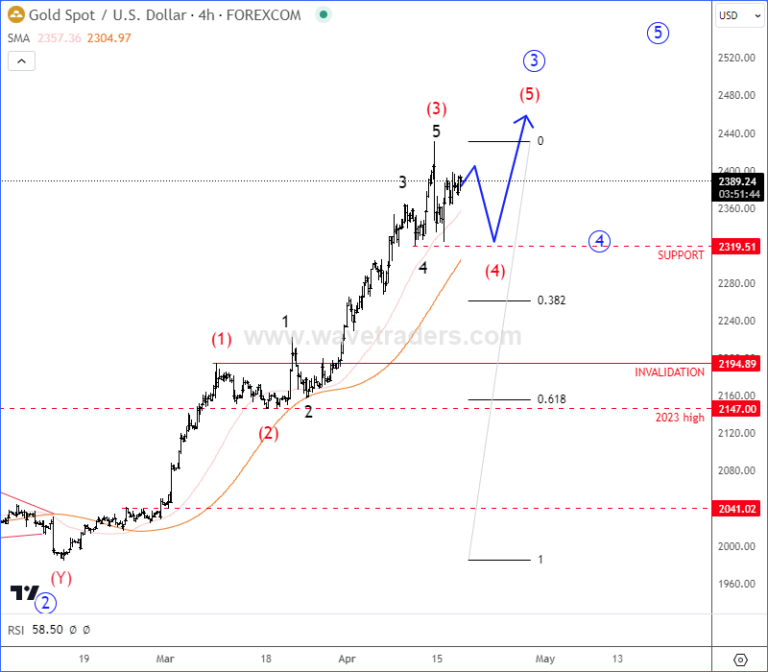
Narrowing down to the 4-hour timeframe, we’re seeing an impulsive recovery with significant moves from $2,146 to recent highs, which could be part of a larger impulsive degree. After the next dip, we anticipate further gains. The current consolidation, which is wave four, shows substantial support around $2,300, where we believe gold could find stability if it reaches that level. The short-term invalidation level for this intraday bull run is at $2,194—should gold drop below this, we may be headed for a more profound correction rather than just an intraday one.
Get Full Access To Our Premium Elliott Wave Analysis For 14 Days. Click here.
Get Full Access To Our Premium Elliott Wave Analysis For 14 Days. Click here.
Author
Gregor Horvat
Wavetraders
Experience Grega is based in Slovenia and has been in the Forex market since 2003.