|

Don't blame production slump on hurricanes

Summary

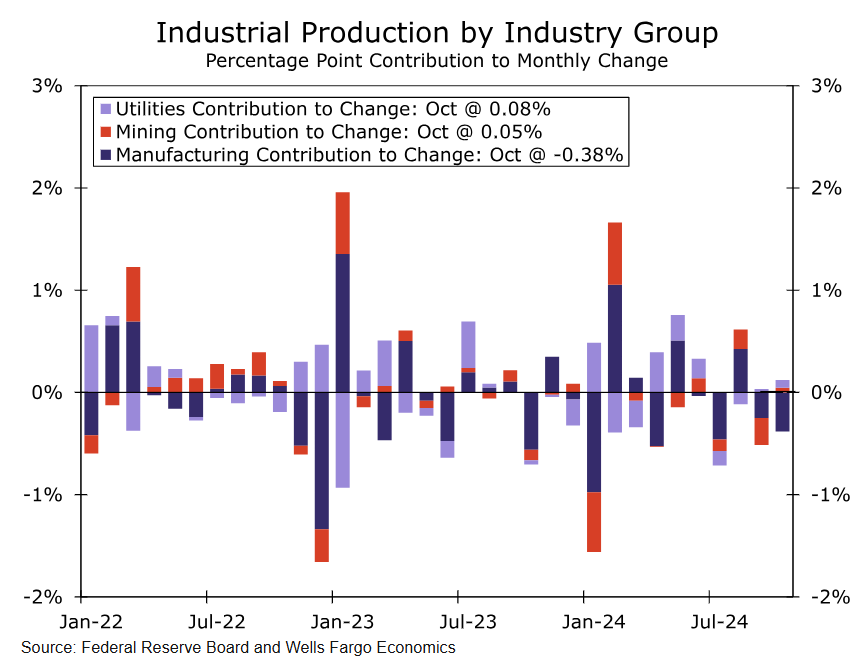
The outlook wasn't brilliant for industrial production that day. The consensus expectation was for a decline of 0.4% in October. The actual reported decline was "just" 0.3%, although downward revisions to prior data nullified any sense of relief from that.

No joy in muddville

October came with a strike at Boeing and hurricanes that disrupted activity, but the fact of the matter is the slump in industrial production is bigger than these one-off factors and output is not yet seeing relief from lower interest rates. In fact, a supplemental note in today's release clocked the drag from hurricanes as a drag of just 0.1 percent.

It is an unfortunate commentary on the state of affairs that the best that can be said about October industrial production is that the decline of 0.3% is a bit less than the 0.4% drop that was the glum consensus expectation (chart). Yet even this modest consolation turns out to be a hollow one after noting that last month's 0.3% decline was revised lower to report an even bigger drop in September output of 0.5%.
Chart

The Federal Reserve's base year for industrial production is 2017 and output set such that 2017=100 for the index. The October reading is 102.3. In the years since 2017, total industrial production has grown less than 3%.

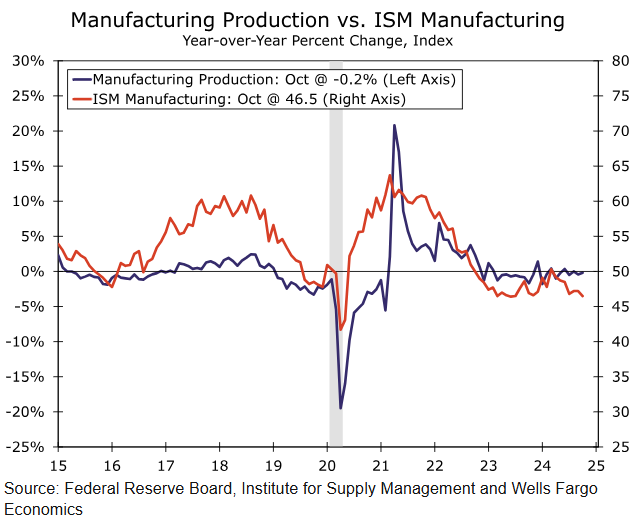
For manufacturing production, the backdrop is worse (chart). The October reading there is 98.5, meaning output is actually down since 2017. The weakness here transcends politics; at its zenith during the past 15 years, manufacturing output never exceeded a reading of 102. Manufacturing production fell again in October just as it has in three out of the past four months.
Chart

Utilities and mining production, which together comprise about a quarter of overall production both eked out modest gains in October.

Download The Full Economic Indicator

Author

More from Wells Fargo Research Team
Share:

Markets move fast. We move first.

Orange Juice Newsletter brings you expert driven insights - not headlines. Every day on your inbox.

By subscribing you agree to our Terms and conditions.

Editor's Picks

EUR/USD struggles for direction amid USD gains

EUR/USD is trimming part of its earlier gains, coming under some mild downside pressure near 1.1730 as the US Dollar edges higher. Markets are still digesting the Fed’s latest rate decision, while also looking ahead to more commentary from Fed officials in the sessions ahead.

GBP/USD drops to daily lows near 1.3360

Disappointing UK data weighed on the Sterling towards the end of the week, triggering a pullback in GBP/USD to fresh daily lows near 1.3360. Looking ahead, the next key event across the Channel is the BoE meeting on December 18.

Gold poised to challenge record highs

Gold prices added roughly 3% in the week, flirting with the $4,350 mark on Friday, to finally settle at around $4,330. Despite its safe-haven condition, the bright metal rallied in a risk-on scenario, amid broad US Dollar weakness.

Week ahead: US NFP and CPI, BoE, ECB and BoJ mark a busy week

After Fed decision, dollar traders lock gaze on NFP and CPI data. Will the BoE deliver a dovish interest rate cut? ECB expected to reiterate “good place” mantra. Will a BoJ rate hike help the yen recover some of its massive losses?

Big week ends with big doubts

The S&P 500 continued to push higher yesterday as the US 2-year yield wavered around the 3.50% mark following a Federal Reserve (Fed) rate cut earlier this week that was ultimately perceived as not that hawkish after all. The cut is especially boosting the non-tech pockets of the market.

Aave Price Forecast: AAVE primed for breakout as bullish signals strengthen

Aave (AAVE) price is trading above $204 at the time of writing on Friday and approaching the upper boundary of its descending parallel channel; a breakout from this structure would favor the bulls.