|

Contrary to widespread myth, imports do not subtract from GDP

The subject of imports came up twice today in Tweets. Let's take a look at myth and reality.
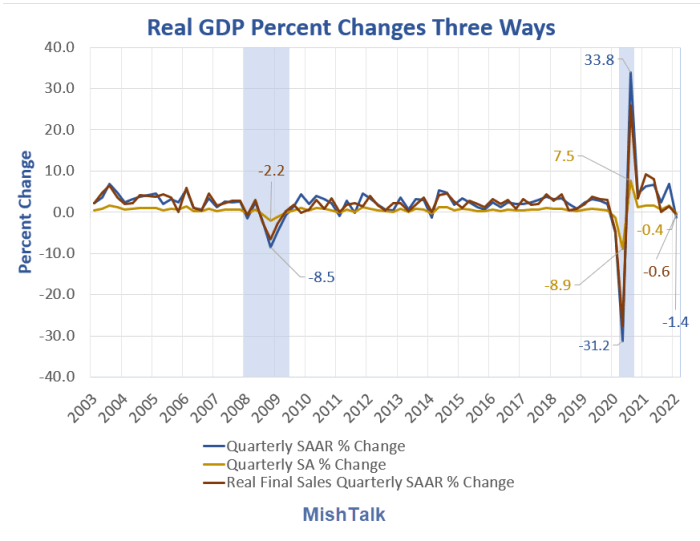
Chart

GDP numbers from BEA, chart by Mish

GDP equation

GDP = private consumption + gross private investment + government investment + government spending + (exports – imports).

That equation causes confusion. It "appears" as if we need to subtract imports, but that's not what's really happening.

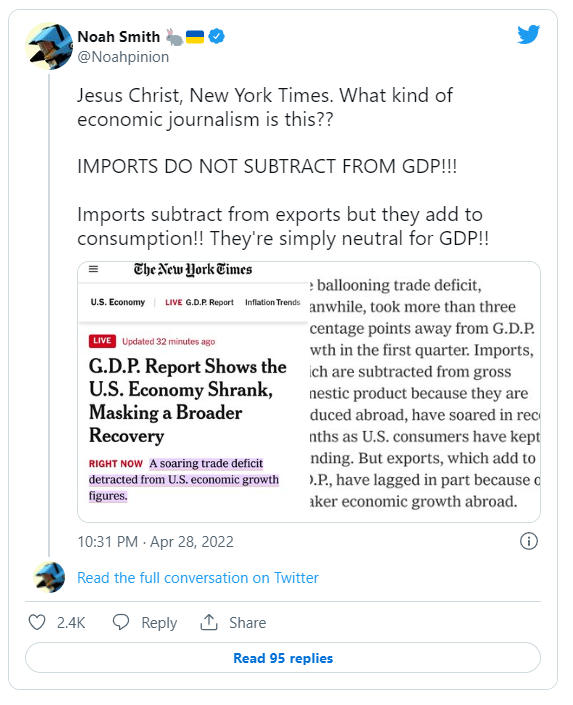
Blasting the New York Times 
fxsoriginal

I was asked if Noah was correct. Yes, he is.

fxsoriginal

Key word is domestic

In my Tweet I said the reason for the subtraction is the word "net".

Instead, I should have emphasized Gross DOMESTIC Product.  

Imports have nothing to do with "domestic". But it's not exactly easy to subtract imports from retail sales. 

So, the formula subtracts what should not have been counted in the first place.

It's not the imports that matter to GDP but exports. But the balance does add to the trade deficit.

Imports are irrelevant to GDP but the US dollar is worth a discussion.

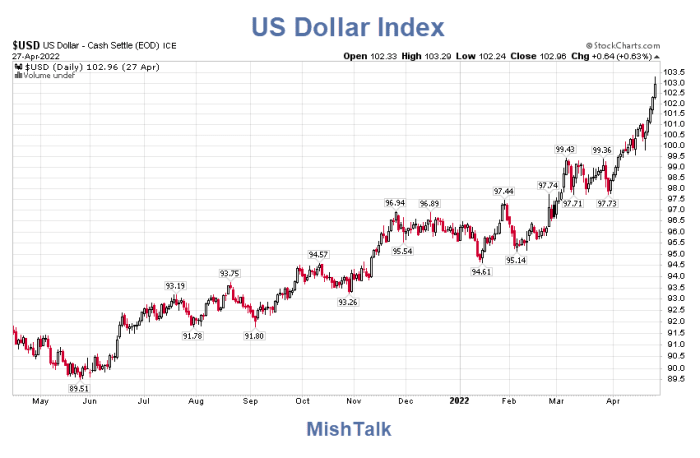
US Dollar Index 
Chart

US dollar chart courtesy of StockCharts.Com

That chart is from yesterday. As I type, the dollar is 103.657 up from 102.96.

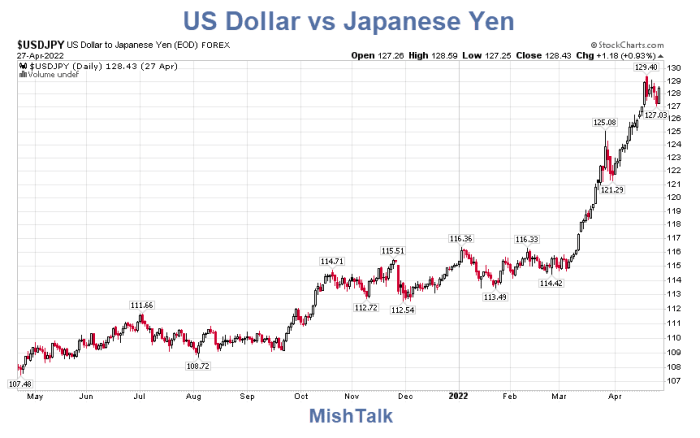
US Dollar vs Japanese Yen
Chart

US dollar/Yen chart courtesy of StockCharts.Com

That chart is from yesterday. As I type, the Yen fell to 130.87. In this currency pair, a rising chart represents a sinking currency.

A year ago it took 109 Yen to buy a dollar. Now it takes 131. That's a 16.8 percent decline in a year.

A strong dollar makes US exports expensive and imports cheap.

I am surprised the Biden administration is not moaning loudly about the plunging Yen and euro causing huge trade deficits.

Investigating a shocking increase in the trade deficit and economists' blown forecasts
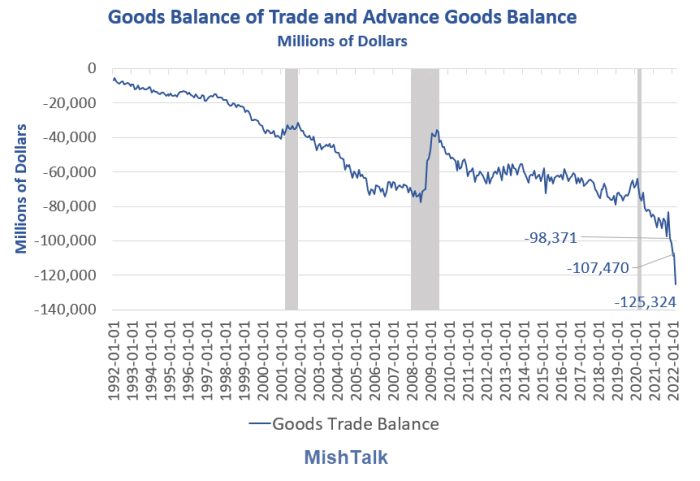
Chart

Balance of Trade data from Census Department, chart by Mish

The US registered its biggest goods trade deficit in history, by far. 

For discussion, please see Investigating a Shocking Increase in the Trade Deficit and Economists' Blown Forecasts

For discussion of the GDP, please see GDP Declines 1.4% in First Quarter of 2022 Sounding Recession Bells

Hopefully this ties all the pieces together. The only thing missing is Biden administration whining about the strong dollar. 

Author

Mike “Mish” Shedlock's

Mike “Mish” Shedlock's

Sitka Pacific Capital Management,Llc

More from Mike “Mish” Shedlock's
Share:

Markets move fast. We move first.

Orange Juice Newsletter brings you expert driven insights - not headlines. Every day on your inbox.

By subscribing you agree to our Terms and conditions.

Editor's Picks

EUR/USD trades with negative bias around 1.1730 amid recovering USD; downside seems limited

The EUR/USD pair kicks off the new week on a softer note, though it remains within striking distance of the highest level since early October, touched last Thursday. Spot prices currently trade around the 1.1730 region, down less than 0.10% for the day.

GBP/USD holds steady above mid-1.3300s as traders await key data and BoE this week

The GBP/USD pair remains on the defensive during the Asian session on Monday, though it lacks bearish conviction and holds above the 200-day Simple Moving Average pivotal support. Spot prices currently trade around the 1.3360 region, nearly unchanged for the day.

Gold edges higher above $4,300 on Fed rate cut bets

Gold price attracts some buyers to around $4,315 during the early Asian trading hours on Monday. The precious metal extends its upside to the highest since October 21 amid the prospect of interest rate cuts by the US Federal Reserve next year. The delayed US Nonfarm Payrolls report for October will be in the spotlight later on Tuesday. 

Week ahead: US NFP and CPI, BoE, ECB and BoJ mark a busy week

After Fed decision, dollar traders lock gaze on NFP and CPI data. Will the BoE deliver a dovish interest rate cut? ECB expected to reiterate “good place” mantra. Will a BoJ rate hike help the yen recover some of its massive losses?

Big week ends with big doubts

The S&P 500 continued to push higher yesterday as the US 2-year yield wavered around the 3.50% mark following a Federal Reserve (Fed) rate cut earlier this week that was ultimately perceived as not that hawkish after all. The cut is especially boosting the non-tech pockets of the market.

Aave Price Forecast: AAVE primed for breakout as bullish signals strengthen

Aave (AAVE) price is trading above $204 at the time of writing on Friday and approaching the upper boundary of its descending parallel channel; a breakout from this structure would favor the bulls.