Technical analysis – Will CHF/JPY quotes continue to decline?

CHF/JPY technical analysis summary
Below 137,4.
Sell Stop.
Above 147.
Stop Loss.
| Indicator | Signal |
| RSI | Neutral |
| MACD | Sell |
| MA(200) | Neutral |
| Fractals | Sell |
| Parabolic SAR | Sell |
| Bollinger Bands | Neutral |
CHF/JPY chart analysis
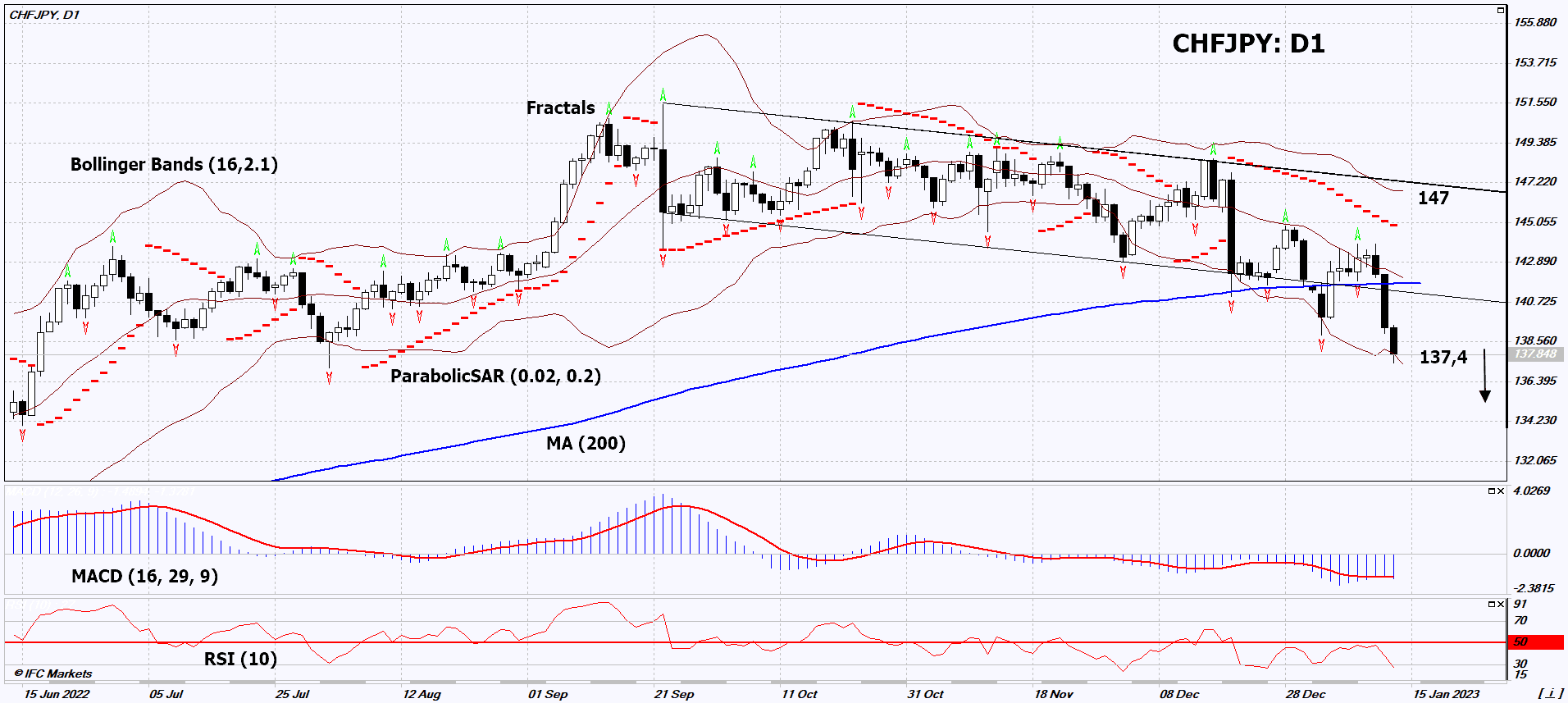
On the daily timeframe, CHFJPY: D1 is in a downtrend and has made a fresh low. A number of technical analysis indicators formed signals for further decline. We do not rule out a bearish movement if CHFJPY: D1 falls below the latest low and lower Bollinger band: 137.4. This level can be used as an entry point. The initial risk limit is possible above the last 2 upper fractals, the upper Bollinger band, the 200-day moving average line and the Parabolic signal: 147. After opening a pending order, we move the stop following the Bollinger and Parabolic signals to the next fractal low. Thus, we change the potential profit/loss ratio in our favor. The most cautious traders, after making a trade, can switch to a four-hour chart and set a stop loss, moving it in the direction of movement. If the price overcomes the stop level (147) without activating the order (137.4), it is recommended to delete the order: there are internal changes in the market that were not taken into account.
Fundamental analysis of forex – CHF/JPY
On January 18, 2023, the meeting of the Bank of Japan (BOJ) will take place. Will CHFJPY quotes continue to decline?
Such dynamics means the strengthening of the yen against the Swiss franc. The Japanese newspaper Yomiuri reported that at the next meeting, the BOJ may discuss the effectiveness of its policy in the government bond market (yield curve control policy (YCC). Its actions are viewed by investors as a tightening of monetary policy and contribute to the strengthening of the yen. Recall that at the end of December 2022, the BOJ expanded its YCC yield range for the first time, pushing the Japan 10-Year Bond yield up from 0.25% to 0.5% pa and appreciably strengthening the yen. It could reach 132 billion Swiss francs ($143 billion). This may have a negative impact on the Swiss franc. It should be noted that on January 19 in Japan the trade balance will be released and on January 20 - inflation. In Switzerland, January 19 will be published producer price index.
Want to get more free analytics? Open Demo Account now to get daily news and analytical materials.
Want to get more free analytics? Open Demo Account now to get daily news and analytical materials.
Author
Dmitry Lukashov
IFC Markets
Dimtry Lukashov is the senior analyst of IFC Markets. He started his professional career in the financial market as a trader interested in stocks and obligations.