CFTC Positioning Report: Japanese Yen net longs remain firm


These are the main highlights of the CFTC Positioning Report for the week ending September 10.
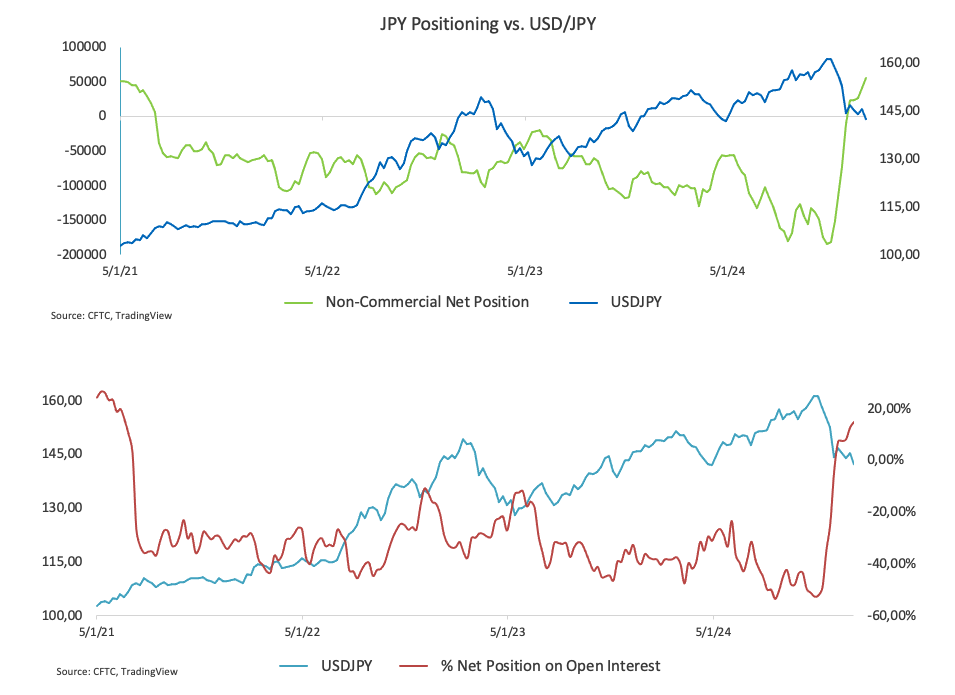
- Speculative net longs in the Japanese Yen climbed to levels last seen in early October 2012, near 56K contracts. Commercial net shorts, in the meantime, rose markedly to around 67K contracts, all amidst an important weekly gain in open interest (+15.4%). Furthermore, the net longs/net shorts ratio also climbed to more than three-year highs around 2.30%. Against that, USD/JPY maintained its downtrend well in place during the period, navigating the vicinity of yearly lows and always bolstered by the steady hawkish narrative from BoJ officials, while speculation of a jumbo rate cut by the Fed also contributed to the better tone around the Japanese currency.
- Non-commercial players markedly trimmed their gross longs in the European currency to send net longs to three-week lows around 81.4K contracts, while Commercial participants also reduced their net shorts to multi-week lows against the backdrop of a marginal increase in open interest. EUR/USD came under pressure soon after hitting monthly peaks around 1.1150, triggering a corrective decline to the boundaries of the psychological 1.1000 neighbourhood.
- Meanwhile, net longs in the US Dollar advanced to nearly 20.1K contracts, an area last visited in November 2023, also amidst a humble raise in open interest. The US Dollar Index (DXY) rebounded from the proximity of YTD lows in the mid-100.00s, regaining upside impulse on the back of rising bets of a 25 bps rate reduction by the Fed at its September event.
- Net longs in the British pound dropped to two-week lows just above 90K contracts on the back of a marked reduction in gross longs, while open interest contracted by nearly 5%. Against that scenario, GBP/USD could not sustain a move to September highs in the 1.3240 zone, sparking a retracement that eventually challenged the key 1.3000 neighbourhood.
- WTI’s speculative net longs retreated for the third consecutive week to levels just above 140K contracts for the first time since late June 2023, all amidst an acceptable uptick in open interest. Prices of the barrel of the American reference WTI accelerated their downtrend and broke below the key $70.00 mark to hit a new 2024 bottom near $65.30, as incessant demand concerns stemming from the Chinese economy weighed heavily on traders’ sentiment.
Japanese Yen FAQs
The Japanese Yen (JPY) is one of the world’s most traded currencies. Its value is broadly determined by the performance of the Japanese economy, but more specifically by the Bank of Japan’s policy, the differential between Japanese and US bond yields, or risk sentiment among traders, among other factors.
One of the Bank of Japan’s mandates is currency control, so its moves are key for the Yen. The BoJ has directly intervened in currency markets sometimes, generally to lower the value of the Yen, although it refrains from doing it often due to political concerns of its main trading partners. The current BoJ ultra-loose monetary policy, based on massive stimulus to the economy, has caused the Yen to depreciate against its main currency peers. This process has exacerbated more recently due to an increasing policy divergence between the Bank of Japan and other main central banks, which have opted to increase interest rates sharply to fight decades-high levels of inflation.
The BoJ’s stance of sticking to ultra-loose monetary policy has led to a widening policy divergence with other central banks, particularly with the US Federal Reserve. This supports a widening of the differential between the 10-year US and Japanese bonds, which favors the US Dollar against the Japanese Yen.
The Japanese Yen is often seen as a safe-haven investment. This means that in times of market stress, investors are more likely to put their money in the Japanese currency due to its supposed reliability and stability. Turbulent times are likely to strengthen the Yen’s value against other currencies seen as more risky to invest in.
Japanese Yen PRICE This month
The table below shows the percentage change of Japanese Yen (JPY) against listed major currencies this month. Japanese Yen was the strongest against the New Zealand Dollar.
| USD | EUR | GBP | JPY | CAD | AUD | NZD | CHF | |
|---|---|---|---|---|---|---|---|---|
| USD | 0.02% | 0.35% | -2.87% | 0.76% | 1.41% | 1.83% | 0.22% | |
| EUR | -0.02% | 0.32% | -2.89% | 0.73% | 1.39% | 1.77% | 0.20% | |
| GBP | -0.35% | -0.32% | -3.20% | 0.40% | 1.07% | 1.29% | -0.12% | |
| JPY | 2.87% | 2.89% | 3.20% | 4.45% | 4.42% | 4.65% | 3.14% | |
| CAD | -0.76% | -0.73% | -0.40% | -4.45% | 0.64% | 0.94% | -0.53% | |
| AUD | -1.41% | -1.39% | -1.07% | -4.42% | -0.64% | 0.22% | -1.19% | |
| NZD | -1.83% | -1.77% | -1.29% | -4.65% | -0.94% | -0.22% | -1.39% | |
| CHF | -0.22% | -0.20% | 0.12% | -3.14% | 0.53% | 1.19% | 1.39% |
The heat map shows percentage changes of major currencies against each other. The base currency is picked from the left column, while the quote currency is picked from the top row. For example, if you pick the Japanese Yen from the left column and move along the horizontal line to the US Dollar, the percentage change displayed in the box will represent JPY (base)/USD (quote).
Premium
You have reached your limit of 3 free articles for this month.
Start your subscription and get access to all our original articles.
Author
Pablo Piovano
FXStreet
Born and bred in Argentina, Pablo has been carrying on with his passion for FX markets and trading since his first college years.