Canadian CPI inflation accelerates in october; BoC still likely to cut rates

Policymakers ‘may’ think twice about reducing the overnight rate by another 50 basis points (bps) next month following inflation accelerating to the upside. I emphasise the word ‘may’ here.
According to the October CPI inflation report (Consumer Price Index) released by Statistics Canada, headline YY (Year on Year) CPI inflation increased to 2.0%. This marked its first acceleration in five months, rising from 1.6% in September (north of economists’ expectations of 1.9%) and immediately sent the Canadian dollar (CAD) northbound.
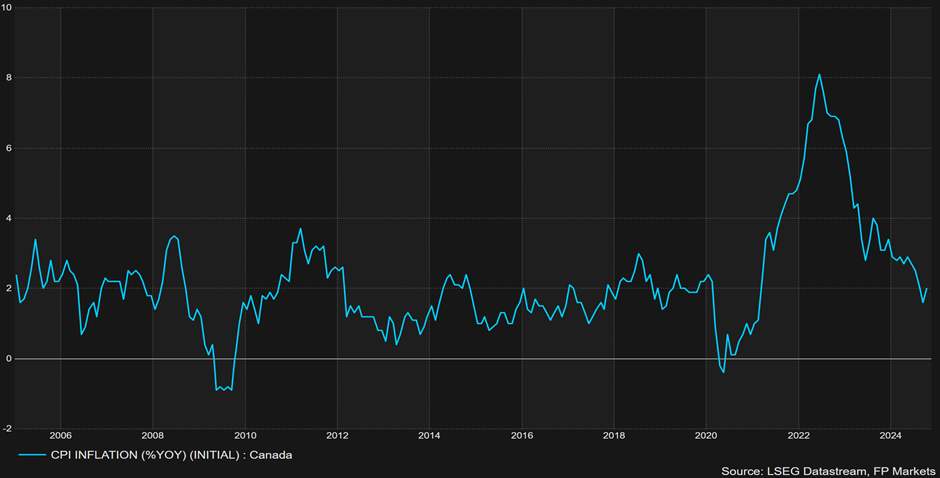
The release noted that gasoline prices fell less last month (4.0%), following September’s fall of 10.7%, ultimately bolstering headline inflation. In addition to this, the report also showed that shelter prices eased further, rising 4.8% from 5.0% in September. However, food (purchased from stores) showed prices accelerated by 2.7% from September’s reading of 2.4%.
BoC Eyeing a 50 Basis Point Cut?
The Bank of Canada (BoC) has reduced its overnight rate by 125 basis bps since June, and along with the previous meeting’s bumper 50 bp cut, the central bank’s Governor, Tiff Macklem, left the door wide ajar for further policy easing.
Despite higher-than-expected inflation, price pressures remain around the BoC’s 2.0% mid-point inflation band of 1-3%. And we must remember that while it does show inflation increased, the rise in prices is largely in line with what the BoC expected according to their latest forecasts: ‘The Bank expects inflation to remain close to the target over the projection horizon, with the upward and downward pressures on inflation roughly balancing out’. This may explain the Canadian dollar’s swift correction in the CAD and the absence of follow-through after the release.
Markets are still pricing in around 32 bps of easing for the BoC’s next policy decision – largely unchanged compared to before the release of inflation numbers. So, in my opinion, with the economy still weak, a loose labour market and inflation at target, the BoC cutting rates by another 50 bps remains a possibility next month.
BoC’s preferred measures increase
Between September and October, inflation also increased to 0.4%, bettering the market’s median estimate for a 0.3% rise and above the previous 0.4% decline. The BoC’s preferred measures of inflation also accelerated to the upside. The CPI Median rose 2.5% from 2.3% in September (consensus: 2.4%), while the CPI Trim measure rose 2.6% from 2.4% in September (consensus: 2.4%). Therefore, the average pace of inflation between these two measures is 2.55%, up from 2.35% in September. Additionally, the CPI Common measure was higher at 2.2%, up from 2.1% in September.
Where does this leave the USD/CAD?
With oil prices lower and positioning for the CAD also low (according to CFTC data), as well as the central bank expected to continue easing policy and the Fed’s moderately hawkish commentary, the recent upside in USD/CAD should not be a surprise.
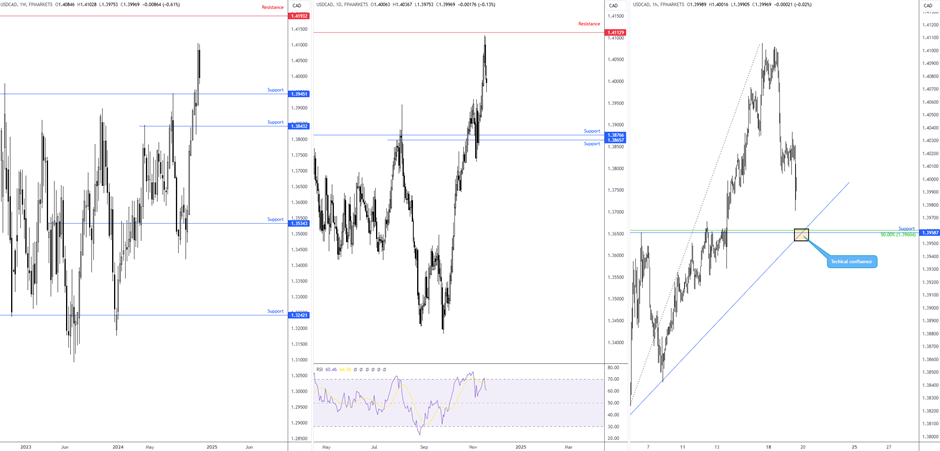
However, while the USD/CAD is biased to the upside and has been for some time now, a correction is in play, and the recent inflation numbers added to the possibility of further downside. Technically, support on the weekly timeframe from C$1.3945 and C$1.3843 and two neighbouring support levels on the daily timeframe (C$1.3866 and C$1.3877) could be worth noting and possibly lend a floor for buyers to work with should the unit reach this far south.
Shorter-term flow shows H1 price hovering just ahead of support from C$1.3959, which happens to be a level that converges with a reasonably long-term trendline support, extended from the low of C$1.3472, and a 50% retracement ratio coming in from C$1.3960. What’s also technically appealing for C$1.3959 support is the weekly support coinciding closely with the level at C$1.3945. As a result, this area on the charts could have USD/CAD buyers return to the fold if tested.
Author
Aaron Hill
FP Markets
After completing his Bachelor’s degree in English and Creative Writing in the UK, and subsequently spending a handful of years teaching English as a foreign language teacher around Asia, Aaron was introduced to financial trading,