Brazil: Current trade patterns with China threaten the promise of re-industrialization


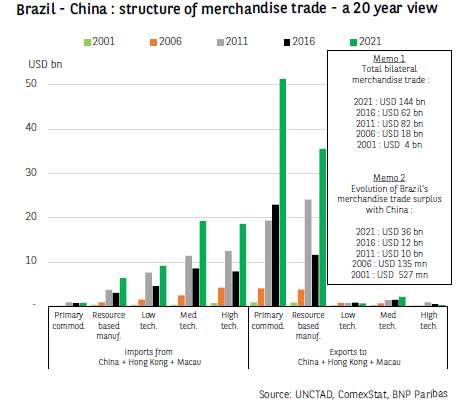
President Lula is set to meet Chinese President Xi Jinping later this month. A heavy delegation of ministers, members of Congress, and hundreds of executives are expected to accompany the President and as many as 20 bilateral agreements are expected to be signed during the visit. Looking at the structure of merchandise trade between the two countries over time highlights i/ Brazil’s heavy dependence on China and thus the importance of nurturing this relationship at a time of geopolitical upheaval; ii/ the evolution of bilateral trade also shows a trend towards specialization (primary products for Brazil and high/medium technology intensive products for China).
Trade integration with China (including Hong Kong and Macau) has changed tremendously over the past 20 years. In 2022, bilateral trade amounted to some USD 150 bn – a 37-fold increase relative to trade in 2001. Since 2009, China has been Brazil’s main trading partner absorbing today close to 27% of its exports (vs 11% for the US). In 2001, this figure amounted to a mere 3%. The Asian giant is also Brazil’s main source of imports (22.3%) ahead of the US (18%) and Argentina (5%). The scope of exports has shrunk over time with higher levels of concentration: 96% of Chinese imports from Brazil are commodity-based (either raw materials or resource-based manufactured products) vs 72% back in 2001. From a product perspective, China is Brazil’s top buyer of soybeans (69% of exports), iron ore (61%), wood pulp (41%), oil (37%) meat (36%), and sugar (15%) according to 2021 data from ITC. In 2022, roughly 1/3rd of agribusiness exports were China-bound.
These trade dynamics have taken place at a time when the Brazilian economy has undergone a process of relative de-industrialization. Industry has fallen as a share of GDP from 25.6% in 2000 to 20.8% in 2022 with most of the loss emanating from a shrinking manufacturing sector. Meanwhile, Brazil’s USD 8bn trade surplus in manufactured goods in the mid 2000’s has turned into a deficit of USD 90 bn in 2019. Multiple factors lay behind this development, including China’s role as both a buyer of primary products and a supplier of high-and medium tech manufactured goods. Considering the fact that current investment flows from China tend to reinforce existing trade patterns, Lula may after all be facing an uphill battle on his promise to re-industrialize Brazil.
Author
BNP Paribas Team
BNP Paribas
BNP Paribas Economic Research Department is a worldwide function, part of Corporate and Investment Banking, at the service of both the Bank and its customers.