Bank of Japan Preview: Policymakers can boost the JPY
- The Bank of Japan will announce its latest decision on monetary policy on December 20.
- Broad US Dollar weakness is likely to limit advances, especially if the BoJ stands pat.
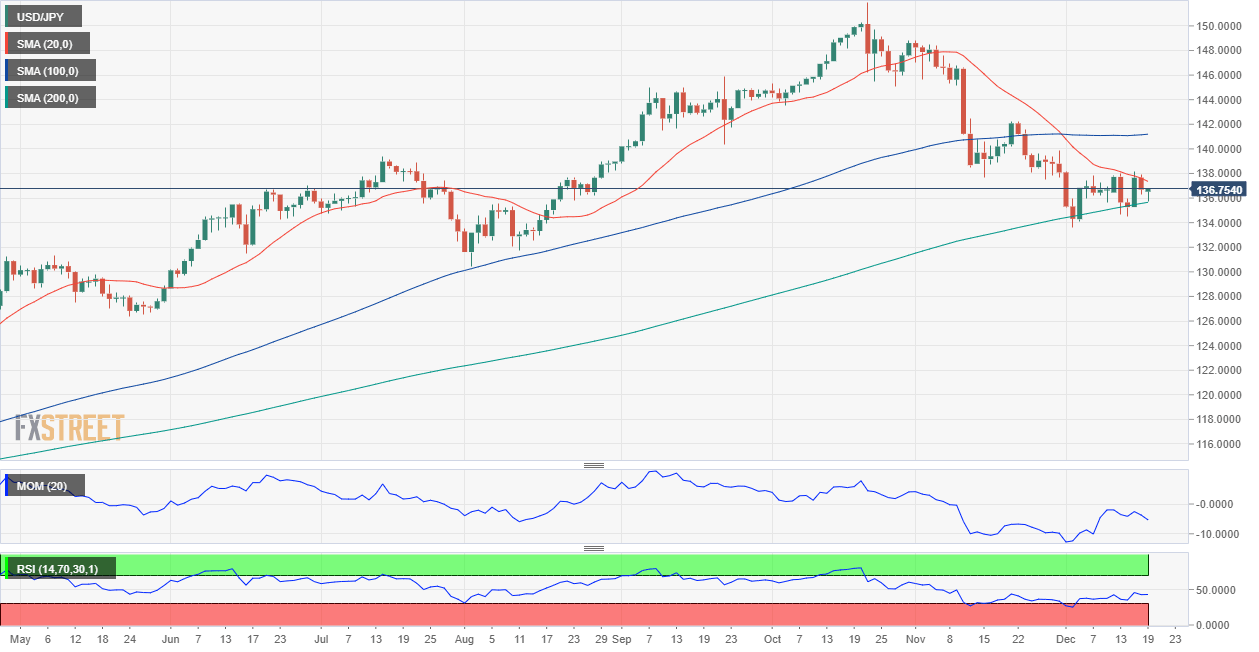
- USD/JPY is technically bearish and could retest November’s low at 133.60.


The Bank of Japan (BoJ) is the last to decide on monetary policy this Tuesday, December 20. The central bank is expected to maintain its benchmark rate at -0.1%, while policymakers will probably leave unchanged the yield-curve control that aims to keep the yield of the 10-year government bond at around 0%.
The Bank of Japan holding on to the accommodative policy is no surprise, but market participants are wondering for how long Japanese policymakers will be able to do it.
In fact, the JPY appreciates ahead of the announcement, as the news makes the rounds about a potential joint statement from the BoJ and the local government revising the inflation target.
Japanese core inflation almost doubled the central bank’s goal in October, after the core annual Consumer Price Index (CPI) rose by 3.6% – its fastest pace in four decades. Also relevant, is that consumer inflation expectations remain high, despite the government’s efforts to keep prices under control.
"We will do our best to ensure that Japanese people will benefit from our efforts, including cutting electricity prices, as soon as possible," Prime Minister Fumio Kishida said early this month.
At the same time, macroeconomic data released throughout the year showed that business output has shrunk, with the economy battling economic contraction. Softening global demand and continued inflationary pressures have weighed on growth.
The BoJ is focused on boosting growth rather than taming inflation, exactly the opposite of what most of its counterparts are doing. The joint statement is yet to be seen, but it could pave the way towards the first sign of tightening in over a decade. Policymakers can anticipate an adjustment to the yield curve control, but a rate hike is almost certainly out of discussion.
If policymakers suggest a shift in their ultra-loose monetary policy stance, the Japanese Yen will likely strengthen, something that will probably result in raising inflationary pressures. Governor Haruhiko Kuroda is between a rock and a hard place ahead of the end of his term.
USD/JPY possible reactions
The USD/JPY pair trades at around 136.50 as the US Dollar advances alongside local government bond yields. The pair plummeted in November, bottoming at 133.60, and the subsequent recovery met sellers at around 138.00. The over 1,000 pips slide from the October high towards the aforementioned low resulted from mounting expectations inflation had begun receding in the US.
From that side, things remain the same. The US Dollar gave up a good bunch of its yearly gains as the US Federal Reserve announced a slower pace of tightening at its December meeting, although a hawkish twist in the accompanying statement slowed the USD sell-off. Nevertheless, the American currency remains on the bearish path.
An on-hold BoJ should help the pair advance, but with the broad USD weakness, gains are likely to remain limited. Hints on upcoming tightening should send USD/JPY close to the aforementioned November low.
From a technical perspective, the risk is skewed to the downside, given that the daily chart shows that a bullish 200 SMA provides support at around 135.70, with pressure on the dynamic support increasing since early December. At the same time, a bearish 20 SMA caps advances, currently at around 141.15. Finally, technical indicators remain directionless within negative levels, reflecting the absence of substantial buying interest.
Premium
You have reached your limit of 3 free articles for this month.
Start your subscription and get access to all our original articles.
Author
Valeria Bednarik
FXStreet
Valeria Bednarik was born and lives in Buenos Aires, Argentina. Her passion for math and numbers pushed her into studying economics in her younger years.