AUD/USD Weekly Forecast: Bulls hesitate as Lowe pours cold water on tightening speculation
- RBA Governor Philip Lowe noted divergences between the central bank and market expectations.
- Soaring US inflation pushed speculative interest into pricing in a 50 bps rate hike in March.
- AUD/USD is mildly bullish from a wider perspective – needs to clear 0.7250 resistance.


The AUD/USD pair is up for a second consecutive week, despite retreating sharply from a fresh monthly high of 0.7248, reached after the greenback entered a selling spiral following the release of US inflation figures, only to later give up on the back of plummeting equities.
Generally speaking, the American currency maintained its bearish tone from the previous week, although US data made market participants rethink their stance. The US Consumer Price Index printed at 7.5% YoY in January, the highest in almost five decades, spurring speculation the US Federal Reserve will answer with a 50 bps rate hike at the March meeting. Yields soared, and stocks plunged as an immediate reaction, although the greenback struggled to advance.
In fact, AUD/USD fell to 0.7108 on Friday but got to recover towards the 0.7160 price zone ahead of the close, despite persistent weakness among global indexes. Somehow, it seems that financial markets are uncertain about dealing with a new era of central bank tightening.
RBA’s Lowe cools buying interest
Much of AUD/USD’s decline heading into the weekend could be attributed to Reserve Bank of Australia Governor Philip Lowe. In a testimony before the Australian House of Representatives Standing Committee on Economics, Lowe repeated that the Board is prepared to be patient on monetary policy, although acknowledging the risk of waiting.
He added that there is a big divergence between the central bank and markets’ expectations. Last but not least, Lowe warned that there is a risk in financial markets if the US central bank makes “abrupt adjustments” to its monetary policy.
Lowe poured cold water on speculation that the RBA will move into tightening sooner than anticipated, despite Australian Consumer Inflation Expectations continuing to rise, up to 4.6% in February. Also, the January TD Securities Inflation estimate reached 0.4%, doubling the previous 0.2%.
Australian employment takes center stage
Australian data was mixed. NAB’s Business Confidence improved in January to 3, although NAB’s Business Conditions in the same period came in worse than anticipated, at 3. Westpac Consumer Confidence remained subdued in February, printing at -1.3.
US data was encouraging, as the December Goods and Services Trade Balance posted a better-than-anticipated deficit of $80.73 billion. Finally, the preliminary estimate of the February Michigan Consumer Sentiment Index printed a disappointing 61.7.
Australia will publish its January employment figures next Thursday, and, at this point, the country is expected to have lost 15K positions in the month. The US, on the other hand, will release January Retail Sales, seen up 1.7% MoM, while the FOMC will publish the Minutes of the latest meeting.

AUD/USD technical outlook
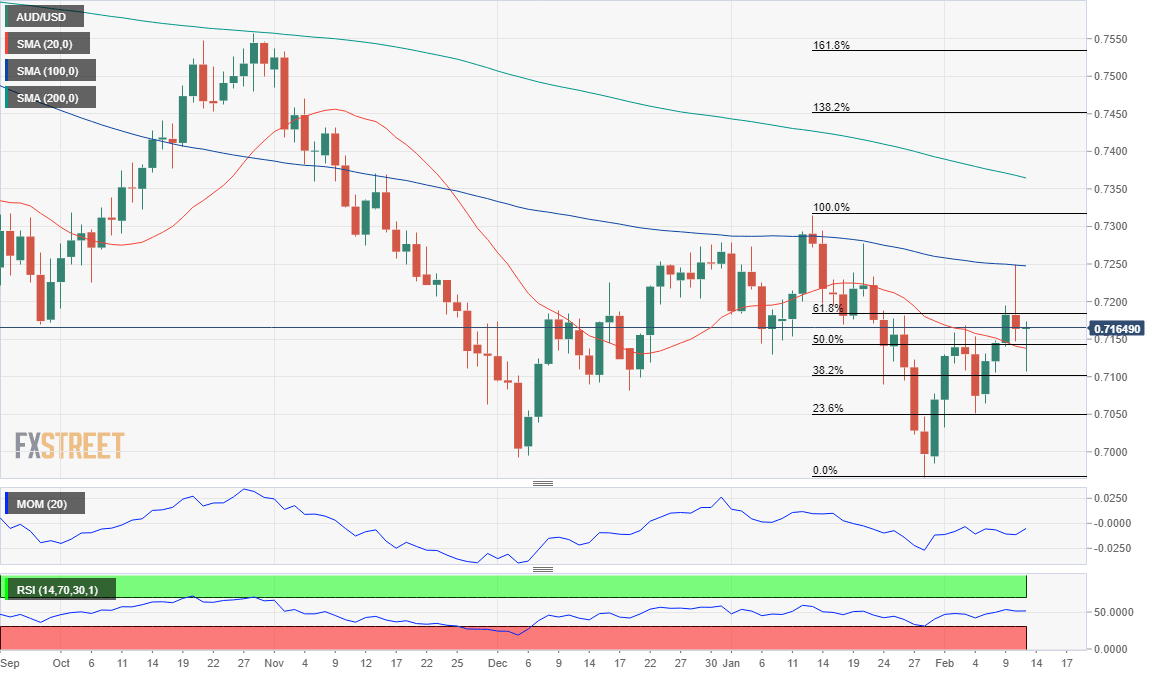
The weekly chart for the AUD/USD pair shows that the pair met buyers around its 20 and 100 SMAs, and is currently trading around a flat 200 SMA. Technical indicators maintain their bullish slopes within negative levels, falling short of supporting additional gains. Additionally, the pair is ending the week below the 61.8% retracement of its January decline at around 0.7180, an immediate resistance level.
The daily chart shows that the pair met sellers around a bearish 100 SMA, while technical indicators lack directional strength within neutral levels. Additionally, the 20 SMA maintains its bearish slope below the current level.
The weekly high is the next relevant resistance to watch, with a break above 0.7250 exposing the 0.7310 price zone. Below 0.7100, on the other hand, the risk will turn to the downside with room for the pair to retest the yearly low at 0.6966.
AUD/USD sentiment poll
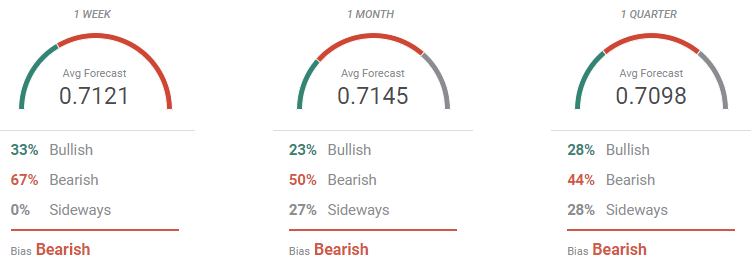
According to the FXStreet Forecast Poll, the AUD/USD pair is set to extend its decline. Bears are a majority in the three time-frame under study, with the pair seen around or below 0.7100 in the upcoming weeks. A few analysts looking for gains above 0.7400 lift the average, but overall, chances of a break sub-0.7000 have continued to increase.
The Overview chart shows that the near-term moving averages are directionless, while the longer one maintains its bearish slope. In the quarterly perspective, there is a growing number of possible targets as low as 0.6699 and 0.7000.
Premium
You have reached your limit of 3 free articles for this month.
Start your subscription and get access to all our original articles.
Author
Valeria Bednarik
FXStreet
Valeria Bednarik was born and lives in Buenos Aires, Argentina. Her passion for math and numbers pushed her into studying economics in her younger years.