AUD/USD Price Forecast: Seems vulnerable near 0.6200 amid US-China trade war 2.0
- AUD/USD drops to a one-month low amid rising US-China trade tensions and a modest USD uptick
- Bets that the Fed might keep rates higher and the risk-off mood lend support to the safe-haven buck.
- Hawkish RBA meeting minutes and upbeat Australian Retail Sales do little to impress the AUD bulls.


The AUD/USD pair resumes its downfall following the previous day's brief pause and drops below the 0.6200 mark, or a one-month low on Tuesday amid the worsening US-China relation. US President Donald Trump's long-threatened tariffs against China, which were doubled to 20%, come into effect from today. China swiftly announced countermeasures and imposed tariffs of up to 15% on imports of key farm products – including chicken, pork, soy, and beef from the US. The tit-for-tat tariffs fuel concerns about a trade war between the world's two largest economies, which is expected to harm global trade and weighs on investors' sentiment. This turns out to be a key factor driving flows away from the China-proxy Australian Dollar (AUD).
Meanwhile, worries that Trump's protectionist policies would increase price pressures and force the Federal Reserve to keep interest rates higher for longer lend some support to the US Dollar (USD). This, to a larger extent, overshadows hawkish minutes from the Reserve Bank of Australia's (RBA) February 18 policy meeting, which reinforced the central bank’s cautious approach to monetary easing. Other data released today showed that consumer spending in Australia continued to pick up amid a slowdown in inflation and large cuts to income taxes. In fact, the Australian Bureau of Statistics reported that Retail Sales rose, as expected, by 0.3% in January. This, however, does little to impress the Aussie bulls or lend any support to the AUD/USD pair.
That said, the lack of follow-through USD buying, amid worries that Trump's policy moves would undermine US consumer spending and dent the outlook for the world’s largest economy, limits the downside for spot prices. Traders also seem reluctant and opt to wait for the release of the US monthly employment details – popularly known as the Nonfarm Payrolls (NFP) report – on Friday before placing fresh directional bets. Any meaningful recovery for the AUD/USD pair, however, still seems elusive in the wake of the US-China trade war 2.0.
Technical Outlook
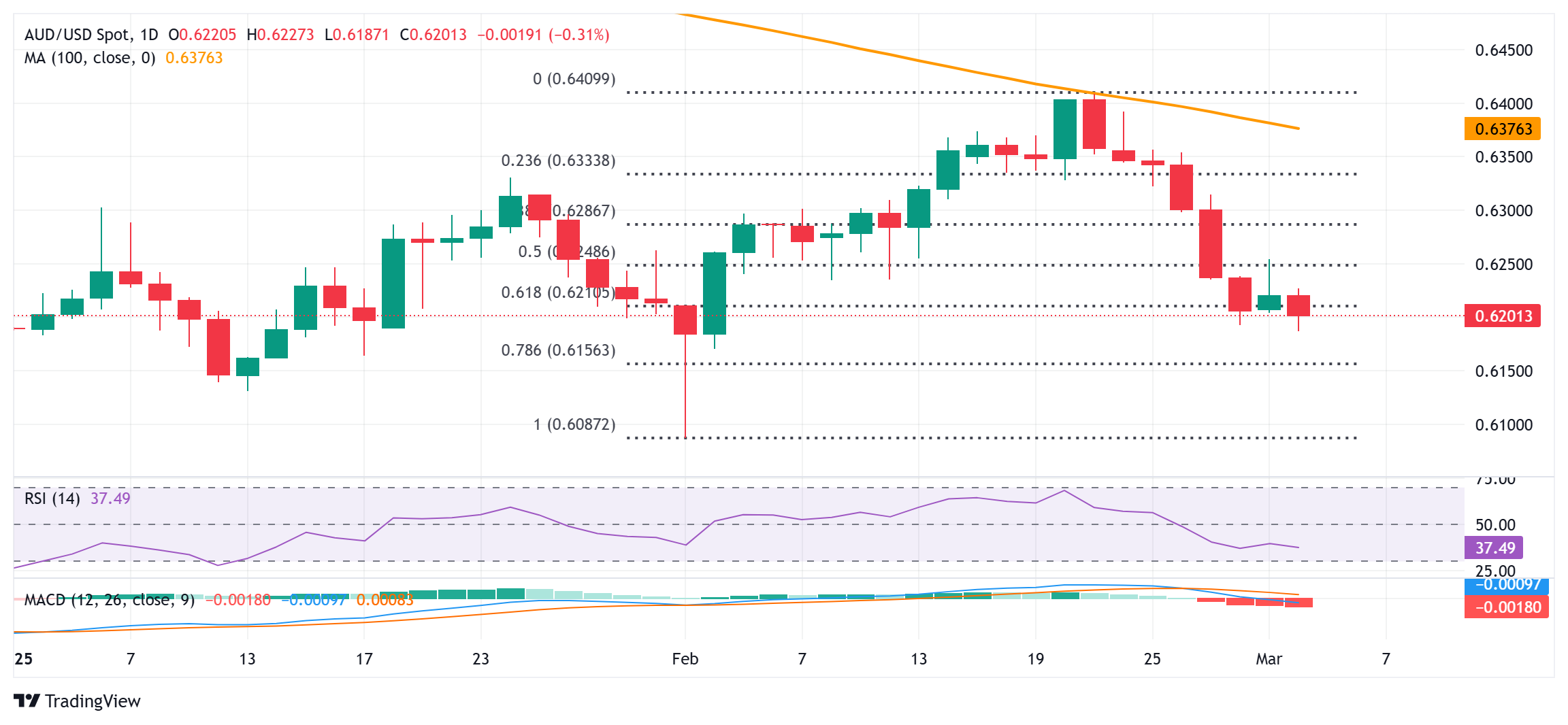
From a technical perspective, the recent fall from the vicinity of the 100-day Simple Moving Average (SMA) and a subsequent breakdown below the 61.8% Fibonacci retracement level of the February move-up favor bearish traders. Moreover, oscillators on the daily chart are holding deep in negative territory and are still away from being in the oversold zone. This validates the near-term negative outlook for the AUD/USD pair and supports prospects for an extension of a nearly two-week-old downtrend. Acceptance below the 0.6200 mark will reaffirm the negative outlook and drag spot prices further towards the 0.6140 intermediate support en route to the sub-0.6100 levels, or the lowest level since April 2020 touched last month.
On the flip side, attempted recovery might now be seen as a selling opportunity and remain capped near the overnight swing high, around the 0.6255 region, which coincides with the 50% Fibo. level. A sustained strength beyond, however, might trigger a short-covering rally and allow the AUD/USD pair to reclaim the 0.6300 mark. The momentum could extend further towards the 0.6335-0.6340 horizontal support breakpoint, now turned resistance, en route to the 100-day SMA, currently pegged ahead of the 0.6400 round figure. The latter should act as a key pivotal point, which if cleared decisively would shift the near-term bias in favor of bullish traders and pave the way for a further near-term appreciating move.
Premium
You have reached your limit of 3 free articles for this month.
Start your subscription and get access to all our original articles.
Author
Haresh Menghani
FXStreet
Haresh Menghani is a detail-oriented professional with 10+ years of extensive experience in analysing the global financial markets.