AUD/USD Price Forecast: Further upside now looks likely
- AUD/USD added to Monday’s gains and surpassed the 0.6600 barrier.
- Further weakness in the US Dollar contributed to the upside in AUD.
- The Australian Wage Price Index rose by 0.8% QoQ in Q2.


AUD/USD resumed its upward trajectory, adding to gains recorded at the beginning of the week and surpassing the 0.6600 mark to print fresh three-week highs near 0.6620, a region coincident with the 100-week SMA.
Having surpassed the critical 200-day SMA (0.6596), the outlook for AUD/USD should gradually shift to a more constructive one, allowing for the continuation of the uptrend at least in the short-term horizon.
Tuesday’s advance in the pair coincided with a broad recovery in the risk-linked galaxy and mixed performance in the commodity sector, where both copper prices and iron ore prices eased a tad from Monday’s levels.
Back to monetary policy, investors’ confidence in the Australian currency was further supported by the Reserve Bank of Australia's (RBA) latest decision to maintain its official cash rate (OCR) at 4.35%. The RBA emphasized its cautious approach, indicating that it is not in a hurry to ease policy with expectations that domestic inflation will remain persistent. Both trimmed-mean and headline CPI inflation are now expected to approach the mid-point of the 2-3% range by late 2026, rather than the previously anticipated June 2026.
During her press conference, RBA Governor Michele Bullock mentioned that the Board considered a rate hike and stressed that rate cuts are not imminent. She also noted that expectations for rate cuts are premature.
In her latest comments, Governor Bullock reiterated that the bank would not hesitate to raise interest rates if necessary to control inflation, underscoring a hawkish stance as underlying inflation remains elevated. She highlighted the bank's vigilance regarding the risks of rising inflation, following the decision to keep interest rates unchanged. Core inflation, which stood at 3.9% last quarter, is expected to decrease to the target range of 2% to 3% by late 2025.
Overall, the RBA is likely to be the last among the G10 central banks to begin cutting interest rates. Potential easing by the Federal Reserve (Fed) in the medium term, contrasted with the RBA's expected prolonged restrictive stance, could support the AUD/USD in the coming months.
However, the sluggish momentum in the Chinese economy could impede a sustained recovery of the Australian dollar. China continues to face post-pandemic challenges, deflation, and insufficient stimulus for a robust recovery. Concerns about demand from China, the world's second-largest economy, also arose following the Politburo meeting, where, despite promises to support the economy, no specific new stimulus measures were introduced.
Notably, Chinese inflation figures showed a slight increase in July, both in the monthly and yearly CPI, while Producer Prices also came in slightly above estimates.
Meanwhile, non-commercial traders (speculators) largely remain net-short on the AUD, primarily in response to the lack of positive signs from China. Barring a two-week interruption in positioning, net shorts have prevailed since Q2 2021.
AUD/USD daily chart
 AUD/USD short-term technical outlook
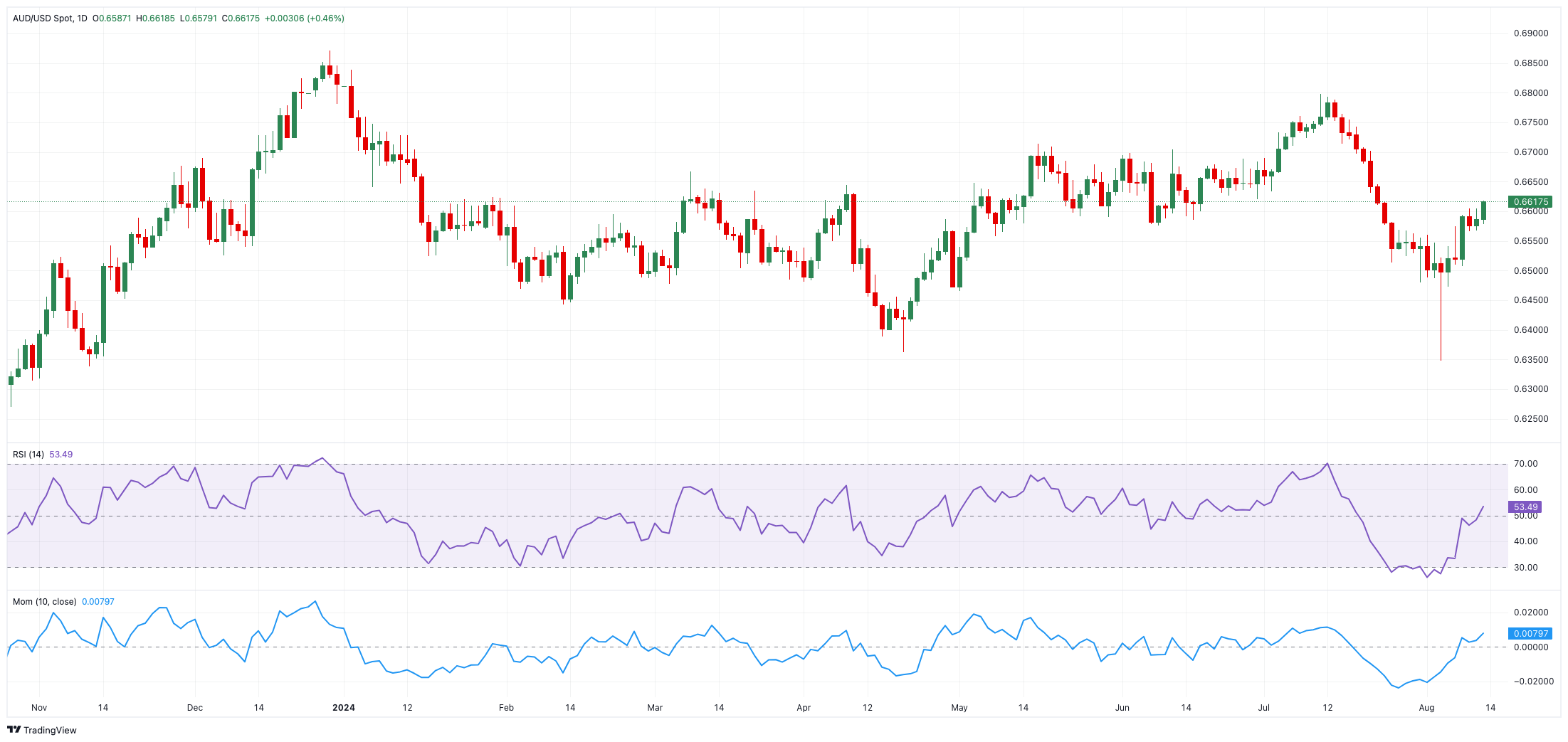
Further increases should push the AUD/USD to target the transitory 55-day SMA of 0.6637, ahead of the July top of 0.6798 (July 8) and the December peak of 0.6871.
Occasional bearish moves might prompt a move to the 2024 bottom of 0.6347 (August 5) before falling to the 2023 low of 0.6270 (October 26).
The four-hour chart suggests a modest pick-up for the time being. That said, the immediate barrier comes at the 200-SMA at 0.6637 ahead of 0.6702. On the other hand, initial support is at the 100-SMA of 0.6556, prior to the 55-SMA of 0.6542, and then 0.6347. The RSI advanced to around 66.
Premium
You have reached your limit of 3 free articles for this month.
Start your subscription and get access to all our original articles.
Author
Pablo Piovano
FXStreet
Born and bred in Argentina, Pablo has been carrying on with his passion for FX markets and trading since his first college years.