AUD/USD Price Forecast: Bears retain control near 61.8% Fibo. ahead of US PCE Price Index
- AUD/USD drifts lower for the sixth straight day amid some follow-through USD buying.
- Hawkish Fed expectations amid inflation concerns underpin the buck amid tariff jitters.
- Traders now look forward to the US PCE Price Index for some meaningful opportunities.

The AUD/USD pair extends its recent downfall from levels just above the 0.6400 mark, or the year-to-date high touched last week, and remains under some selling pressure for the sixth straight day on Friday. The downward trajectory drags spot prices to the 0.6200 round figure, or a multi-week low during the early European session, and is sponsored by broad-based US Dollar (USD) strength.
The USD Index (DXY), which tracks the Greenback against a basket of currencies, is seen prolonging this week's goodish bounce from the lowest level since December 10 amid expectations that the Federal Reserve (Fed) will stick to its hawkish stance. The bets were lifted by the second reading of the US Gross Domestic Product (GDP) released on Thursday, which showed that inflationary pressures continue to rise.
The US Bureau of Economic Analysis reported that the economy expanded by a 2.3% annualized pace during the final quarter of 2024, as was initially estimated. Additional details revealed that the GDP Price Index rose 2.4% compared to the 2.2% reported previously. This comes on top of worries that US President Donald Trump's policies would reignite inflation and put additional pressure on the Fed to hold rates steady.
Furthermore, Fed officials remain wary of future interest rate cuts amid still sticky inflation, which continues to underpin the USD and exert downward pressure on the AUD/USD pair. Apart from this, worries about the potential economic fallout from Trump's tariff plans, along with the risk-off mood, overshadow the Reserve Bank of Australia's (RBA) relative hawkish outlook and drive flows away from the Aussie.
In fact, Trump confirmed that his proposed 25% tariffs on Mexican and Canadian goods will take effect on March 4. Trump added that China would face an additional 10% surcharge that day and also threatened to announce a 25% tariff on imports from the European Union. This continues to fuel worries about a global trade war and suggests that the path of least resistance for the AUD/USD pair remains to the downside.
The USD bulls, however, might refrain from placing aggressive bets and opt to wait for the release of the US Personal Consumption Expenditure (PCE) Price Index. The crucial US inflation data would offer fresh cues about the Fed's interest rate outlook. This, in turn, will determine the near-term trajectory for the USD and the AUD/USD pair, which remains on track to register heavy losses for the first time in three weeks.
AUD/USD daily chart
Technical Outlook
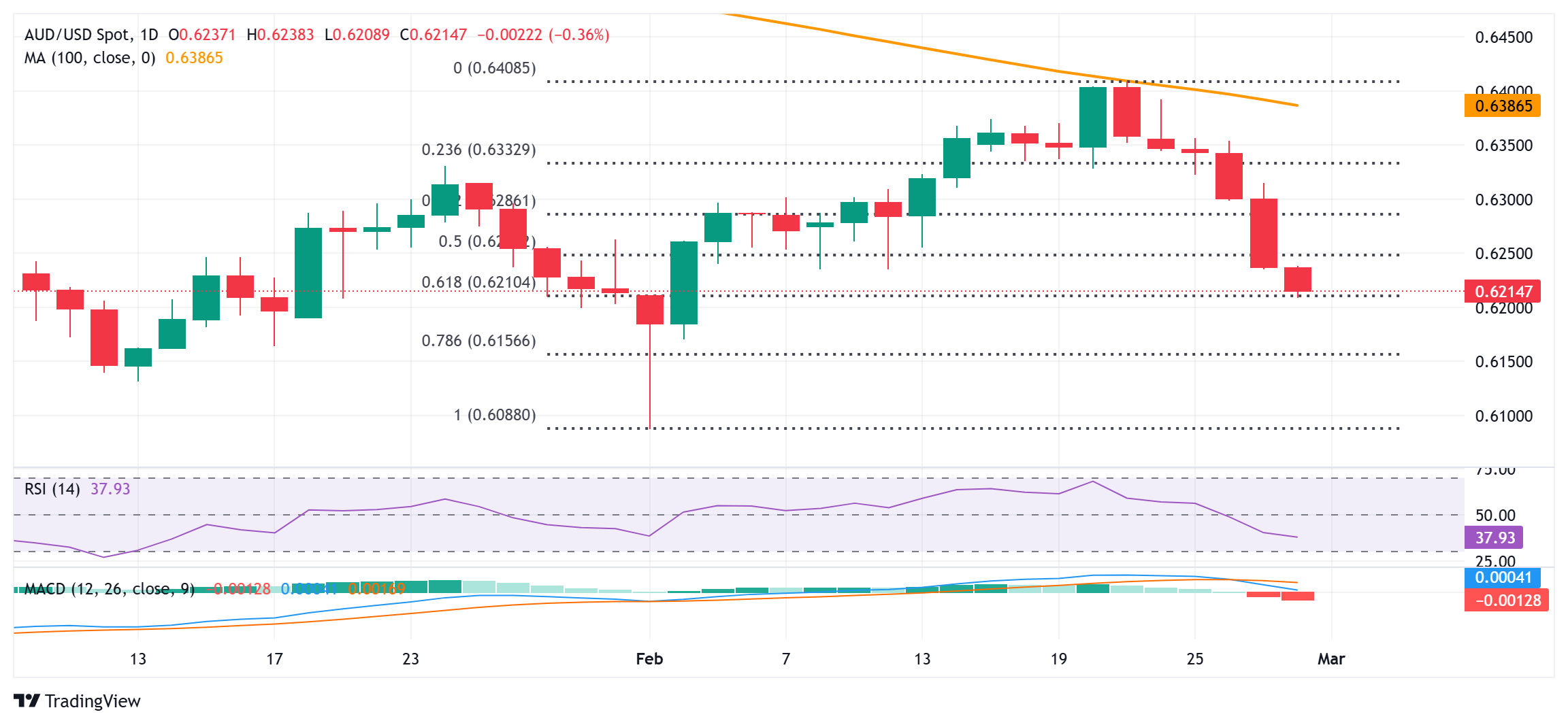
From a technical perspective, the AUD/USD pair is currently placed near the 61.8% Fibonacci retracement level of the recent bounce from the lowest since April 2020 touched earlier this month. Given that oscillators on the daily chart are holding in negative territory and are still away from being in the oversold zone, some follow-through selling below the 0.6200 mark would be seen as a fresh trigger for bearish traders. The subsequent fall could drag spot prices to the 0.6170-0.6165 intermediate support en route to the 0.6135 region and sub-0.6100 levels, or the multi-year trough.
On the flip side, any attempted recovery might now confront an immediate hurdle near the 0.6245-0.6250 region, or the 50% Fibo. level. A sustained strength beyond could trigger a short-covering rally and allow the AUD/USD pair to reclaim the 0.6300 mark. The latter coincides with the 38.2% Fibo. support breakpoint, which if cleared decisively will suggest that spot prices have formed a near-term bottom and pave the way for additional gains.
Premium
You have reached your limit of 3 free articles for this month.
Start your subscription and get access to all our original articles.
Author
Haresh Menghani
FXStreet
Haresh Menghani is a detail-oriented professional with 10+ years of extensive experience in analysing the global financial markets.