AUD/USD Price Forecast: A drop to 0.6000 should not be ruled out
- AUD/USD traded close to the key support at 0.6100.
- The US Dollar remained well bid around yearly peaks.
- The RBA is still seen keeping rates unchanged at its February event.


The US Dollar (USD) kicked off a new trading week on a strong foot, sending the US Dollar Index (DXY) past the key barrier of 110.00. Meanwhile, the Australian Dollar (AUD) treaded water in the lower end of its current range around the mid-0.6100s, an area last visited in April 2020.
What’s pressuring the Aussie?
The Aussie has been struggling against a reinvigorated US Dollar, which kicked off the new year with strength, building on its rally since October thanks to the so-called "Trump trade." This dollar strength has left the Australian currency on the defensive.
Adding to the pressure, the Reserve Bank of Australia (RBA) has hinted at a possible shift toward cutting interest rates. Minutes from the RBA's December meeting revealed that while the central bank believes its restrictive monetary policy remains appropriate for now, it’s prepared to consider a rate cut as early as February—provided economic data supports the case. Markets are now pricing in a 62% chance of a February rate cut, a dovish turn that contrasts sharply with the Federal Reserve’s more cautious tone on further easing.
Sentiment around the Aussie has also been weighed down by broader market risk aversion and persistent concerns about China’s slowing economy, a key trading partner for Australia.
Weak Australian fundamentals
The Aussie’s troubles haven’t been helped by disappointing domestic economic data. The latest GDP figures for the July–September quarter showed the economy growing by just 0.3% quarter-on-quarter and 0.8% year-on-year, both missing expectations. This weak performance further dampened confidence in the Australian economy.
Even rising prices for Australia’s key exports, such as copper and iron ore, haven’t provided much relief. While copper prices started the year strongly and iron ore prices have recovered slightly after a weak start, these gains have failed to translate into meaningful support for the Aussie. Meanwhile, the lack of movement in the Chinese Yuan and lingering uncertainty about China's economic stimulus have added to the currency's struggles.
The RBA’s cautious approach
At its December meeting, the RBA kept interest rates steady at 4.35%, as expected. However, it surprised markets by signalling the possibility of a rate cut in February, dropping its earlier neutral stance. The RBA now appears more confident that inflation is trending toward its target, noting that “some of the upside risks to inflation appear to have eased.” This is a significant shift from its previous warnings about inflationary risks.
RBA Governor Michele Bullock remained measured in her comments, avoiding firm commitments on future policy. She emphasized that the Board had not explicitly decided on cutting or raising rates, nor had it set specific conditions for a February move.
Challenges and opportunities for AUD/USD
Looking ahead, the AUD/USD faces a tough path. On the downside, persistent US inflation, a resilient US Dollar, the RBA’s dovish tilt, and China’s economic slowdown pose significant challenges. However, should the Fed shift toward fewer rate cuts, it could offer some reprieve for the Aussie.
Overall, the combination of domestic and international pressures leaves the Australian Dollar facing an uphill battle in the near term.
Technical snapshot
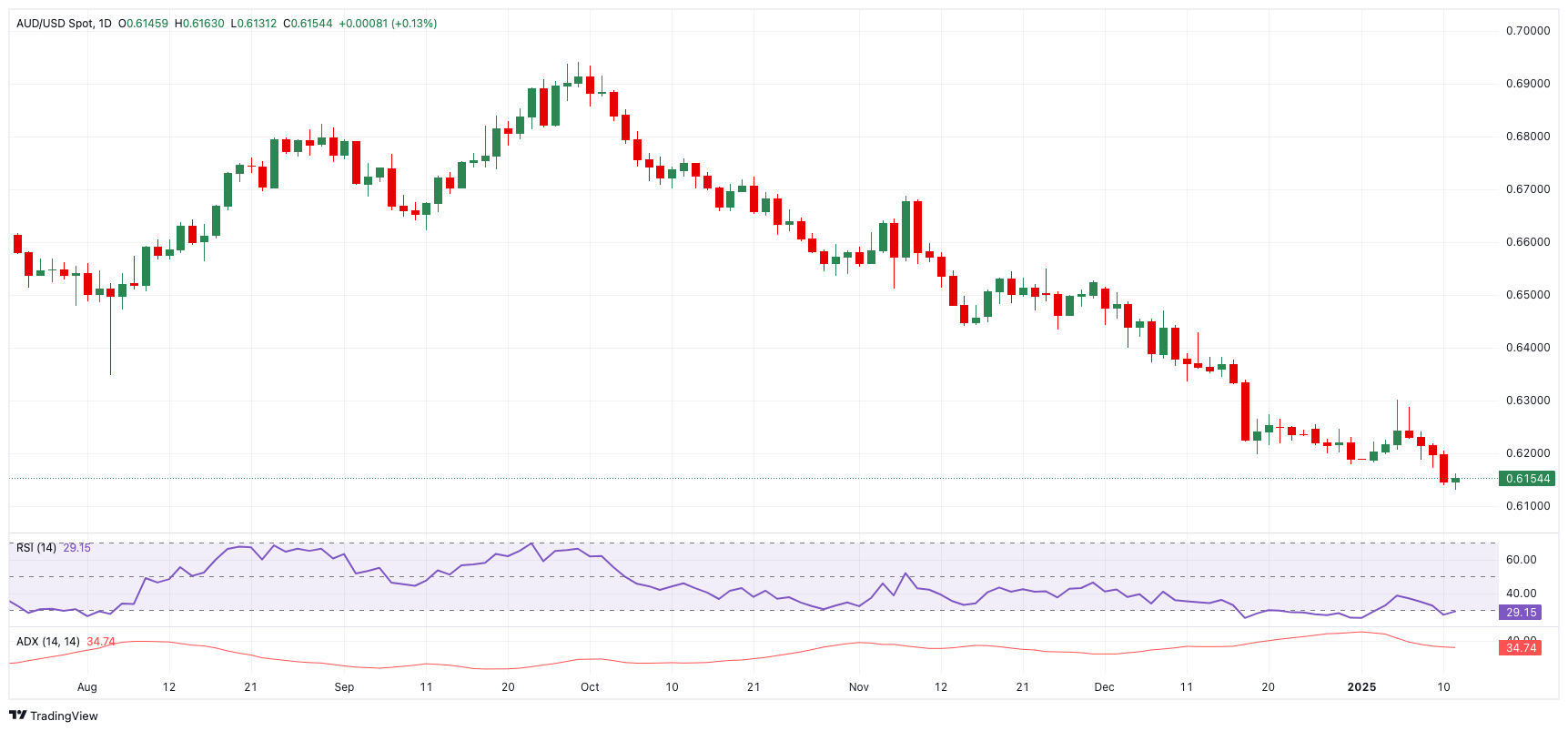
The pair remains weak and faces the next support at the 2025 bottom of 0.6130 (January 13). The breakdown of this level could prompt the key 0.6000 contention zone to emerge on the horizon prior to the April 2020 low of 0.5980 (April 3). In the meantime, immediate up-barrier is at the 2025 high of 0.6301 (January 6), ahead of the interim 55-day SMA of 0.6417and the weekly top of 0.6549 (November 25).
Momentum indicators suggest that the Relative Strength Index (RSI) has entered the oversold region around 29, indicating increasing negative momentum and also the likelihood of a technical bounce in the near term. In addition, the Average Directional Index (ADX) near 39 indicates a strong trend's direction.
Key data to watch
The next salient event on the Australian calendar will be the release of the Consumer Confidence index by Westpac on January 14, seconded by the final prints of Building Permits for the month of November. Later in the week, the publication of the Australian labour market report should take centre stage on January 16, followed by Consumer Inflation Expectations towards the end of the week.
Bottom Line
The Australian Dollar remains under pressure, caught between domestic challenges and global uncertainties. While there’s room for recovery, much will depend on upcoming data from Australia, the US, and China, as well as the RBA’s timing for an interest rate cut. For now, caution seems to be the prevailing sentiment.
Premium
You have reached your limit of 3 free articles for this month.
Start your subscription and get access to all our original articles.
Author
Pablo Piovano
FXStreet
Born and bred in Argentina, Pablo has been carrying on with his passion for FX markets and trading since his first college years.