AUD/USD Forecast: immediately to the upside comes 0.6870
- AUD/USD rose to the boundaries of the 0.6800 barrier.
- The Greenback collapsed post-US CPI data.
- Australian Consumer Inflation Expectations dropped in July.


Another robust session saw AUD/USD continue its upward movement, this time coming in just pips away of the 0.6800 milestone on Thursday, extending its positive streak for the third day.
The pair's consecutive increase was propelled by extra weakness in the US Dollar (USD), especially after US inflation readings came in below expectations in June, which, at the same time, added to speculation of a potential interest rate cut by the Fed as soon as September.
The above remained in contrast to the latest comments from Chair Jerome Powell's testimonies before Congress, where he took a cautious approach regarding the potential timing of a Fed interest rate cut, stating that more evidence of inflation moving towards the target is required before any rate adjustments are made.
On another front, daily retracements of both copper and iron ore prices seem to have limited the upside impetus in the Aussie dollar.
Regarding monetary policy, both the Reserve Bank of Australia (RBA) and the Federal Reserve (Fed) are expected to be among the last G10 central banks to begin cutting interest rates.
At its latest meeting, the RBA maintained a hawkish stance, keeping the official cash rate at 4.35% and indicating flexibility for future decisions. The meeting minutes revealed that the decision to hold the policy rate was mainly due to "uncertainty around consumption data and clear evidence of financial stress among many households."
The RBA is not in a hurry to ease policy, anticipating that it will take some time before inflation consistently falls within the 2-3% target range. There is approximately a 25% chance of a rate cut in August, increasing to around 50% in the following months.
Additionally, potential easing by the Fed, contrasted with the RBA’s likely prolonged restrictive stance, could support AUD/USD in the upcoming months.
However, concerns about slow momentum in the Chinese economy might hinder a sustained recovery of the Australian currency as China continues to face post-pandemic challenges. In addition, the persistent lack of traction in Chinese inflation could lead to some stimulus from the People’s Bank of China (PBoC), which could eventually morph into some sort of support for AUD.
Meanwhile, in Oz, Consumer Inflation Expectations dropped to 4.3% in July (from 4.4%), according to the Melbourne Institute. Despite the drop, the gauge remains well above the RBA’s 2%–3% target band.
AUD/USD daily chart
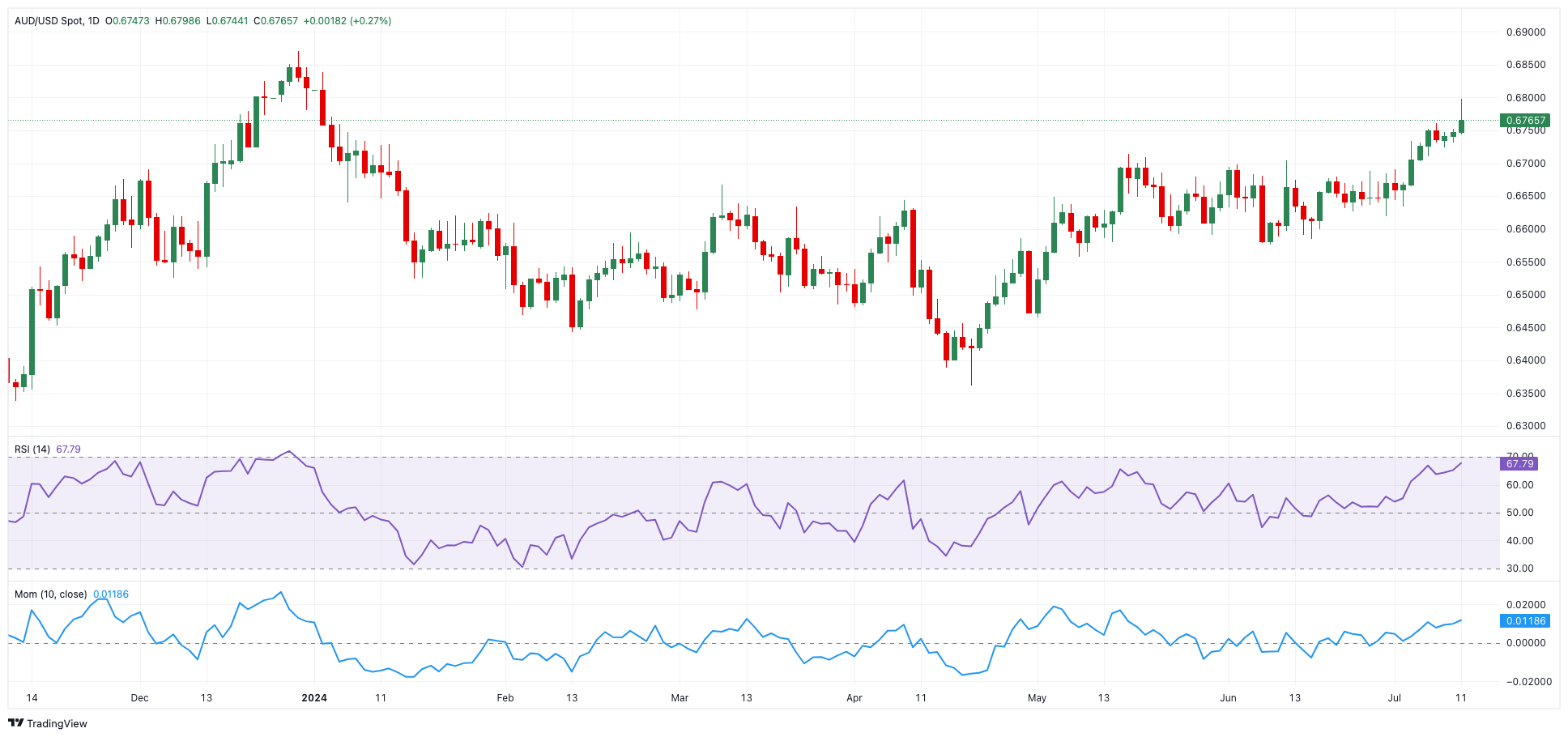
AUD/USD short-term technical outlook
If bulls push higher and AUD/USD clears the July high of 0.6798 (July 8), it might test the December 2023 top of 0.6871, followed by the July 2023 peak of 0.6894 (July 14), all before the key 0.7000 barrier.
Bearish attempts, on the other hand, may drive the pair lower, first to the June low of 0.6574 (June 10) and subsequently to the key 200-day SMA of 0.6569. A further decline might result in a return to the May low of 0.6465 and the 2024 low of 0.6362 (April 19).
Overall, the uptrend should continue as long as the AUD/USD remains above the 200-day SMA.
The 4-hour chart shows an acceleration of the upside momentum. That said, 0.6798 appears to be the first barrier, ahead of 0.6871. On the other side, 0.6709 provides quick support, prior to the 100-SMA of 0.6688. The RSI dropped to roughly 61.
Premium
You have reached your limit of 3 free articles for this month.
Start your subscription and get access to all our original articles.
Author
Pablo Piovano
FXStreet
Born and bred in Argentina, Pablo has been carrying on with his passion for FX markets and trading since his first college years.

















