AUD: Short-term gains, long-term risks


Key points
-
Australia’s July inflation: Despite a higher-than-expected headline print, Australia’s July CPI data shows slowing inflation with core measures declining, indicating a disinflation trend.
-
AUD could see more short-term strength: The Reserve Bank of Australia is unlikely to pivot at the September meeting, which could add another layer of strength for the AUD in the short-term along with cyclical USD weakness and stable global growth dynamics.
-
Potential risks: Slowing global growth, sluggish Chinese economic performance, Mideast tensions, and potential carry trade volatility could disrupt the AUD rally in the more medium-to-long term.
July CPI emphasized disinflation
The latest Australian Consumer Price Index (CPI) data shows a headline reading of 3.5%, slightly above the expected 3.4%. While some interpret this as a hawkish print that might support the Reserve Bank of Australia (RBA) in delaying rate cuts until next year, it's important to note that headline inflation has actually slowed from 3.8% in June. Core inflation measures provide a clearer picture of disinflation:
-
Trimmed Mean CPI declined to 3.8% YoY from 4.1% in June.
-
CPI Excluding Volatile Items and Travel decreased to 3.7% YoY in July from 4.0%.
Moreover, the RBA tends to focus more on quarterly CPI prints for monetary policy decisions rather than monthly data, with the next significant reading not due until October 30.
What can propel more AUD gains
-
USD weakness: A broadly weaker USD, influenced by potential dovish moves from the Fed, could provide additional tailwinds for the AUD.
-
RBA September pivot unlikely: With limited data points ahead of the RBA’s September 24 meeting, it is unlikely that the RBA’s hawkish stance will shift significantly.
-
Chinese stimulus: Expected Chinese economic stimulus could push iron ore prices higher, which would benefit the AUD.
What can disrupt the rally
-
Slowing global growth: A global economic slowdown could negatively impact demand for Australian exports, putting pressure on the AUD.
-
China sluggishness: Continued economic challenges in China or slow, insufficient stimulus could weigh on Australia’s economic outlook and the AUD.
-
Carry unwinding: If the broader unwinding of carry trades leads to increased volatility or shifts in market sentiment, it could disrupt the AUD rally and create downward pressure on the currency.
-
Mideast tension: Ongoing geopolitical instability in the Middle East could lead to global market volatility, affecting commodity prices and investor sentiment.
In summary, while the AUD has gained traction following the CPI data, its future performance will be influenced by a mix of domestic and external factors. Hawkish RBA comments and Chinese stimulus could provide further support in the short-term. However, expecting the RBA to delay rate cuts to next year if the Fed cuts 2-4 times this year may be a bit stretched.
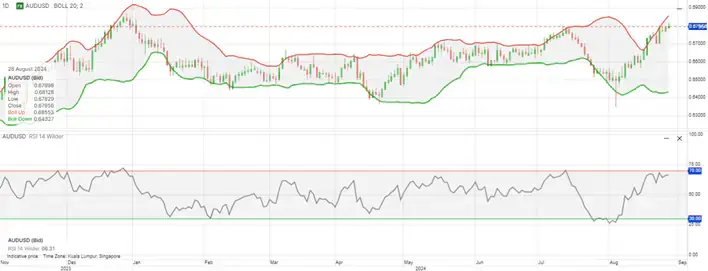
Technical indicators are not yet hinting at overbought conditions in AUD. Source: Saxo. Disclaimer: Past performance does not indicate future performance.
Read the original analysis: AUD: Short-term gains, long-term risks
Author
Saxo Research Team
Saxo Bank
Saxo is an award-winning investment firm trusted by 1,200,000+ clients worldwide. Saxo provides the leading online trading platform connecting investors and traders to global financial markets.