Americans throw away millions of U.S. coins because american money is junk
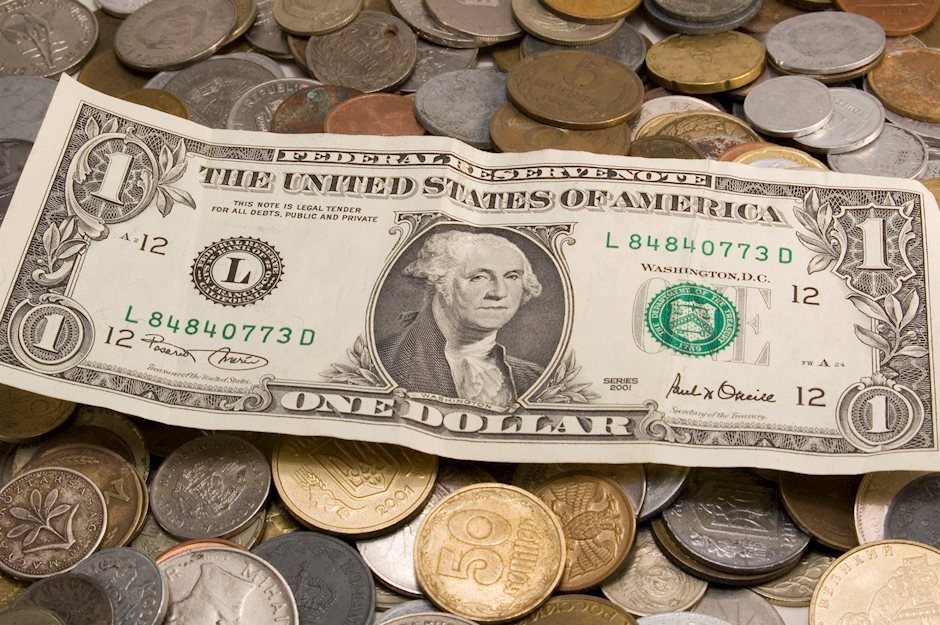

Americans throw away millions of dollars in coins every year.
That's because American money is junk.
But that wasn’t always the case.
In an article published by the Wall Street Journal, Reworld, a Pennsylvania waste management facility, claimed that Americans toss about $68 million worth of coins every year.
“Coins are as good as junk for many Americans,” the WSJ proclaimed.
Why are so many people willing to pitch money in the garbage?
For one thing, coins are a pain to carry around. They're heavy and take up a lot of space. Meanwhile, the U.S. is moving quickly toward a cashless society. Most people primarily use electronic payments. As the Wall Street Journal pointed out, “Buses, laundromats, toll booths, and parking meters now take credit and debit cards and mobile payments.”
But more significantly, the U.S. government and the Federal Reserve have devalued the currency to the point that coins have virtually zero purchasing power. The WSJ article notes that the buying power of a quarter in 1980 was equal to about a dollar today. In other words, the quarter has lost about 75 percent of its value in the last 40-plus years.
Real coins, real money
The extent of the quarter's depreciation since 1980 may shock a lot of people. It vividly illustrates just how much price inflation has eaten up your purchasing power. But it’s even worse than the WSJ example reveals.
If you want to understand the full extent of the government’s monetary malfeasance, we need to travel back in time to 1964. That was the last year the U.S. coins were minted from silver (90%).
In other words, coins minted before 1965 were real money – not government fiat currency.
President Lyndon B. Johnson changed that when he signed the Coinage Act of 1965. Under the law, the U.S. Treasury removed all of the silver from dimes, quarters, and half-dollars. Instead, the government mints coins from “composites, with faces of the same alloy used in our 5-cent piece that is bonded to a core of pure copper.”
You will sometimes hear coins minted before 1965 referred to as “junk silver.”
In reality, we should call modern American coins junk.
And that’s exactly how most Americans treat them. They’re tossing them in the trash!
Johnson promised removing silver would have no impact on the value of US coinage.
“[The] Treasury has a lot of silver on hand, and it can be, and it will be used to keep the price of silver in line with its value in our present silver coin,” he said.
Just a few years later, President Richard Nixon made a similar claim when he cut the final tie to the gold standard. He said, “Let me lay to rest the bugaboo of what is called devaluation,” and promised, “Your dollar will be worth just as much as it is today.”
Both men were lying.
When you disconnect money from anything of tangible value, it is going to quickly depreciate. It’s as certain as death and taxes.
Seth Lipsky revealed the extent of post-1965 coin debasement in a 2015 Wall Street Journal column.
“When LBJ signed the 1965 act, the value of a dollar was almost exactly the same as it had been in 1792—0.77 ounces of silver. Despite some downs and ups, on average it had been remarkably steady for the long span…
“The value of the dollar started sinking after the 1965 coinage act, and by 1980 the dollar—so long valued at 0.77 ounces of silver—plunged to 0.02 ounces of silver. Today it is valued at 0.06 ounces of silver.”
President Johnson made another claim that turned out wildly wrong. He declared that silver coins would “very definitely” not disappear or “even become rarities.”
You’ll be shocked to learn that silver coins have disappeared. Try finding a quarter minted before 1965 out in the wild. It rarely occurs.
But if you do happen to find one, keep it. It’s worth a lot more than you probably think.
How much has the government devalued our coins?
Just how much have U.S. coins depreciated since Johnson’s inauspicious act?
- The melt value of a pre-1965 silver quarter is currently $5.15.
- The melt value of a pre-1965 dime is $2.06.
- And if you’re lucky enough to find a pre-1965 silver half-dollar, its melt value comes in at $10.32.
Here’s a little perspective.
In 1964, the minimum wage stood at $1.25 per hour, the equivalent of five silver U.S. quarters. If you got paid five pre-1965 quarters today, you would hold $25.75 in your hands.
There’s your living wage.
We don’t have a wage problem. We have a money problem.
And the government caused it!
People are tossing worthless fiat coins in the trash. They would never do that with real money.
To receive free commentary and analysis on the gold and silver markets, click here to be added to the Money Metals news service.
Author
Mike Maharrey
Money Metals Exchange
Mike Maharrey is a journalist and market analyst for MoneyMetals.com with over a decade of experience in precious metals. He holds a BS in accounting from the University of Kentucky and a BA in journalism from the University of South Florida.