2020 US Elections: Calling the winner or not?
- American media 'call' of Biden as the winner has no legal meaning.
- President Trump said there is election fraud that will be presented to the courts.
- Supreme Court has ordered some ballots in Pennsylvania sequestered pending review.
- Arizona count is unfinished with Biden's margin down by more than two-thirds.
- In 2000 the election was undecided until a Supreme Court ruling on December 12, 2000.
- The Trump campaign's challenge to the election is a legal long-shot.
- Markets face a prolonged period of uncertainty if Trump wins Arizona.

The American tradition of media 'calls' on presidential elections has no legal or statutory basis. It has worked in the past because the winners of most contests have been clear the day of the election and the loser accepted the judgment and conceded.
That is not the case this year. Neither Joe Biden nor Donald Trump has yet won this election.
President Trump has said there is evidence of fraud in several of the deciding states that will be presented to the courts.
Arizona is still counting its votes. Georgia has announced a recount where Biden is leading by a little more than 5,000 mail-in ballots out of five million total votes. The Supreme Court has ordered Pennsylvanian ballots that arrived after the 8:00 pm election day deadline set aside pending a court review.
Charges of fraud in Michigan are being investigated by the Department of Justice and the FBI, where Republican poll observers in Detroit were not permitted to monitor the election as required by law. The Trump campaign plans to ask for recounts in Michigan, Wisconsin and Nevada.
In 2000 the election was not decided until December 12 after the Democratic candidate Al Gore had exhausted all of his legal challenges to the Florida count with a defeat in the Supreme Court. Several networks withdrew their early calls on Florida that year as it became clear that the state was undecided. Republican George Bush ended winning Florida by 537 votes and the Electoral College 271 to 266 with 270 needed for election.

Electoral College
The official process for electing a US President begins with each state certifying its election results and choosing electors for the vote in Washington that actually selects the president. The electors pledge to vote for the candidate that won the popular vote in each state as certified. In rare instances electors betray that trust and change their vote. In the 2016 election seven of these so-called faithless electors, five from Hillary Clinton and two from Donald Trump voted for other candidates..
President Trump's challenges are a long shot as the results in two states would need to be changed from their current position for him to win the Electoral Collage vote.
Election standing
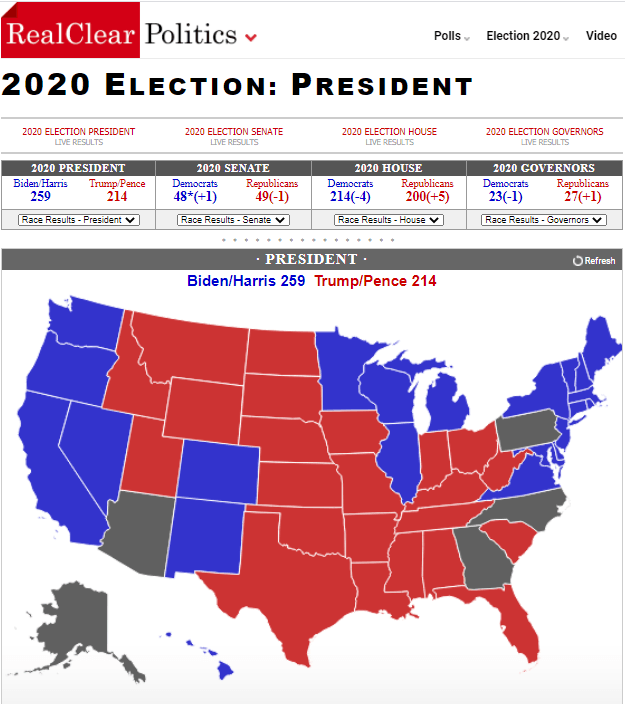
States where Biden is leading, including those whose totals are under recount and court order or will be challenged by the Trump campaign, give him 306 electoral votes. Mr Trump's states total 232.
Biden's total was 259 Electoral College votes before adding the late counting states of Arizona (11), Pennsylvania (20) and Georgia (16). North Carolina (15) and Alaska (3) are still undecided but Mr. Trump leads in both.
Arizona, as of this post, was still counting with Biden leading by about 20,000 votes. That is down from a surplus over 90,000. There are 173,000 votes remaining to be counted. In Pennsylvania Mr. Trump trails by about 29,000 and in Georgia by about 5,000. In all three states Mr. Biden's lead came from mail-in ballots whose eligibility and accuracy is open to challenge under existing election law. At the close of voting on November 3 Mr. Trump has substantial leads in all three states.
Georgia has already announced a recount. Pennsylvania is under a Supreme Court order to set aside ballots pending a potential US Supreme Court review of the legality of the Pennsylvanian Supreme Court's redrawing of its election law on the eve of the presidential vote.
If Mr. Trump wins in Arizona, the Georgia recount and the Supreme Court review of Pennsylvania's law possibly invalidating thousands of ballots, mean that the election cannot be won until these states are decided.
Senate
The election began with the Republicans holding a 53-47 edge in the upper chamber. The Democrats picked up one seat in the election. The two Georgia seats will be settled by run-off votes in January due to the state requirement that a victor receive at least 50% of the vote. Republicans are leading in both races.
It is possible that the Georgia recount could give one of the seats a Republican victor in which case the Democrats could not win the chamber. If the Democrats win both Georgia seats the Senate would be 50-50 with the vice-president the deciding vote.


House of Representatives
In the House the Republicans will pick up between 10-15 seats just shy of the 18 they needed to take control of the chamber. The result is another huge black eye for polling firms, most of whom had predicted a Democratic gain of upwards of 10 seats.
The Democratic majority will be between three and eight seats in the 435 member House. With a number of the Democratic seats in conservative districts in the mid-West and South and the entire House up for reelection in two years, the practical effect of the Republican gains will be even more pronounced than the simple shift in members. Republicans stand a excellent chance of wooing many of these members to their side on any controversial topic that is considered for a vote.
Conclusion and markets
Mr Biden is the presumptive victor and President-elect. Until and if the actual vote totals in Arizona and Georgia turn to Mr. Trump and the Supreme Court orders a change in the legally allowable ballots in Pennsylvania, there is no basis for any other conclusion.
The results from Arizona will not be known until Wednesday when provisional ballots are counted..
In order to change the outcome Mr. Trump will have to gain the 47 electoral vote of Arizona, Georgia and Pennsylvania. It is not an impossibility but it must begin with a victory in Arizona.
Markets have largely priced in a Biden win and until more is known about the policies and personnel of a Democratic White House, speculation would be pointless.
Premium
You have reached your limit of 3 free articles for this month.
Start your subscription and get access to all our original articles.
Author
Joseph Trevisani
FXStreet
Joseph Trevisani began his thirty-year career in the financial markets at Credit Suisse in New York and Singapore where he worked for 12 years as an interbank currency trader and trading desk manager.