 Sam Seiden
Independent Analyst

As I have written about so many times, the movement of price in any and all free markets is simply a function of an ongoing supply and demand equation. Trading opportunity exists when this simple and straight forward equation is “out of balance.” Meaning prices turn at price levels where supply and demand are most out of balance, in any market. The key for the market speculator is to have the ability to identify what this picture of opportunity looks like on a price chart. The lowest risk, highest reward, and highest probability time to buy into a market, for example, is to buy at price levels way down on the supply/demand curve where demand exceeds supply. At these price levels profit margins to the upside are huge and the risk is low. Unfortunately, price does not fall to these types of desired levels as much as we would like and when it does, it doesn’t stay their long. Of course, this is because demand exceeds supply in such a big way.
Another thing to consider is how and why prices in markets fall to these desired sale prices. The stronger the news event, the greater mass perception is created. The stronger the mass perception, the more buying and selling happens and this moves price. Last week we had a Fed day. While the news was not all that unexpected, price moved fast and far.
Supply/Demand Grid 03/18/15: NASDAQ Buying Opportunity, Fed Day
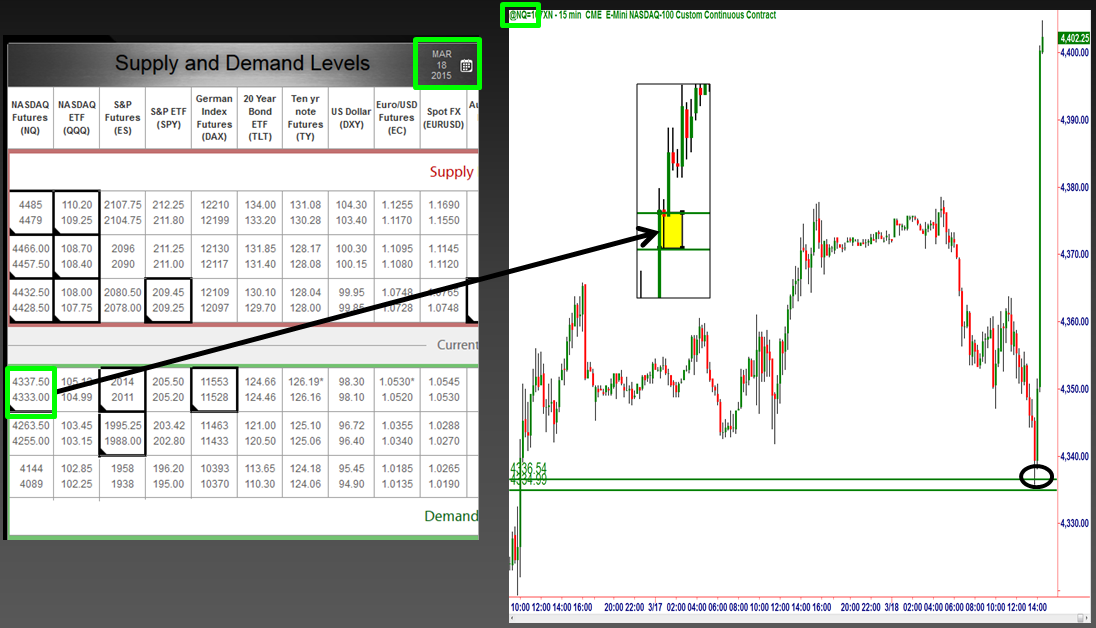
Many traders ask me the same question regarding news days like the Fed day. They ask if they should pull their orders from the market around news events like the Fed news day last week and not trade. I have two answers… first, if you’re new to trading and don’t know how to identify real supply and demand in the markets, don’t trade around news events (don’t trade period). Second, if you are good at identifying real supply and demand in a market, you really want to be ready with orders in the market around news events. When it comes to price movement the news typically speeds up what was going to happen anyway. As you can see on the NASDAQ Futures chart above, just prior to the Fed announcement, price declined in somewhat strong fashion right into our demand zone from that mornings supply/demand grid. Next, price exploded away from that demand zone. Whatever the news is, however strong it is, the movement of price is always a function of pure supply and demand, a simple numbers game.
Wall Street tells us that you can’t time the market’s turning points and that it’s a waste of time. Of course they tell us that. If the average person could time the market’s turning points no one would need Wall Street. I would argue that the average person can time the market’s turning points like we did with the NASDAQ. It’s not that we are always right and can pick every turning point in a market. With our rules however, I would argue that the average person can time the market’s turning points with a very high degree of accuracy.
Note: All information on this page is subject to change. The use of this website constitutes acceptance of our user agreement. Please read our privacy policy and legal disclaimer. Opinions expressed at FXstreet.com are those of the individual authors and do not necessarily represent the opinion of FXstreet.com or its management. Risk Disclosure: Trading foreign exchange on margin carries a high level of risk, and may not be suitable for all investors. The high degree of leverage can work against you as well as for you. Before deciding to invest in foreign exchange you should carefully consider your investment objectives, level of experience, and risk appetite. The possibility exists that you could sustain a loss of some or all of your initial investment and therefore you should not invest money that you cannot afford to lose. You should be aware of all the risks associated with foreign exchange trading, and seek advice from an independent financial advisor if you have any doubts.
Editors’ Picks

EUR/USD falls to near 1.1600 due to persistent bearish bias
EUR/USD depreciates after registering modest gains in the previous session, trading around 1.1610 during the Asian hours on Thursday. The technical analysis of the daily chart suggests a persistent bearish bias as the EUR/USD pair remains within the descending channel pattern.

GBP/USD underperforms as UK faces stagflation risks amid Middle East war
The Pound Sterling trades lower against its major currency peers, is down 0.22% around 1.3340 against the US Dollar, during the Asian trade on Thursday. The British currency faces selling pressures amid fears that the United Kingdom economy could face stagflation risks due to higher energy prices, a situation in which inflation accelerates with economic growth and employment conditions remaining stagnant.

USD/JPY bounces back to 157.00 amid renewed USD demand
USD/JPY bounces back to near 157.00, cutting losses in the Asian session on Thursday. Renewed US Dollar demand amid Middle East and China concerns outweighs fears of Japanese intervention, aiding the pair's recovery.
Editors’ Picks

AUD/USD eases below 0.7100 after Aussie trade data, China growth woes
AUD/USD meets fresh supply and eases below 0.7100 following the release of dismal Australian Trade Balance data on Thursday. A record-low growth target set by China for 2026 also weighs on the Chinese proxy, the Australian Dollar, while the US Dollar finds fresh bids amid the ongoing geopolitical tensions in the Middle East.
USD/JPY bounces back to 157.00 amid renewed USD demand
USD/JPY bounces back to near 157.00, cutting losses in the Asian session on Thursday. Renewed US Dollar demand amid Middle East and China concerns outweighs fears of Japanese intervention, aiding the pair's recovery.

Gold buyers stay hopeful amid Middle East war, China growth woes
Gold is building on the previous rebound in Thursday’s Asian trades, testing offers once again at the $5,200 threshold. Deeper escalation of the Middle East war and dovish US Federal Reserve monetary policy outlook continue to support Gold.
Top Crypto Gainers: Decred, Zcash, and Dogecoin lead recovery as Bitcoin crosses $72,000
Bitcoin trades above $72,500 at press time on Thursday, holding its 6% gain from the previous day, contributing to a broader market recovery. The total cryptocurrency market capitalization stands at over $2.43 trillion as the broader market sentiment improves significantly.

First Venezuela, now Iran: The US-China energy war escalates Premium
At first glance, the latest escalation involving the United States with both Iran and Venezuela looks like another chapter in a long-running geopolitical story. But viewed through a broader strategic lens, something else may be unfolding: Energy.
RECOMMENDED LESSONS
Making money in forex is easy if you know how the bankers trade!

I’m often mystified in my educational forex articles why so many traders struggle to make consistent money out of forex trading. The answer has more to do with what they don’t know than what they do know. After working in investment banks for 20 years many of which were as a Chief trader its second knowledge how to extract cash out of the market.
5 Forex News Events You Need To Know

In the fast moving world of currency markets where huge moves can seemingly come from nowhere, it is extremely important for new traders to learn about the various economic indicators and forex news events and releases that shape the markets. Indeed, quickly getting a handle on which data to look out for, what it means, and how to trade it can see new traders quickly become far more profitable and sets up the road to long term success.
Top 10 Chart Patterns Every Trader Should Know

Chart patterns are one of the most effective trading tools for a trader. They are pure price-action, and form on the basis of underlying buying and selling pressure. Chart patterns have a proven track-record, and traders use them to identify continuation or reversal signals, to open positions and identify price targets.
7 Ways to Avoid Forex Scams

The forex industry is recently seeing more and more scams. Here are 7 ways to avoid losing your money in such scams: Forex scams are becoming frequent. Michael Greenberg reports on luxurious expenses, including a submarine bought from the money taken from forex traders. Here’s another report of a forex fraud. So, how can we avoid falling in such forex scams?
What Are the 10 Fatal Mistakes Traders Make
Trading is exciting. Trading is hard. Trading is extremely hard. Some say that it takes more than 10,000 hours to master. Others believe that trading is the way to quick riches. They might be both wrong. What is important to know that no matter how experienced you are, mistakes will be part of the trading process.
The challenge: Timing the market and trader psychology

Successful trading often comes down to timing – entering and exiting trades at the right moments. Yet timing the market is notoriously difficult, largely because human psychology can derail even the best plans. Two powerful emotions in particular – fear and greed – tend to drive trading decisions off course.