 Brandon Wendell, CMT
Brandon Wendell
New traders often get confused when deciding what tools to use in order to analyze the markets and select trading opportunities. Looking at the selections available as well as the tools offered in today’s advanced trading software, it is easy for one to become overwhelmed. Fortunately, there is a simple and logistical way to sort through the market ebbs and flows and identify the highest probability, lowest risk trading opportunities.
When we are planning to trade, we need to start from the top. It does not matter if you are holding for 10 minutes, 10 days, or 10 weeks. The broad markets always have influence over the stocks making up their components. I have seen this hold true for markets in the U.S., India, London, Dubai, and Singapore. We need to establish the trend and potential turning points (supply & demand), of the broad market before we look to our individual stocks. Most stocks will move further and faster with the market’s trend than when they are fighting it. Of course, there are always exceptions. However, even when the stock is trending opposite of the market, they will often reach supply and/or demand at nearly the same time.
Once we know what the market is likely to do during the timeframe we are trading, it is important to look at the stock to find the current trend. We want to know the direction of the trend, the strength of the trend, and the possible turning points in that trend (again supply and demand). By looking at the price and volume, a trader gains most of the knowledge they need to trade without the added use of any indicators. You can ascertain the trend direction and strength by observing the color, size, and shape of the candles themselves with volume as a supporting indicator. Looking at the past price action, a trader can also see the most probable turning points or entry and exit targets from supply and demand.
For those of you who are not familiar or comfortable with reading price and volume, I suggest you visit your local Online Trading Academy center and take one of our courses that will give you this knowledge. For added information regarding strength of the trend and confirming weakness at turning points, you can use a momentum indicator such as ADX or MACD. Even multiple moving averages offer a clue to a trader looking to determine trend strength. Just remember that you need to rely on price itself to make your entries and exits. Relying on the indicators makes you late as they are all lagging in their movement and signals.
When looking at the possible turning points of price, we can also look at the condition of oscillators like Stochastics, RCI, CCI and others. You have to use them in the correct manner however. Trying to take all buy and sell signals given by them will not only make your crazy, it will also drain your account. They are to be used to confirm decisions made on price action. Stocks will remain overbought or oversold for a long time in a strong trend. What you need to look for are clues that there is a change in sentiment and price action at a previously identified supply or demand zone.
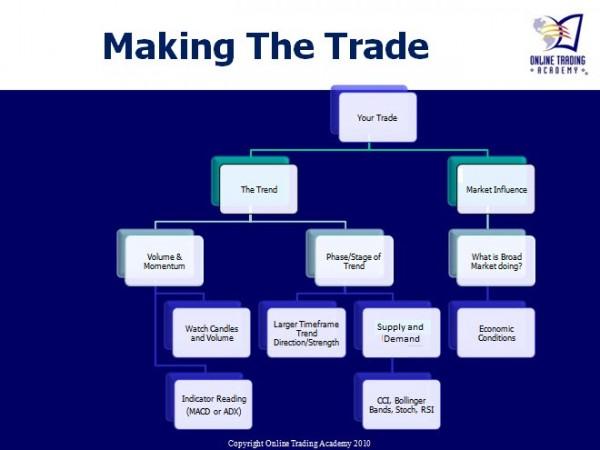
Overall, your trading decisions need to be centered on identifying trends and supply and demand zones of the broad market and your stock. The technical indicators are decision support tools and may not even be necessary once you become adept at reading price.
Neither Freedom Management Partners nor any of its personnel are registered broker-dealers or investment advisers. I will mention that I consider certain securities or positions to be good candidates for the types of strategies we are discussing or illustrating. Because I consider the securities or positions appropriate to the discussion or for illustration purposes does not mean that I am telling you to trade the strategies or securities. Keep in mind that we are not providing you with recommendations or personalized advice about your trading activities. The information we are providing is not tailored to any individual. Any mention of a particular security is not a recommendation to buy, sell, or hold that or any other security or a suggestion that it is suitable for any specific person. Keep in mind that all trading involves a risk of loss, and this will always be the situation, regardless of whether we are discussing strategies that are intended to limit risk. Also, Freedom Management Partners’ personnel are not subject to trading restrictions. I and others at Freedom Management Partners could have a position in a security or initiate a position in a security at any time.
Editors’ Picks

EUR/USD regains balance, targets 1.1800
EUR/USD has lost a bit of momentum after its earlier push higher and is now attempting to reclaim the key 1.1800 barrier on Monday. In the meantime, investors remain focused on the evolving US–EU trade relationship after President Trump’s announcement of sweeping global tariff hikes.

GBP/USD recedes from tops, back to 1.3500
GBP/USD is extending its move higher on Monday, meeting some resistance around 1.3530 on the back of the widespread bearish tone in the US Dollar amid ongoing uncertainty around tariffs. For now, traders are watching overall risk sentiment and central bank rhetoric for the next directional cue.

USD/JPY recovers early losses as investors look beyond US SC’s ruling
The USD/JPY pair recovers almost its entire early losses and trades marginally lower to near 154.85 during the European trading session on Monday. The pair bounces back as the US Dollar claws back its initial losses, driven by the United States Supreme Court’s ruling against President Donald Trump’s tariff policy.
Editors’ Picks

US Dollar struggles as Trump tariff uncertainty grows
The US Dollar struggles to stay resilient against its rivals to start the new week as investors assess the headlines surrounding the US trade regime. After the Supreme Court ruled against US President Trump's tariffs, Trump announced that he will hike global tariff rates to 15%.

Gold advances to four-week highs, focus is on $5,200
Gold is holding onto its bullish tone on Monday, hovering near monthly highs well above the $5,100 mark per troy ounce. Fresh trade-war concerns, coupled with rising geopolitical tensions in the Middle East, are keeping demand for the yellow metal well on the rise.
EUR/USD regains balance, targets 1.1800
EUR/USD has lost a bit of momentum after its earlier push higher and is now attempting to reclaim the key 1.1800 barrier on Monday. In the meantime, investors remain focused on the evolving US–EU trade relationship after President Trump’s announcement of sweeping global tariff hikes.

Crypto Today: Bitcoin, Ethereum, XRP intensify sell-off as tariff uncertainty weighs
Bitcoin, Ethereum and Ripple are trading amid increasing selling pressure at the time of writing on Monday, as investors react to fresh trade uncertainty over US President Donald Trump’s push for more tariffs.

Supreme Court nixes tariffs, Trump teases 15% global tariff
On February 20th, the Supreme Court ruled that Trump’s global tariffs under IEEPA authority were unconstitutional, effectively nullifying the framework. However, the relief was short-lived. Within hours, Trump floated a 15% blanket tariff under an alternative legal authority.
RECOMMENDED LESSONS
Making money in forex is easy if you know how the bankers trade!

I’m often mystified in my educational forex articles why so many traders struggle to make consistent money out of forex trading. The answer has more to do with what they don’t know than what they do know. After working in investment banks for 20 years many of which were as a Chief trader its second knowledge how to extract cash out of the market.
5 Forex News Events You Need To Know

In the fast moving world of currency markets where huge moves can seemingly come from nowhere, it is extremely important for new traders to learn about the various economic indicators and forex news events and releases that shape the markets. Indeed, quickly getting a handle on which data to look out for, what it means, and how to trade it can see new traders quickly become far more profitable and sets up the road to long term success.
Top 10 Chart Patterns Every Trader Should Know

Chart patterns are one of the most effective trading tools for a trader. They are pure price-action, and form on the basis of underlying buying and selling pressure. Chart patterns have a proven track-record, and traders use them to identify continuation or reversal signals, to open positions and identify price targets.
7 Ways to Avoid Forex Scams

The forex industry is recently seeing more and more scams. Here are 7 ways to avoid losing your money in such scams: Forex scams are becoming frequent. Michael Greenberg reports on luxurious expenses, including a submarine bought from the money taken from forex traders. Here’s another report of a forex fraud. So, how can we avoid falling in such forex scams?
What Are the 10 Fatal Mistakes Traders Make
Trading is exciting. Trading is hard. Trading is extremely hard. Some say that it takes more than 10,000 hours to master. Others believe that trading is the way to quick riches. They might be both wrong. What is important to know that no matter how experienced you are, mistakes will be part of the trading process.
The challenge: Timing the market and trader psychology

Successful trading often comes down to timing – entering and exiting trades at the right moments. Yet timing the market is notoriously difficult, largely because human psychology can derail even the best plans. Two powerful emotions in particular – fear and greed – tend to drive trading decisions off course.