
Every trader must learn these terms and ideas before beginning Forex Trading
1. Pip
In Forex trading, a PIP or pip is short for ‘percentage in point’ and is a measure for exchange rate movement. The pip is a unit – a numeric value that ultimately measures profit and loss. A single pip is equal to 0.0001.
Forex traders will often quote the movements, profits or losses in pips. For example, stating something like “I made 30 pips on that last trade” or “the AUD/USD has just gained 30 pips in the last hour”.
MXT Global’s currency prices are displayed to the fifth decimal place (fractional pips) for improved precision. Our spreads can be too small to be seen with only four decimal places.
To find out more about pips, please see the following topics:
• What is a fractional pip?
• How do you calculate the Per Pip Value?
• How is the pip change or movement calculated?
• How do you calculate profit/loss in pips?
2. Spread
A spread is the pip difference between the bid and the ask price of an underlying asset. As it is essentially the cost of making a trade, it is important for Forex traders to know what spreads are. To find the spread we minus the Bid (Sell) Price from the Ask (Buy) Price.
From the example taken from the Trade Terminal below, the AUD/USD is currently priced at 0.93860/0.93865 (Sell/Buy).
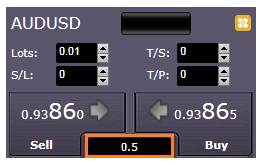
Buy Price – Sell Price = Spread
0.93865 – 0.93860 = 0.00005 or 0.5 pips
The MT4 Trade Terminal will show the spread quoted in pips between the two prices. Spreads are always variable and as we source our feeds from as many as 70 different institutions, we can provide lower spreads. To compare the spreads between different currency pairs and other Forex providers, please see here.
3. Leverage
Leverage is the ratio at which defines the loan amount, “margin”, that traders are allowed to use to gain access to larger sums of trading capital. Leverage can heighten both profits and losses and should be used wisely. Due to the nature of leverage, Forex providers like MXT Global have strict leverage restrictions in place to assist traders in minimising risk.
Let’s look at a numerical example:
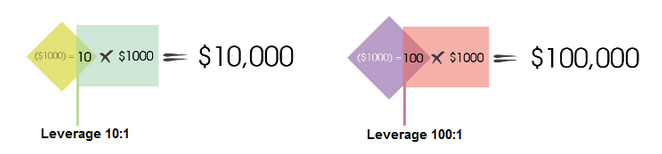
Say two traders have $5,000 USD and they both wish to use $1,000 on one trade as margin. Trader A has an account leverage of 10: 1 and Trader B has an account leverage of 100:1.
The exposure they both have differs due to the difference of their account leverage ratios.
4. Margins
In Forex trading, a margin is required to trade. A margin can be considered as the minimum collateral or deposit. This margin allows you effectively take a ‘loan’ – access to a larger amount of capital.
How do you calculate the margin per trade?
An account leverage ratio is used to determine how much margin will be required.
Overall Lot Size / Leverage Amount = Margin Required
Example with 2 lots at leverage of 400:1
200,000 / 400 = $500 margin required
A margin call is a notification you will receive when there are not enough funds in your trading account support open trades. Essentially, when your floating losses are greater than the minimum margin required. MXT Global’s margin call level is at 80%.
5. Volume
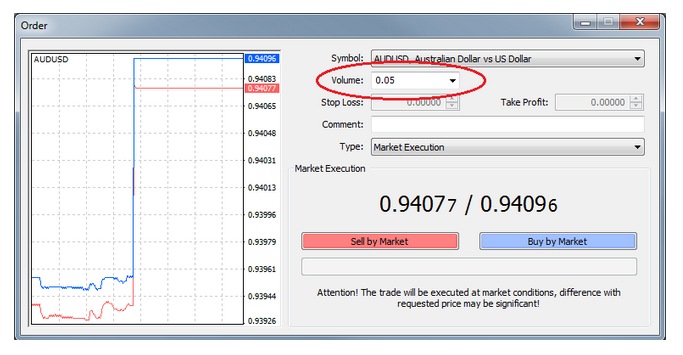
Looking at the your MT4 terminal, you will see the term ‘Volume’ appear.
Volume in the Order window refers to the volume to buy/sell.
Volume refers to number of lots whereby 1 lot = 100,000 units
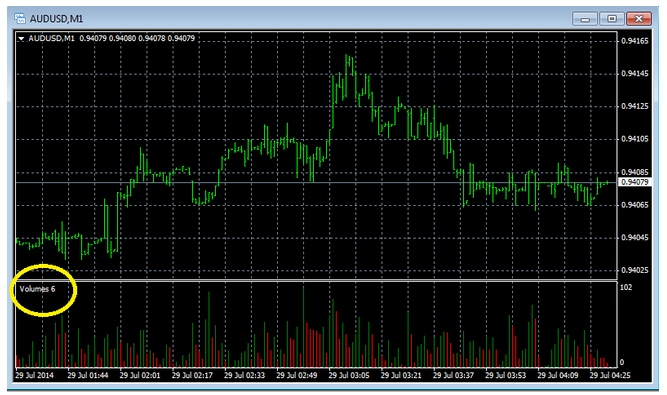
Volume in on the Volume bar in the charts refers to the tick volumes. It counts how many times the price has changed in that period.
6. Slippage
When you’re trading, sometimes you’ll notice a slight difference between the price you expect and the execution price (the price when the trade is executed). When this happens, it’s known as slippage. It’s a common thing to experience as a trader and it can work either positively or negatively. The main reasons for slippage are market volatility and execution speeds.
Slippage Example
The price of the AUD/USD was 0.9010. After analysing the market, you speculate that it’s on an upward trend and long a one standard lot trade at the now current price of AUD/USD 0.9050, expecting to execute at the same price of 0.9050.
The market follows the trend but goes past your execution price and up to 0.9060 very quickly – within a second. Because your expected price of 0.9050 is not available in the market, you’re offered the next best available price. For the sake of the example, that price is 0.9045.
In this case, you would experience positive slippage:
0.9050 – 0.9045 = 0.0005, or +5 pips.
On the other hand, let’s say your trade was executed at 0.9055. You would then experience negative slippage:
0.9050 – 0.9055 = 00.0005, or -5 pips.
Related read: Trading Breakouts in Forex
When trading Forex, one can either choose to follow the myriad rules that other traders have put in place or go their own way. The path chosen will depend on several factors, such as experience, technical knowledge and risk appetite. As the saying goes, smooth seas never made a skilled sailor - and the same can be said for traders. Keep reading
Editors’ Picks

EUR/USD trims gains, back below 1.1800
EUR/USD now loses some upside momentum, returning to the area below the 1.1800 support as the Greenback manages to regain some composure following the SCOTUS-led pullback earlier in the session.

GBP/USD off highs, recedes to the sub-1.3500 area
Following earlier highs north of 1.3500 the figure, GBP/USD now faces some renewed downside pressure, revisiting the 1.3490 zone as the US Dollar manages to regain some upside impulse in the latter part of the NA session on Friday.

USD/JPY sticks to gains above 155.00, over one-week top ahead of US data
The USD/JPY pair gains positive traction for the third straight day and climbs to over a one-week top, around the 155.35-155.40 region. Data released early today showed that Japan’s key inflation gauge eased to the slowest pace in two years, tempering expectations for an immediate policy tightening by the Bank of Japan.
Editors’ Picks

EUR/USD: US Dollar comeback in the makes? Premium
The US Dollar (USD) stands victorious at the end of another week, with the EUR/USD pair trading near a four-week low of 1.1742, while the USD retains its strength despite some discouraging American data released at the end of the week.

Gold: Escalating geopolitical tensions help limit losses Premium
Gold (XAU/USD) struggled to make a decisive move in either direction this week as it quickly recovered above $5,000 after posting losses on Monday and Tuesday.

GBP/USD: Pound Sterling braces for more pain, as 200-day SMA tested Premium
The Pound Sterling (GBP) crashed to its lowest level in a month against the US Dollar (USD), as critical support levels were breached in a data-packed week.

Bitcoin: No recovery in sight
Bitcoin (BTC) price continues to trade within a range-bound zone, hovering around $67,000 at the time of writing on Friday, and falling slightly so far this week, with no signs of recovery.

US Dollar: Tariffed. Now What? Premium
The US Dollar (USD) reversed its previous week’s decline, managing to stage a meaningful rebound and retesting the area just above the 98.00 barrier when tracked by the US Dollar Index (DXY).
RECOMMENDED LESSONS
Making money in forex is easy if you know how the bankers trade!

I’m often mystified in my educational forex articles why so many traders struggle to make consistent money out of forex trading. The answer has more to do with what they don’t know than what they do know. After working in investment banks for 20 years many of which were as a Chief trader its second knowledge how to extract cash out of the market.
5 Forex News Events You Need To Know

In the fast moving world of currency markets where huge moves can seemingly come from nowhere, it is extremely important for new traders to learn about the various economic indicators and forex news events and releases that shape the markets. Indeed, quickly getting a handle on which data to look out for, what it means, and how to trade it can see new traders quickly become far more profitable and sets up the road to long term success.
Top 10 Chart Patterns Every Trader Should Know

Chart patterns are one of the most effective trading tools for a trader. They are pure price-action, and form on the basis of underlying buying and selling pressure. Chart patterns have a proven track-record, and traders use them to identify continuation or reversal signals, to open positions and identify price targets.
7 Ways to Avoid Forex Scams

The forex industry is recently seeing more and more scams. Here are 7 ways to avoid losing your money in such scams: Forex scams are becoming frequent. Michael Greenberg reports on luxurious expenses, including a submarine bought from the money taken from forex traders. Here’s another report of a forex fraud. So, how can we avoid falling in such forex scams?
What Are the 10 Fatal Mistakes Traders Make
Trading is exciting. Trading is hard. Trading is extremely hard. Some say that it takes more than 10,000 hours to master. Others believe that trading is the way to quick riches. They might be both wrong. What is important to know that no matter how experienced you are, mistakes will be part of the trading process.
The challenge: Timing the market and trader psychology

Successful trading often comes down to timing – entering and exiting trades at the right moments. Yet timing the market is notoriously difficult, largely because human psychology can derail even the best plans. Two powerful emotions in particular – fear and greed – tend to drive trading decisions off course.