UK preliminary Q1 GDP QoQ preview


The Bank of England anticipates UK economic output contracted by 1.5% in the first quarter of the year, which should be pretty much our reference point for the print on Wednesday, with the consensus at –1.6%. The –2.2% in January was stronger than expected and was followed by a 0.4% expansion in February. Whilst March data does not capture the reopening of non-essential shops, there is evidence that spending and activity were already picking up before the Apr 12th easing of lockdown restrictions. Moreover, the UK economy has proved to be a lot more resilient to lockdown 3 than lockdown 1. Put that down to the adjustment of people and business to the displacement; for instance the embrace of remote working, as well the lockdown rules themselves being less restrictive to economic activity than the first lockdown a year before. Better and more comprehensive testing has also played an important part in keeping most economic activity going.
The March IHS Markit/CIPS services PMI showed a strong rebound in March, with the index rising to 56.3 from 49.5 in Feb. The robust PMI coupled with other evidence of increased card spending and mobility suggest a solid bounce back in the final month of the quarter, with a month-on-month expansion of around 1.3% expected. Whilst not a direct read on the Q1 numbers, Barclays today says that April card spending has exceeded pre-pandemic levels.
But this all remains rear-view fare: the market is more interested in the +7% growth expected in 2021 which is going to imply some pretty impressive expansion in the third and fourth quarters in particular. Strongest expansion since WW2 is more eye-catching than a mild contraction in Q1 that has been well and truly priced. Going forward, we are not really going to know what the true size of the economy really is for some time because there has been a huge displacement in economic activity as well as the velocity of people. Adjusting to this new normal will take time and measures of output will always lag what is really happening. Moreover, as Friday’s nonfarm payrolls report in the US evinces, hard data is liable to being way off forecasts because it’s so hard to get a handle on what we are comparing it with; furlough and other emergency schemes masked the true depth of the economic contraction. Just as the pandemic led to an unprecedented contraction, there is not really a playbook for this recovery, so we should be careful not to over-read individual prints.
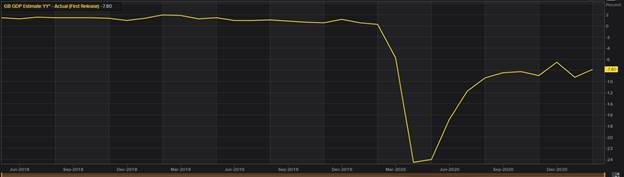
By way of context, the NIESR estimates that the UK economy will recover 2019 levels by the end of 2022. The recovery is strong but it’s coming from a low base. To add further context, as of Feb the British economy remains 7.8% smaller than it was a year before. Moreover, it is still 3.1% below where it was at the peak of the post-lockdown recovery in October 2020 – evidence that this long third lockdown over the first quarter has set things back some way. NIESR also estimates that UK unemployment will peak at 6.5% rather than 7.5%, reflecting the extent to which government support schemes have masked what is really going on.
Author
Neil Wilson
Markets.com
Neil is the chief market analyst for Markets.com, covering a broad range of topics across FX, equities and commodities. He joined in 2018 after two years working as senior market analyst for ETX Capital.