China is dumping US treasuries and buying Gold


As the Chinese accumulate more and more gold, they’re dumping U.S. Treasuries.
That raises an important question: who is going to keep funding the federal government’s borrowing spree?
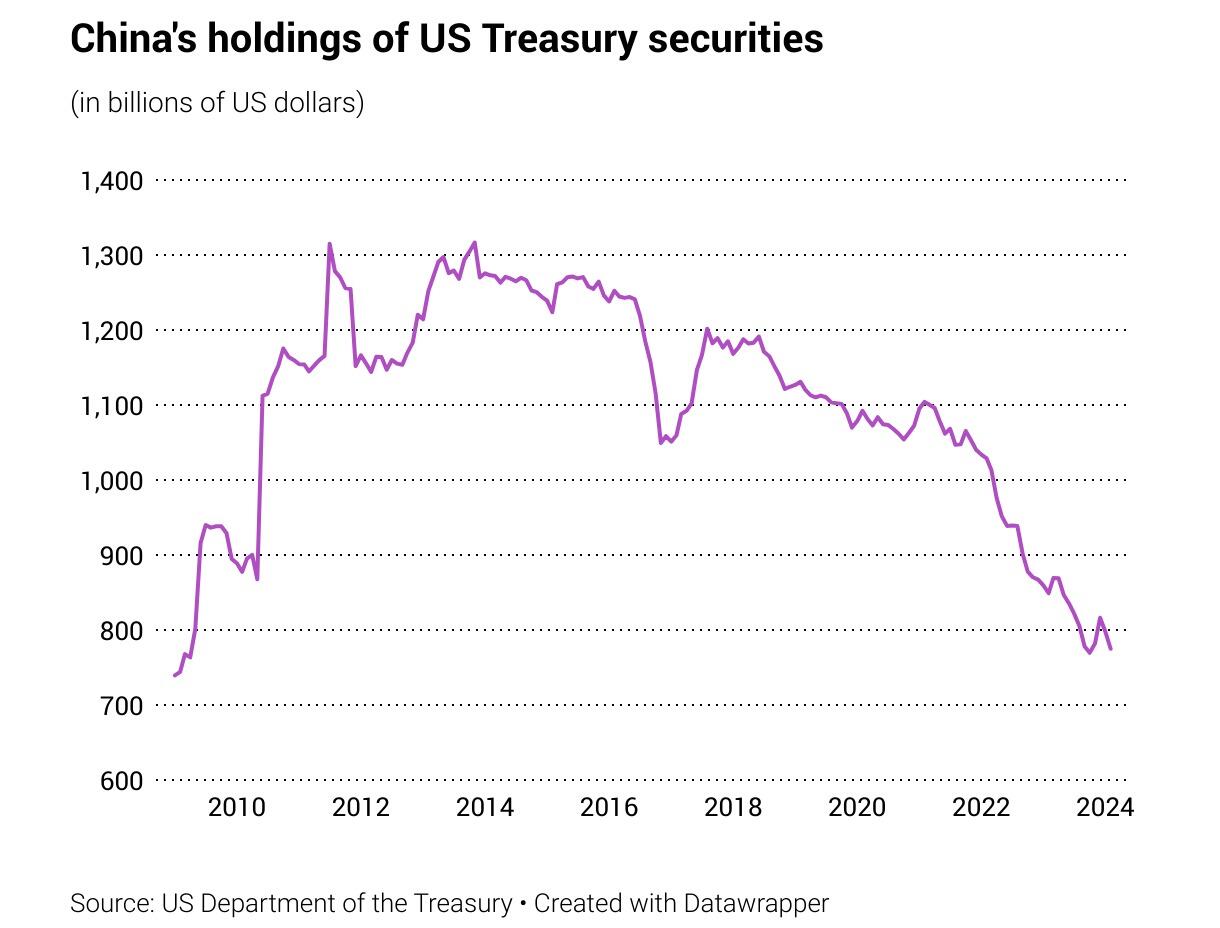
China offloaded another $22.7 billion in U.S. Treasuries in February, according to the latest data from the Federal Reserve. That dropped its total holdings to $775 billion.
China still ranks as the second-largest foreign holder of U.S. debt, but the U.K. could soon overtake China and slide into the second position if the current trend continues.
Japan ranks as the biggest foreign U.S. creditor with $1.17 trillion in Treasuries. The U.K. comes in third with $700.8 billion in U.S. Treasuries.
China has been divesting itself of U.S. debt for several years. The country’s Treasury holdings have fallen to their current level from around $1.1 trillion in 2021. Chinese investment in U.S. debt hit a 14-year low in October.
Renmin University finance professor Zhao Xijun told the South China Morning Post that the selloff will likely continue.
“China’s overseas investment has been concentrated on U.S. Treasuries in the past, [but] there is space for the Chinese government to further cut back its holdings in the future.
China is intentionally minimizing its exposure to the dollar. Chinese policymakers have seen how the U.S. uses the dollar as a foreign policy weapon. Last month, Janet Yellen floated the idea of seizing Russia’s frozen dollar-denominated assets and giving them to Ukraine.
The Chinese aren’t dumb. They realize the U.S. could put the same kind of squeeze on them. So, if you recognize something makes you vulnerable, what do you do?
You minimize the vulnerability.
In other words, if you are concerned that the U.S. could pull the "dollar rug" out from under you, why not pull out from the dollar system first?
This seems to be China’s strategy.
Meanwhile, the Chinese are stockpiling gold, a reserve asset that carries no counterparty risk at all.
The People’s Bank of China has added gold to its reserves for 16 straight months, adding over 300 tons of gold to its stash since it resumed reporting gold purchases in October 2022.
And China may hold far more gold than it officially reports. As Jim Rickards pointed out on Mises Daily back in 2015, many analysts believe that China keeps several thousand tons of gold “off the books” in a separate entity called the State Administration for Foreign Exchange (SAFE).
A big problem for the US treasury
China’s Treasury dump underscores a big problem for the U.S. Treasury.
The federal government is running massive deficits month after month. If China and other countries spurn U.S. debt, who is going to fund this borrowing spree?
Foreign investors make up about one-third of the market for U.S. Treasuries. You could argue that there is still plenty of capacity in the domestic market. The problem is the largest domestic U.S. bondholder is also out of the market.
That’s the Federal Reserve.
In fact, no entity holds more U.S. bonds than the Fed. As of the end of 2022, the Fed owned 35 percent of all domestically held Treasuries. Fed Treasury holdings totaled over $6 trillion.
The Fed generally keeps its big fat thumb on the bond market. By buying and holding U.S. bonds, the central bank creates artificial demand, driving prices higher than they otherwise would be and keeping yields lower. This allows the U.S. government to borrow more at lower interest rates than it otherwise could.
The problem is the Fed is out of the market right now. The central bank is allowing Treasuries to roll off its balance shed with a quantitative tightening policy meant to push down price inflation.
So, if the biggest player in the domestic Treasury market and the second-largest player in the foreign Treasury market are selling bonds, who is going to absorb them all, along with the new debt issued by the U.S. Treasury month after month?
This is one of the reasons Treasury yields continue to climb despite hopes of a Federal Reserve rate cut. And that’s a big problem given that the U.S. government has shelled out $522.02 billion on interest payments just halfway through fiscal 2024. That's a 35.9 percent increase over the same period in fiscal 2023. The only category with higher spending was Social Security.
It seems likely the Fed will have to jump back into the Treasury market with another round of quantitative easing to monetize some of the federal government’s debt. The problem is that’s inflationary.
That means you and I are ultimately going to pay for all this through an ever-increasing inflation tax.
To receive free commentary and analysis on the gold and silver markets, click here to be added to the Money Metals news service.
Author
Mike Maharrey
Money Metals Exchange
Mike Maharrey is a journalist and market analyst for MoneyMetals.com with over a decade of experience in precious metals. He holds a BS in accounting from the University of Kentucky and a BA in journalism from the University of South Florida.