Trend/Counter-trend
|In a recent Extended Learning Track (XLT) - Stock class, we were trading the open of the markets and I had an interesting question arise several times. "When trading, is it better to trade with the market and longer term trend, or can you ignore it and trade just the short-term?"
What you have to realize is that there are two environments in any trend. The first is the impulse and the second is the correction. The impulses are the movements of the shorter time frames that move in the direction of the larger time frame trends. Corrections are pullbacks that move counter to the trend and allow the buyers or sellers to regain strength to continue the trend.
Impulses tend to be powerful, move faster and cover more price than the corresponding corrections. Therefore, if you are looking for a way to make faster, larger profits, you should trade the impulses. A trader can make counter-trend trades on the corrections. However, they must realize that they are accepting greater risk as the profit targets will be smaller and the potential for loss is great if they do not exit their trade before the new impulse begins. As always, greater risk = greater rewards. A trader willing to accept the risks of counter-trend trading in addition to trend trading stands to profit more than the one who only trades the impulse.

As a beginning trader, I recommend you stay with the trend trading. The moves are easier to see and predict and the losses will come at a slower, milder pace. Trading in the direction of the larger term trend and the broad markets will accomplish this.
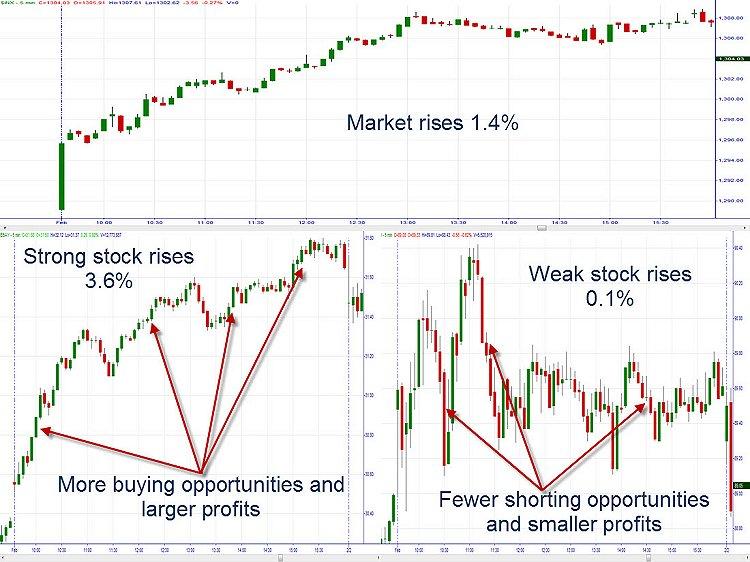
If you do choose to trade counter-trend, then there are several things you must consider: Your skill level, the broader market direction and the supply/demand picture of your stock. Counter-trend trading should only be done by traders who have honed their platform and technical analysis skills. Remember, you are trading a correction which will most likely move very fast against you if you miss the proper exit point. This requires you to be able to interpret the difference between a pullback and a reversal in trend as well as having the knowledge of your platform and ability to execute orders quickly.
When you trade counter-trend, you must also be mindful of the broad market's direction and potential turning points. Just as we saw the bullish market pulling weak stocks upward in the above chart, they will reverse corrections rapidly. Be prepared to exit a counter-trend trade if the market hits supply or demand even if your stock doesn't. The power of the markets over individual stocks is immense.
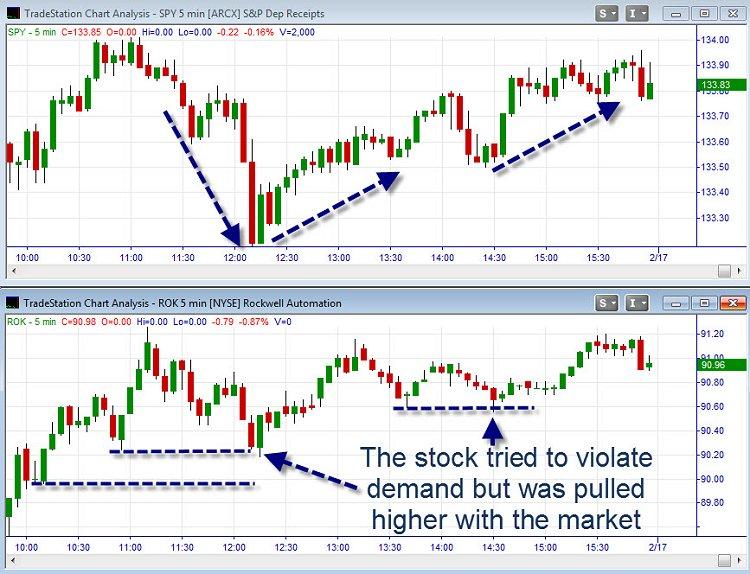
Also, be realistic in your targets for the counter-trend trade. Impulses are powerful and are more likely to break supply or demand levels on your chart only to stall and correct at the supply and demand of larger time frames. Most corrections in contrast, will reverse at areas of supply and demand on the time frame you are viewing. Do not be too greedy as you choose your profit targets for the trade. Like they say, "Bulls profit. Bears profit. But hogs get slaughtered."
So as a newer trader, it is just easier and safer to identify the trend of your stock and trade in the direction of that dominant trend. As you become more skilled and experienced, counter-trend may offer some additional profit opportunities, but are not right for everyone. Trade safe and trade well!
Have a great day.
Information on these pages contains forward-looking statements that involve risks and uncertainties. Markets and instruments profiled on this page are for informational purposes only and should not in any way come across as a recommendation to buy or sell in these assets. You should do your own thorough research before making any investment decisions. FXStreet does not in any way guarantee that this information is free from mistakes, errors, or material misstatements. It also does not guarantee that this information is of a timely nature. Investing in Open Markets involves a great deal of risk, including the loss of all or a portion of your investment, as well as emotional distress. All risks, losses and costs associated with investing, including total loss of principal, are your responsibility. The views and opinions expressed in this article are those of the authors and do not necessarily reflect the official policy or position of FXStreet nor its advertisers.